1600 territory map and events: Battle of Sekigahara and Postwar Reorganization
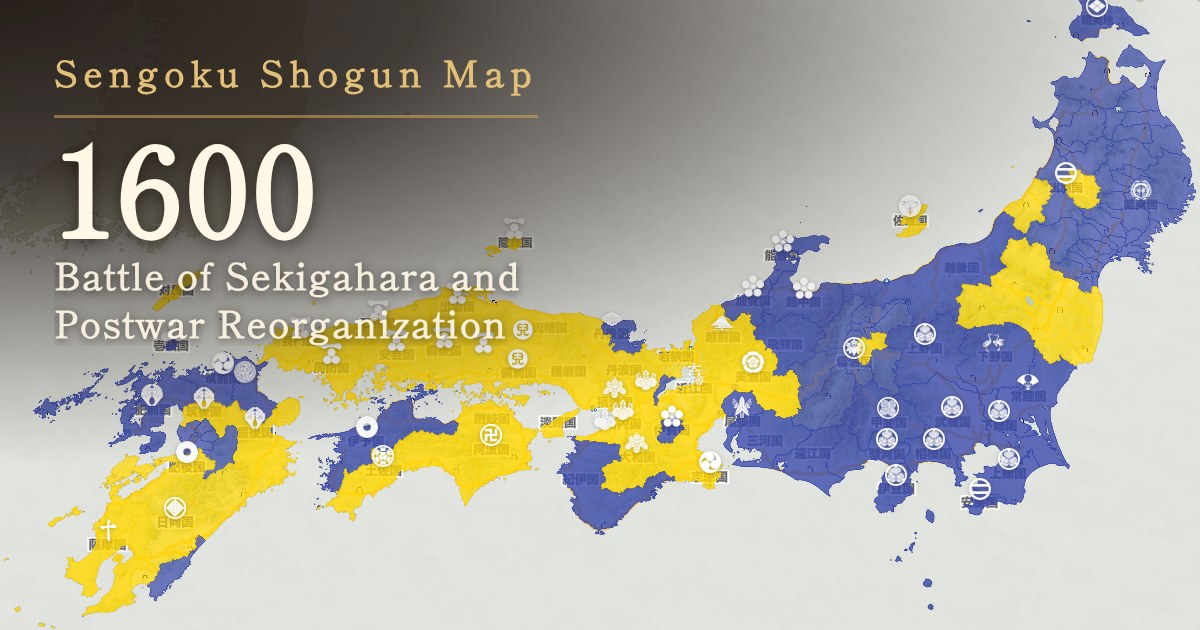
1600 was Keichō 5 (kanoe-ne).
The Western Army led by Ishida Mitsunari and the Eastern Army led by Tokugawa Ieyasu confronted each other on a nationwide scale. In October, the Eastern Army won a decisive victory at Sekigahara. Preliminary battles were fought at Fushimi, Gifu, Otsu, Ueda, and in the northern provinces. After the war, massive reassignments, dispossessions, and rewards reshaped the daimyōs, solidifying Tokugawa supremacy.
1600 territory map: major daimyo and their provinces
Each province is counted under its main power. The map shows the finer division by district.
- 伊勢国 (Tomita Nobutaka, Ujiie Yukihiro and others), 志摩国 (Kuki Yoshitaka), 近江国 (Ishida Mitsunari, Nagatsuka Masaie, Kyōgoku Takatsugu and others), 美濃国 (Oda Hidenobu and others), 若狭国 (Kinoshita Katsutoshi and others), 佐渡国 (Uesugi Kagekatsu), 丹波国 (Onogi Shigetsugu, Maeda Shigekatsu and others), 但馬国 (Sugihara Nagafusa and others), 因幡国 (Miyabe Nagafusa), 伯耆国 (Nanjō Mototada and others), 出雲国 (Mōri Terumoto), 石見国 (Mōri Terumoto), 隠岐国 (Mōri Terumoto), 美作国 (Ukita Hideie), 備前国 (Ukita Hideie), 備中国 (Mōri Terumoto, Ukita Hideie and others), 備後国 (Mōri Terumoto), 安芸国 (Mōri Terumoto), 周防国 (Mōri Terumoto), 長門国 (Mōri Terumoto), 淡路国 (Wakisaka Yasuharu), 讃岐国 (Ikoma Chikamasa), 土佐国 (Chōsokabe Morichika), 筑後国 (Tachibana Muneshige and others), 大隅国 (Shimazu Yoshihisa), 薩摩国 (Shimazu Yoshihisa), 対馬国 (Sō clan)
Ishida faction27 provinces
- 伊賀国 (Tsutsui Sadatsugu), 尾張国 (Fukushima Masanori), 三河国 (Tanaka Yoshimasa, Ikeda Terumasa and others), 遠江国 (Horio Tadauji and others), 駿河国 (中村一栄), 甲斐国 (Asano Yoshinaga), 伊豆国 (Tokugawa Ieyasu), 相模国 (Tokugawa Ieyasu), 武蔵国 (Tokugawa Ieyasu), 安房国 (Satomi Yoshiyasu), 上総国 (Tokugawa Ieyasu, Honda Tadakatsu and others), 下総国 (Tokugawa Ieyasu), 常陸国 (Satake Yoshinobu), 飛驒国 (Kanamori Nagachika), 上野国 (Tokugawa Ieyasu), 下野国 (Gamō Hideyuki and others), 越中国 (Maeda Toshinaga), 越後国 (Hori Hideharu and others), 丹後国 (Hosokawa Tadaoki), 紀伊国 (Kuwayama Kazuharu and others), 阿波国 (Hachisuka Yoshishige), 伊予国 (Katō Yoshiaki, Tōdō Takatora and others), 筑前国 (Kobayakawa Hideaki), 豊前国 (Kuroda Yoshitaka, Kuroda Nagamasa), 肥前国 (Nabeshima Katsushige), 壱岐国 (Matsura Shigenobu), 蝦夷地 (Matsumae Yoshihiro)
Tokugawa faction27 provinces
- 山城国 (Toyotomi Hideyori), 大和国 (Toyotomi Hideyori, Mashita Nagamori, Lords of Yamato and others), 河内国 (Toyotomi Hideyori), 和泉国 (Toyotomi Hideyori), 摂津国 (Toyotomi Hideyori, Lords of Settsu and others), 播磨国 (Kinoshita Iesada and others)
Toyotomi clan6 provinces
- 能登国 (Maeda Toshimasa)
Maeda clan1 province
Provinces divided among several powers8 provinces
信濃国 (Ishikawa Yasunaga and others), 陸奥国 (Date Masamune and others), 出羽国 (Mogami Yoshiaki and others), 越前国 (Aoki Kazunori and others), 加賀国 (Maeda Toshinaga and others), 豊後国 (Hosokawa Tadaoki and others), 肥後国 (Katō Kiyomasa and others), 日向国 (Itō Suketake and others)
Events this year
Month 3
The rebellion, in which Ijūin Tadazane, whose father had been killed, holed up in Shōnai (Miyakonojō), was settled through Tokugawa Ieyasu's mediation. Tadazane was pardoned and moved to Ei with 10,000 koku.
Sources 四本健光「島津氏と関ケ原合戦」/鹿児島市『鹿児島市史』
Month 4
The Dutch ship Liefde drifted ashore at Sashiu in Bungo. Its pilot William Adams and others later served Ieyasu and became advisers on diplomacy and shipbuilding.
Sources 臼杵市「歴史」/臼杵市「黒島の古墳」
Month 7
Around late July, on the way to join Tokugawa Ieyasu's campaign against Aizu, the Sanada father and sons at Inubushi divided their allegiance in response to Ishida Mitsunari's uprising. Masayuki and Nobushige took the Western Army, and Nobuyuki is said to have sided with the Tokugawa side.
Sources コトバンク「犬伏」/佐野市「地名のいわれ」(座標は国土地理院の住所検索による町域代表点。会談の場所は断定しない)
Yoshihiro, whom Ieyasu had asked to guard Fushimi Castle, is said, according to the Shimazu side's account, to have been refused entry and to have answered the Ishida side's request while commanding few troops.
Sources 四本健光「島津氏と関ケ原合戦」(鹿児島大学)
Month 8
With Hosokawa Tadaoki away on the Aizu campaign, Tango was attacked on Ishida Mitsunari's orders. Tadaoki's father Yusai held Tanabe Castle with about 500 men against a Western force said to number 15,000.
See this battle in detail →Sources 舞鶴市「舞鶴ふるさと発見館(郷土資料館)だより 令和4年9月号」
Yoshinobu refused Ieyasu's demand for hostages, sent an envoy to Uesugi Kagekatsu in Aizu, and is thought to have agreed on an alliance.
Sources 水戸市史 上巻 第十三章 第一節
8/26
After Tokugawa Ieyasu marched toward Aizu, the Western Army surrounded Fushimi Castle, defended by Torii Mototada and his garrison.
See this battle in detail →Sources 京都市「都市史20 伏見城」/京都市「伏見区の歴史:安土桃山時代 秀吉が開いた城下町」/京都市文化財保護課「伏見城跡・指月城跡 現地説明会資料」
9/2
Tokugawa Ieyasu, on the march against Uesugi Kagekatsu at Aizu, received a messenger from Fushimi while encamped at Oyama and learned that Ishida Mitsunari had risen. At the council he called, the Aizu campaign was called off and the assembled lords are said to have turned west toward Sekigahara.
Sources 小山市「徳川家康ゆかりの地 小山評定と小山御殿」
9/8
Fushimi Castle fell and burned after the Western Army's assault, and its commander Torii Mototada and the garrison were killed.
9/15
Tadakatsu participated as military supervisor of the Eastern Army, deploying west of Tsuzura Pond. In the afternoon he, along with Matsudaira Tadayoshi and Ii Naomasa, pursued the forces of Shimazu Yoshihiro.
See this battle in detail →Sources 岐阜県観光公式サイト「本多忠勝陣跡」
Shimazu Yoshihiro's contingent, positioned at Sekigahara as part of the Western army, executed a daring charge directly toward Tokugawa Ieyasu's headquarters. They broke through enemy lines and returned to Satsuma by sea from Sakai via the Ise route.
See this battle in detail →Sources 鹿児島県立黎明館「関ヶ原の戦い」
9/28
Thirteen days after Sekigahara, Terasawa Masanari and Yamaguchi Naotomo sent a letter to Yoshihisa and Tadatsune asking whether they had agreed with Yoshihiro's act of disloyalty, and negotiations over the treatment of the Shimazu clan began.
Sources 四本健光「島津氏と関ケ原合戦」(鹿児島大学)
9/30
Eastern Army commanders including Fukushima Masanori and Ikeda Terumasa captured Gifu Castle from Oda Hidenobu, securing the route through the Tōkaidō region.
See this battle in detail →Sources 岐阜観光コンベンション協会「岐阜城」/岐阜市「岐阜城跡」
Month 10
Former members of the Waga clan, including 和賀忠親, rose up from 岩崎城, but were suppressed by the 南部方. It is also said that they had Date Masamune's support.
Date Masamune invaded the 信達 region and fought the Uesugi side around 信夫山 and the Matsukawa area below 福島城. Fukushima City describes this as a victory for the Uesugi side.
Tokugawa Hidetada's army attacked Ueda Castle, defended by Sanada Masayuki and Nobushige, but failed to take it and was delayed on its westward march.
See this battle in detail →Sources 上田市「上田城の歴史」/上田市「史跡上田城跡」
An Uesugi army under Naoe Kanetsugu invaded Mogami territory but failed to take Hasedo Castle and withdrew after news of Sekigahara.
See this battle in detail →Sources 山形市「長谷堂城跡」/山形城公式「歴代城主」/山形市地域教材「長谷堂合戦」
Takatori fought with the Eastern Army at the Battle of Sekigahara, and for his military service received a 120,000-koku increase, reaching 200,000 koku, and was enfeoffed at Imabari in Iyo Province.
See this battle in detail →Sources 津市「藤堂高虎 略年譜」
After the Battle of Sekigahara, Kuroda Nagamasa was granted nearly the whole province of Chikuzen with over 520,000 koku and first entered Najima Castle.
Sources 福岡市史「市史だより」/福岡市博物館「黒田長政の筑前入国」
The Uesugi army under Naoe Kanetsugu stormed Hataya Castle, a border fortress on the Mogami side, and killed its lord Eguchi Gohyōe and his son and others. The date is the 13th of the ninth month (lunar).
After Sekigahara, Tokugawa Ieyasu granted the two provinces of Suō and Nagato to Mōri Terumoto and his son and confirmed their standing.
Sources 広島県史年表(中世2)
After the Battle of Sekigahara, Tokugawa Ieyasu gave the two provinces of Aki and Bingo, part of the Mōri clan's former lands, to Fukushima Masanori. Masanori moved from Kiyosu in Owari to Hiroshima Castle. The date is the 15th of the tenth month (lunar).
Sources 広島城「再考、福島正則の入国時期」/広島市「広島城関係略年表」
10/13
Kyogoku Takatsugu, who had gone over to the Eastern side, shut himself in Otsu Castle, and a Western force of some 15,000 under Mori Motoyasu and Tachibana Muneshige invested it.
See this battle in detail →Sources 大津市観光協会「びわ湖大津トラベルガイド 大津城ゆかりの地を歩く」/大津市観光協会「戦国の大津歴史舞台 大津と大津城」/大津市「大津城跡発掘調査報告書」
10/19
Otomo Yoshimune, seeking to recover his old domain, fought Kuroda Yoshitaka and Matsui Yasuyuki on the Ishigakibaru fan at Beppu. After heavy fighting from midday into the evening the Kuroda and Matsui side won and Yoshimune surrendered.
See this battle in detail →Sources 別府市「大河ドラマ『軍師官兵衛』ゆかりの石垣原合戦」
10/20
On the day before Sekigahara some 500 men under Shima Sakon and Gamo Bitchu left Ogaki Castle, crossed the Kuise river, provoked Nakamura Kazuhide's Eastern unit and broke it with an ambush - the one preliminary engagement the Western army won.
See this battle in detail →Sources 岐阜県観光公式サイト「杭瀬川古戦場」/大垣・西美濃観光ポータル「関ケ原合戦 決戦前夜 大垣城」
10/21
The decisive battle in Mino: Tokugawa Ieyasu’s Eastern Army defeats the Western Army.
See this battle in detail →Sources 岐阜県「岐阜関ケ原古戦場記念館」/関ケ原観光ガイド「決戦地」/関ケ原観光ガイド「開戦地」
Kyogoku Takatsugu gave up Otsu Castle on the same day as the battle at Sekigahara, so the large Western force besieging it never reached the decisive field.
See this battle in detail →Sources 大津市観光協会「びわ湖大津トラベルガイド 大津城ゆかりの地を歩く」/大津市観光協会「戦国の大津歴史舞台 大津と大津城」/大津市「大津城跡発掘調査報告書」
Chōsokabe Morichika took position at Kurihara on Nangūsan as part of the Western Army, but the Mōri forces who had camped ahead of him did not move, and he withdrew without fighting.
The army of Mōri Hidemoto, which took position on Nangūsan as Mōri Terumoto's representative, could not move because Kikkawa Hiroie and others were in contact with Ieyasu's side, and took no part in the battle.
Sources 岐阜県観光公式サイト「毛利秀元陣跡」/堀越祐一(國學院大學)
10/27
Ishida Mitsunari, who had fled from Sekigahara toward Mount Ibuki, was taken at Furuhashi in Omi by a search party under Tanaka Yoshimasa acting on Ieyasu's orders.
Sources 岐阜関ケ原古戦場記念館「石田三成コース」
10/31
Mōri Terumoto, commander-in-chief of the Western Army, which had been defeated at Sekigahara, accepted negotiations through Kuroda Nagamasa and Fukushima Masanori and handed over Osaka Castle. Ieyasu entered the castle and met Hideyori.
Sources 林千寿「慶長五年の戦争と戦後領国体制の創出」(熊本大学)
11/6
Ishida Mitsunari was beheaded at Rokujogawara in Kyoto together with Konishi Yukinaga and Ankokuji Ekei. The execution of the three men at the centre of the Western army closed the first phase of the settlement after Sekigahara.
Sources 岐阜関ケ原古戦場記念館「石田三成コース」/岐阜関ケ原古戦場記念館「黒田長政コース」
At the Battle of Sekigahara, the Kuwayama clan sided with the Eastern Army. After the war, Asano Yoshinaga, rewarded for Eastern Army service, entered Kii Province with 376,000 koku, and the Kuwayama clan lost its position as lords of Wakayama Castle.
Sources 史跡和歌山城、葛城市歴史博物館
In response to the Battle of Sekigahara, Masamune attacked Shiraishi Castle from the Uesugi forces. The region became Oda territory again, and Masamune obtained a certificate of recognition from Tokugawa Ieyasu for one million koku.
Sources 白石市「白石城」
It is said that under Uesugi Kagekatsu's command, Naoe Kanetsugu directed the construction of Kōzashi Castle in Aizu. The construction is said to have been ordered in March 1600 and suspended in June of the same year in preparation for Tokugawa Ieyasu's Aizu campaign.
Sources 福島県「会津都市計画道路の変更について」
In response to Tokugawa Ieyasu's questions, a reply from Naoe Kanetsugu stating the Uesugi position is said to have been sent. The original has not survived, and since the wording differs among manuscript copies, the details of the content are not settled.
Sources 国立国会図書館デジタルコレクション
Tokugawa Ieyasu is said to have departed Osaka to subjugate Uesugi Kagekatsu, proceeding through Fushimi toward Edo. The dates of his departure from Osaka and arrival in Edo vary depending on the sources.
Sources 福岡市博物館「大関ヶ原展」展示リスト/小山市「徳川家康ゆかりの地 小山評定と小山御殿」
Tokugawa Ieyasu, heading toward Aizu, is said to have entrusted the role of caretaker of Fushimi Castle to Torii Mototada. Fushimi Castle was later besieged by the Western Army and fell.
Sources 京都市「伏見城跡 発掘調査報告書」/京都市「都市史20 伏見城」
In response to the uprising of Ishida Mitsunari and Ōtani Yoshitsugu, the three bugyō sent the daimyo the "Naifu chigai no jōjō," which listed Tokugawa Ieyasu's violations. Mōri Terumoto sailed for Osaka on the 15th of the seventh month (lunar), entered Osaka Castle and became commander-in-chief of the Western Army.
Sources 福岡市博物館「大関ヶ原展」展示リスト
Maeda Toshinaga set out for Kaga and captured Daishōji Castle held by the Western Army. On his retreat after learning of Fushimi Castle's fall and an uprising in Echigo, he repelled the attack of Niwa Nagashige, lord of Komatsu Castle, at Asainawate.
Sources 高岡市立博物館「高岡の祖・前田利長略年譜」
At Sekigahara the Ukita forces of the Western Army were wiped out, and the Ukita clan lost its domain. Kobayakawa Hideaki took over Bizen and Mimasaka in its place.
Sources 天下統一と近世城郭の誕生(おかやまの中世争乱史)
After Mōri Terumoto was defeated at Sekigahara and had his domain reduced, Kobori Masatsugu took charge of Bitchū Matsuyama Castle as Bitchū provincial magistrate.
Sources 備中松山城略史 - 高梁市
Kuki Yoshitaka, who sided with the Western Army at Sekigahara, fled from Toba Castle to Toshijima. His son Moritaka's plea for clemency was granted, but he committed seppuku before the news reached him.
Sources 鳥羽市答志町:答志島の洞泉庵跡(嘉隆が切腹した場所)
The Matsumae, based at Ōdate, began building Fukuyama Castle (Fukuyama Residence). Once it was finished, the Matsumae moved from Ōdate to Fukuyama.
Sources 松前氏城跡 福山城跡 館城跡(文化遺産オンライン)
Uesugi forces entered Echigo through 六十里越, 八十里越 and 津川口, urging uprisings among the former domains. Hori Hideharu drove them back, and the uprisings were suppressed.
Sources 越後一揆に関する各資料(座標は栃尾城を代表にとる)
After Sekigahara, Nabeshima Katsushige, who had belonged to the Western Army, was ordered to attack Tachibana Muneshige's Yanagawa Castle as a condition of pardon. The Nabeshima army advanced into Chikugo in the tenth month and closed in on Yanagawa Castle.
Morichika had Tosa confiscated after Sekigahara. When the Yamanouchi clan entered, former retainers refused to hand over Urado Castle and rose in an ikki, and are said to have been suppressed.
Togawa Michiyasu and other senior retainers of the Ukita clan barricaded themselves in their residences in Osaka in defiance of Hideie, and went down to the Kantō for a time through the mediation of Tokugawa Ieyasu.
Sources 森脇崇文「豊臣期宇喜多氏の構造的特質」
After Sekigahara, Mōri Terumoto shaved his head, took the name Sōzui and handed the headship to his son Hidenari. The Mōri clan was reduced to the two provinces of Suō and Nagato.
Sources コトバンク「毛利輝元」「毛利秀就」/山口県文書館ウェブ教材
Mōri Hidemoto, Terumoto's adopted son, was given a little over 36,000 koku at Chōfu by the main family when the clan was transferred to Suō and Nagato, and is said to have become the founder of Chōfu domain.
Sources コトバンク「毛利秀元」/岐阜県観光公式サイト「毛利秀元陣跡」
After the Battle of Sekigahara, Ieyasu's son-in-law Ikeda Terumasa was given all of Harima, over 520,000 koku, and entered Himeji Castle. From the following year he began a major reconstruction of the castle.
Sources 兵庫県立歴史博物館「姫路城 年表」/新修名古屋市史 第2巻
After the Battle of Sekigahara, Ieyasu's fourth son Matsudaira Tadayoshi moved from Oshi in Musashi to Kiyosu Castle in Owari and held most of Owari.
Sources 新修名古屋市史 第2巻 第8章第3節
Ii Naomasa, who had led the vanguard at Sekigahara, was given 180,000 koku in Ōmi centered on Sawayama Castle, Ishida Mitsunari's former seat, and moved there from Kōzuke.
Sources 新修名古屋市史 第2巻 第8章第3節