1602 territory map and events: The Founding of Higashi Hongan-ji
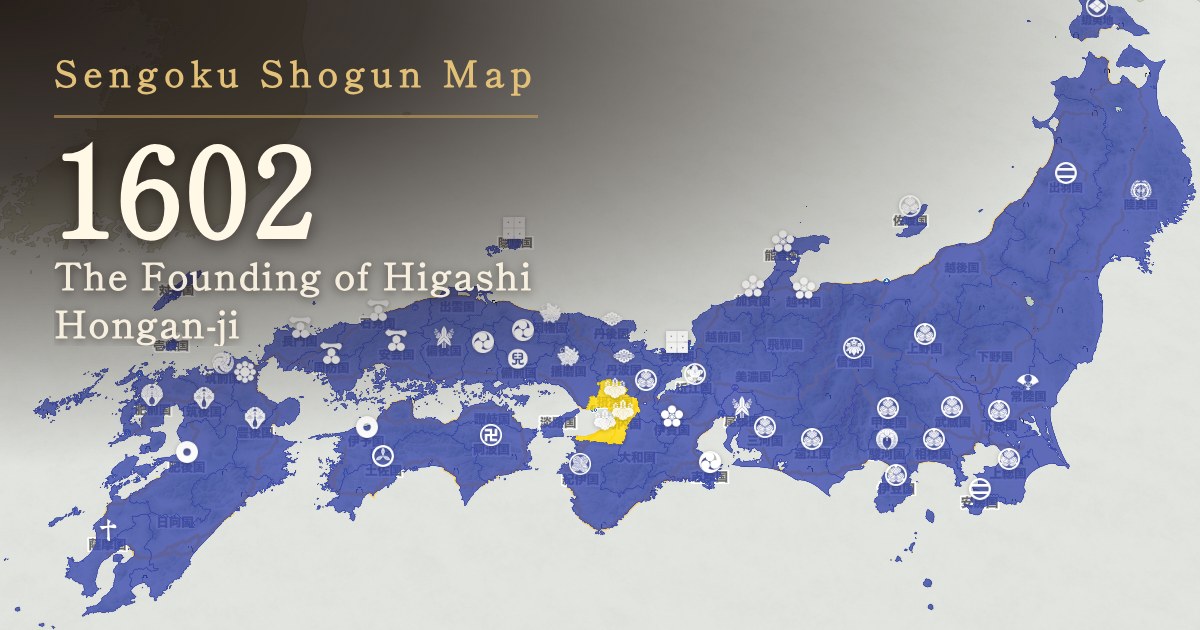
1602 was Keichō 7 (mizunoe-tora).
Tokugawa Ieyasu granted temple land at Karasuma-Shichijō in Kyoto to Kyōnyo, elder brother of Hongan-ji's chief abbot Junnyo and the former leader of the faction that had advocated fighting to the end during the Ishiyama War, allowing him to establish a new Hongan-ji. This split the institution into the Nishi (West) and Higashi (East) Hongan-ji, a division widely seen as a deliberate move by Ieyasu to weaken the political power of the once-formidable religious organization by dividing it in two.
1602 territory map: major daimyo and their provinces
Each province is counted under its main power. The map shows the finer division by district.
- 山城国 (Tokugawa Ieyasu, Itakura Katsushige), 大和国 (Lords of Yamato, Tokugawa intendants and others), 伊賀国 (Tsutsui Sadatsugu), 伊勢国 (Tomita Nobutaka, Honda Tadakatsu and others), 志摩国 (Kuki Moritaka), 尾張国 (Matsudaira Tadayoshi), 三河国 (Tokugawa Ieyasu(直轄) and others), 遠江国 (Matsudaira Sadakatsu and others), 駿河国 (Naitō Nobunari), 甲斐国 (Tokugawa Ieyasu), 伊豆国 (Tokugawa Ieyasu), 相模国 (Ōkubo Tadachika and others), 武蔵国 (Tokugawa Ieyasu), 安房国 (Satomi Yoshiyasu), 上総国 (Honda Tadatomo and others), 下総国 (Tokugawa Ieyasu), 常陸国 (Takeda Nobuyoshi), 近江国 (Ii Naotsugu and others), 美濃国 (Okudaira Nobumasa, Ishikawa Yasumichi and others), 飛驒国 (Kanamori Nagachika, Kanamori Arishige), 信濃国 (Ishikawa Yasunaga and others), 上野国 (Sakai Shigetada and others), 下野国 (Okudaira Iemasa and others), 陸奥国 (Date Masamune and others), 出羽国 (Mogami Yoshiaki and others), 若狭国 (Kyōgoku Takatsugu, Kyōgoku Tadataka), 越前国 (Yūki Hideyasu), 加賀国 (Maeda Toshinaga), 能登国 (Maeda Toshinaga), 越中国 (Maeda Toshinaga), 越後国 (Hori Hideharu and others), 佐渡国 (Tokugawa intendants and others), 丹波国 (Maeda Gen'i, Arima Toyouji and others), 丹後国 (Kyōgoku Takatomo), 但馬国 (Sugihara Nagafusa and others), 因幡国 (Ikeda Nagayoshi, Kamei Korenori, Yamazaki Iemori and others), 伯耆国 (Nakamura Kazutada), 出雲国 (Horio Yoshiharu, Horio Tadauji), 石見国 (Tokugawa intendants, Ōkubo Nagayasu and others), 隠岐国 (Horio Yoshiharu, Horio Tadauji), 播磨国 (Ikeda Terumasa), 美作国 (Kobayakawa Hideaki and others), 備前国 (Kobayakawa Hideaki), 備中国 (Tokugawa intendants, Kinoshita Iesada and others), 備後国 (Fukushima Masanori), 安芸国 (Fukushima Masanori), 周防国 (Mōri Terumoto), 長門国 (Mōri Terumoto), 紀伊国 (Asano Yoshinaga), 淡路国 (Wakisaka Yasuharu), 阿波国 (Hachisuka Yoshishige), 讃岐国 (Ikoma Kazumasa), 伊予国 (Katō Yoshiaki, Tōdō Takatora and others), 土佐国 (Yamauchi Kazutoyo), 筑前国 (Kuroda Nagamasa), 筑後国 (Tanaka Yoshimasa), 豊前国 (Hosokawa Tadaoki), 豊後国 (Nakagawa Hidenari, Inaba Sadamichi, Hosokawa Tadaoki, Kinoshita Nobutoshi, Takenaka Shigetoshi and others), 肥前国 (Nabeshima Katsushige, Terasawa Hirotaka, Matsuura clan, Ōmura Yoshiaki and others), 肥後国 (Katō Kiyomasa, Sagara Yorifusa and others), 日向国 (Lords of Hyūga and others), 大隅国 (Shimazu Tadatsune), 薩摩国 (Shimazu Tadatsune), 壱岐国 (Matsuura clan), 対馬国 (Sō clan), 蝦夷地 (Matsumae Yoshihiro)
Tokugawa regime66 provinces
- 河内国 (Toyotomi Hideyori, Hōjō Ujimori and others), 和泉国 (Toyotomi Hideyori), 摂津国 (Toyotomi Hideyori, Shinjō Naoyori, Arima Noriyori and others)
Toyotomi clan3 provinces
Events this year
Month 2
Kyōnyo received a four-block temple site at Higashi-Rokujō in Kyoto from Tokugawa Ieyasu and founded a temple separate from Honganji. Honganji thus split into west (Junnyo) and east (Kyōnyo).
Sources 京都市「真宗本廟(東本願寺)周辺エリア ~本願寺・東寺界わい景観整備地区・渉成園・下寺町~」
Month 5
Full construction of Nijō Castle began under commissioner Murakoshi Mosuke, with its main buildings prepared ahead of the following year's shogunal appointment.
Month 6
Fushimi Castle, burned during the Sekigahara campaign, was rebuilt as Tokugawa Ieyasu's residence and a center for governing the Kinai region.
Sources 京都市「都市史20 伏見城」
7/27
Ieyasu gave Yoshinobu Akita and Senboku in Dewa by a domain-grant document (chigyō hanmotsu). The document did not state the koku, and the assessed yield of the domain was not shown.
Sources 秋田県公文書館「公文書館だより」第34号
Month 9
Satake Yoshinobu entered Tsuchizaki Minato Castle, the former seat of the Akita clan, and spent one winter there before moving to Kubota the following year.
Sources 水戸市史 上巻 第十三章 第二節
Month 12
Date Masamune gave Shiraishi Castle, which he had taken two years earlier, to Katakura Kagetsuna. The castle remained the seat of the Katakura clan for more than 260 years.
In place of Shimazu Yoshihiro, who had fought for the Western Army at Sekigahara, his successor Shimazu Tadatsune (Iehisa) worked to repair relations with Tokugawa Ieyasu. In Keichō 7, Ieyasu formally recognized Shimazu control over Satsuma, Ōsumi, and territories in Hyūga Province.
Sources 鹿児島県「鹿児島県歴史・美術センター黎明館 常設展示:関ヶ原の戦い」
After the Battle of Sekigahara, in the fifth month, Satake Yoshinobu had his Hitachi domains taken away at Fushimi and was ordered to move to Dewa. The location and koku of the replacement domain were not stated at that time.
Sources 秋田市「久保田城について」/秋田県公文書館 令和元年度企画展(後期)「秋田県の城下町」/常陸大宮市 講座案内「佐竹氏の秋田転封とその影響」
Katō Yoshiaki, rewarded for his service at Sekigahara, began building a new castle on Katsuyama in Iyo, later Matsuyama Castle, to replace his seat at Masaki Castle.
Sources 松山市「松山城跡」/愛媛県「えひめの文化財(たから)松山城」/松山城公式「歴史と人物」
After the Sō sent envoys repeatedly to seek restored relations from just after the withdrawal of their troops, the first envoy from Korea arrived on Tsushima this year.
Sources 世界の中の長崎 - 長崎県の文化財
Hosokawa Tadaoki, who entered Buzen for his service at Sekigahara, began building a full-scale castle at Kokura and laid out the castle town.
Sources 小倉城と小倉藩 - 北九州市
Ijūin Tadazane, who had been pardoned by Ieyasu, was killed at Nojiri in Hyūga by Shimazu Tadatsune, who was on his way to Kyoto, and his family was wiped out. It is said to have been to remove the lingering grudge of the Shōnai Rebellion.
Sources 四本健光「島津氏と関ケ原合戦」(鹿児島大学)
Shimazu Iehisa (Tadatsune) is said to have begun building a new castle (Tsurumaru Castle), moving from Uchijō with Kaminoyama at its back. Accounts differ on the years construction began and ended, with Keichō 6-7 among others.
Sources 鹿児島県「鹿児島(鶴丸)城」/鹿児島市『鹿児島市史』