INTERACTIVE BATTLE
Siege of Fushimi Castle
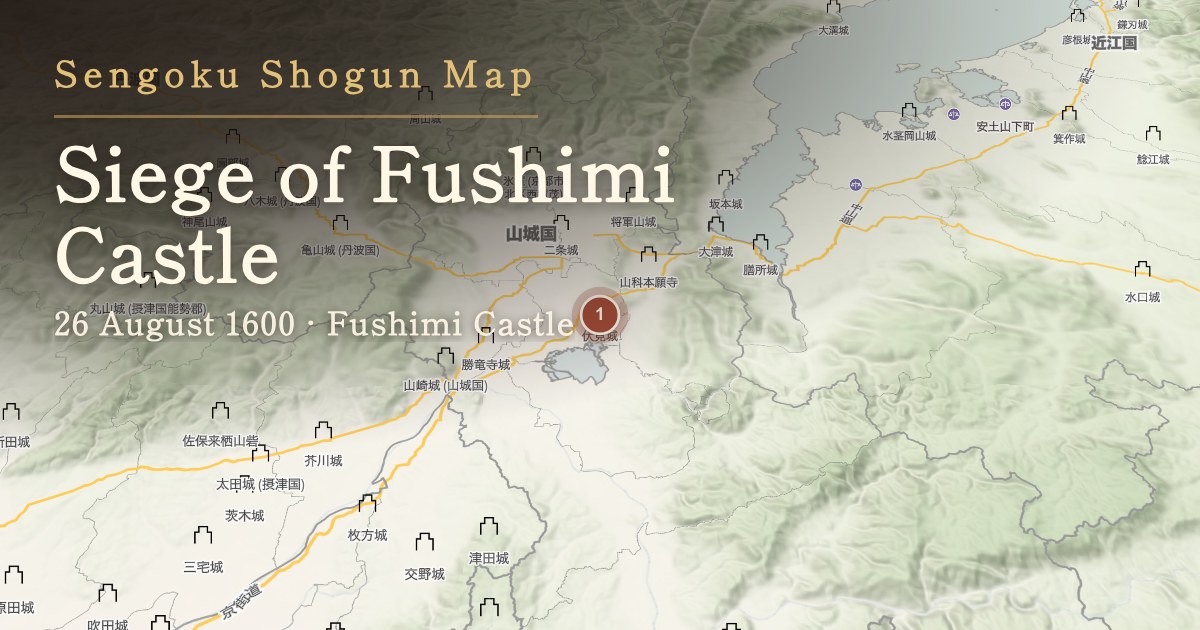
26 August 1600 · Fushimi Castle
After Tokugawa Ieyasu marched toward Aizu, the Western Army surrounded Fushimi Castle, defended by Torii Mototada and his garrison.
Background
Fushimi Castle had been Hideyoshi's political seat in his final years. After his death, Tokugawa Ieyasu entered as chief regent. When Ieyasu departed for Aizu to mount a military campaign against Uesugi Kagekatsu, Torii Mototada and others held the castle in his absence.
Outcome
The Western Army commanders surrounded and assaulted Fushimi Castle. After a desperate defense, Torii Mototada and the garrison fell in battle, and the castle was captured and burned.
Course of the battle
1 July 1600
The Western Army surrounds Fushimi Castle
After Tokugawa Ieyasu marched toward Aizu, the Western Army surrounded Fushimi Castle, defended by Torii Mototada. The castle controlled important Kinai routes and a major political center of the Toyotomi government.
Sources1234·Certainty: High
2 1 August 1600
Fushimi Castle falls and burns
Fushimi Castle fell and burned under assault, and commander Torii Mototada and members of the garrison were killed. Later alterations make precise mapping of combat locations uncertain.
Points of debate
Individual combat locations cannot be fixed precisely on the modern terrain.
Sources1234·Certainty: High
Historical significance
This siege was an independent action preceding the main battle of Sekigahara, and is positioned as the first major siege operation of the Sekigahara campaign. Taken together with actions elsewhere such as Gifu, Ōtsu, and Tanabe, Sekigahara itself represents the culmination of these regional conflicts.
Advertisement
Key figures
徳川方
1

Garrison commander of Fushimi Castle
Died in battle after the Western army besieged and assaulted the castle, which fell and burned.
Sources12·Certainty: High
Other events of 1600
Sources consulted
- 京都市「伏見城跡 発掘調査報告書」
- 京都市「都市史20 伏見城」
- 京都市「伏見区の歴史:安土桃山時代 秀吉が開いた城下町」
- 京都市文化財保護課「伏見城跡・指月城跡 現地説明会資料」
The numbers in the text refer to the list above. Certainty indicates how far a statement is supported by the cited sources; it does not refer to the precision of the coordinates or the dating.
Advertisement