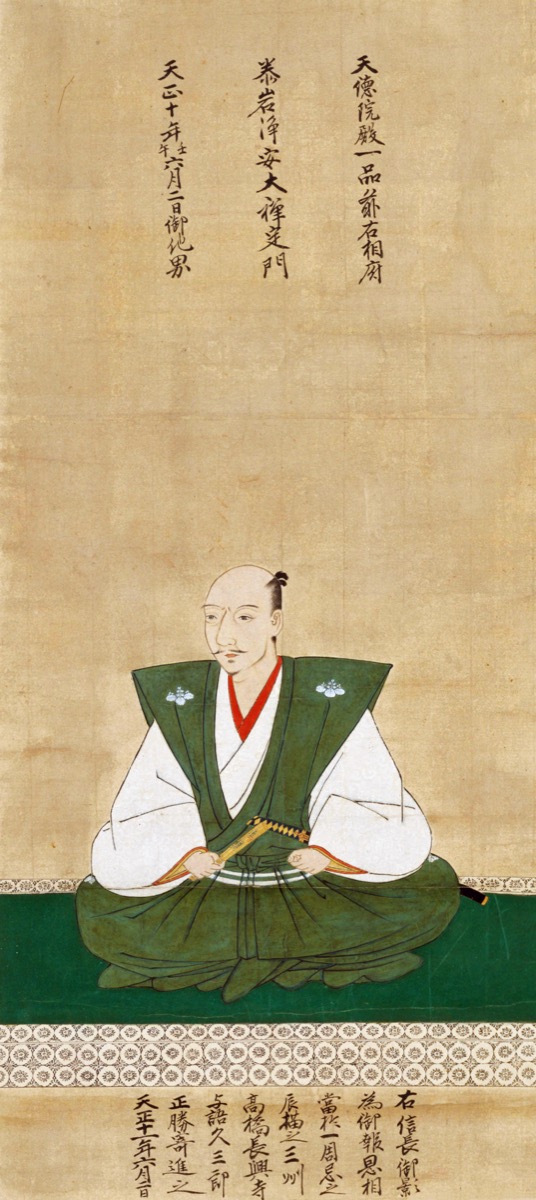
 狩野宗秀「織田信長像」

Head of the Oda Regime
Oda Nobunaga
織田信長
1534 – 1582
Born into the Oda Danjō-no-jō house of Owari, he prevailed in succession struggles and conflicts within the province, bringing nearly all of Owari under his control by 1559. After defeating Imagawa Yoshimoto at Okehazama and conquering Mino from the Saitō, he entered Kyoto in 1568 supporting Ashikaga Yoshiaki. He later expelled Yoshiaki, deployed regional armies toward the Kinai, Hokuriku, Chūgoku, and Shikoku, and promoted free markets, roads, post stations, and castle-town governance. He advanced the unification of Japan from Azuchi Castle but died when Akechi Mitsuhide attacked him in the Honnōji Incident of 1582.
Sources 岩倉市「山内一豊公と岩倉の歴史」/岐阜市「信長公450プロジェクト」/滋賀県「安土城考古博物館」/京都市「本能寺跡」
Explore the 1552 map
Change the year to watch territories shift
Life of Oda Nobunaga
Unifying Owari
Map of 1559Oda Nobunaga was born in 1534 as the son of Oda Nobuhide of Owari. He succeeded to the headship when his father died in 1551, but Owari was a place where branches of the Oda house fought one another. In 1555 he killed Oda Nobutomo at Kiyosu Castle and made Kiyosu his seat, and in 1559 he drove out Oda Nobukata of Iwakura Castle and unified Owari. His later campaigns were built on this foothold of a unified Owari. By this year Nobunaga had come to hold nearly all of Owari.
Defeating Imagawa Yoshimoto at Okehazama
Map of 1560On May 19, 1560, Imagawa Yoshimoto, who ruled Suruga, Tōtōmi, and Mikawa, invaded Owari with an army said to number about 20,000. Nobunaga set out before dawn, and it is said that he advanced from Atsuta through Zenshoji fort and Nakajima fort and, once the rain stopped, made a surprise attack on Yoshimoto's headquarters. Yoshimoto was killed, and the Imagawa army collapsed. The site is near Okehazama, but there are two theories, one placing it in Midori Ward of Nagoya and the other in Toyoake. After this victory, Tokugawa Ieyasu, who had broken with the Imagawa, allied with Nobunaga.
Taking Mino and moving to Gifu
Map of 1567To the west, the struggle with the Saitō clan in Mino continued. In August 1567 Nobunaga attacked the Saitō clan's Inabayama Castle and took Mino. He renamed the place called Inoguchi as Gifu, named the castle Gifu Castle, and made it his base. His territory spread from Owari into Mino and drew closer to the capital. Gifu became the base from which Nobunaga would later advance on Kyoto. The period from this year to his march to Kyoto in 1568 was only about a year.
Going to Kyoto with Ashikaga Yoshiaki
Map of 1568In July 1568 Nobunaga received Ashikaga Yoshiaki, a member of the shogunal family who at first used a different character in his name. Yoshiaki had taken refuge with Asakura Yoshikage of Echizen. In September Nobunaga led his army into Kyoto. In October Yoshiaki was appointed shōgun, and the Muromachi shogunate was revived. But real political power was in Nobunaga's hands. In 1570 he defeated the Azai and Asakura at Anegawa, and in 1571 he burned Enryaku-ji on Mount Hiei. Nobunaga's domains spread into the Kinai region and Ōmi, and his enemies grew in number.
Expelling Yoshiaki and ending the shogunate
Map of 1573As shōgun, Yoshiaki soon began to act on his own. In 1570 Nobunaga presented him with a set of articles, and in 1572 he handed him a seventeen-article memorandum, but Yoshiaki tried to encircle Nobunaga by allying with the Azai, Asakura, Takeda, and Honganji. In July 1573 Yoshiaki raised an army again at Makishima Castle in Yamashiro Province and was defeated. He surrendered after sending his son Yoshihiro as a hostage and was moved to Wakae Castle in Kawachi Province. This is said to have ended the Muromachi shogunate. Yoshiaki later moved to Kii and to Tomo in Bingo, and sought to revive the shogunate with the help of the Mōri clan, but it was never realized.
Defeating Takeda Katsuyori at Nagashino
Map of 1575In 1575 Takeda Katsuyori attacked Nagashino Castle in Mikawa. Nobunaga, together with Tokugawa Ieyasu, met him at Shitaragahara and, using palisades and arquebuses, defeated the Takeda army. It is famously said that 3,000 arquebuses were fired and that the cavalry was broken by three-rank volley fire, but there are doubts about the figures and the tactics. In this battle Nobunaga dealt a heavy blow to the Takeda clan, which had been a threat in the east. After the victory, Nobunaga sent his retainers' armies in various directions and expanded his domains.
Building Azuchi Castle
Map of 1576In 1576 Nobunaga began building a castle on Azuchi Mountain in Ōmi. Niwa Nagahide served as overseer. Construction began in the first month, and in the second month Nobunaga moved in from Gifu. In May 1579 the main keep was completed, and Nobunaga moved into it. Built on a hill that juts into Lake Biwa like a peninsula, it was a castle with stone walls and a main keep, and its castle town was also laid out. The castle became Nobunaga's new base, moved from Gifu. Its completion is thought to have been around 1581. The ruins of Azuchi Castle are a national Special Historic Site.
Nobunaga dies at Honnōji
Map of 1582On June 2, 1582, Akechi Mitsuhide, one of Nobunaga's retainers, attacked him in Kyoto. Nobunaga took his own life at Honnōji, and his son Nobutada is traditionally said to have also killed himself at Nijō Shin-gosho. Mitsuhide was destroyed when Hashiba Hideyoshi and others defeated him at the Battle of Yamazaki on June 13. Why Mitsuhide turned against his lord remains undetermined, with theories ranging from personal grudge and ambition to the existence of a mastermind behind him. The Oda house, which had lost its lord, was later taken over by Hideyoshi, who advanced toward supreme power. Azuchi Castle, too, had its main keep and other buildings burned after the incident.
Sources 日本大百科全書・山川日本史小辞典・世界大百科事典(コトバンク)/文化遺産オンライン「安土城跡」/岐阜市の解説/京都市「明智光秀胴塚」
Territory map of Oda Nobunaga
From 1 province in 1552 to 22 provinces in 1581.
The territory of the Oda clan, limited to the years when he led the house. Lighter colour: provinces held only in part (some districts).Castles Oda Nobunaga used as his seat
In the order he moved his base. Years show when he entered and left.- Kiyosu Castle1555–1563
- Komakiyama Castle1563–1567
- Gifu Castle1567–1576
- Azuchi Castle1576–1582
Family tree
Oda Nobuhide
Parent
Oda Nobuhiro
Sibling
Oda Nobuyuki
Sibling
Oda Nobukane
Sibling
Oichi no Kata
Sibling
Oda Nagamasu
Sibling
Oda Nobunaga
This person
Oda Nobutada
Child
Oda Nobukatsu
Child
Oda Nobutaka
Child
Hashiba Hidekatsu
Child
Tokuhime
Child
Advertisement
Related events
47
1534
Oda Nobunaga Is Born
BornOda Nobunaga, who would later advance the unification of Japan, was born to Oda Nobuhide at Shobata Castle in Owari Province.
1556
5/28
Battle of the Nagara River
Relief force for DōsanOn 28 May 1556 (20th day of the 4th month, old calendar), at the Nagara River in Mino Province (present-day Gifu City), Saitō Dōsan fought his heir, Saitō Yoshitatsu, and was killed. The relief force of his son-in-law Oda Nobunaga arrived too late.
Month 9
Battle of Inō
Oda commander in chief; victoriousOda Nobunaga beat Shibata Katsuie and Hayashi Hidesada, who had raised his brother Nobuyuki, on the plain of Inō, and secured his place within the Oda Danjōnojō house.
1558
Battle of Ukino
Commander in chief of the Kiyosu Oda sideOda Nobunaga beat the Oda of Iwakura at Ukino. With the fall of Iwakura Castle the next year, Owari was united in his hands.
1559
Capture of Iwakura Castle
Took the Iwakura Oda and advanced the unification of OwariOda Nobunaga captured Iwakura Castle, destroyed the Ise-no-kami branch of the Oda in northern Owari, and brought nearly all of the province under his control.
1560
Month 5
Imagawa Yoshimoto’s March to Kyoto
Owari side that met the attack at OkehazamaImagawa Yoshimoto leads troops from Suruga, Tōtōmi, and Mikawa to invade Owari, capturing strongholds such as Odaka Castle and increasing pressure.
6/12
Battle of Okehazama
Commanded the Oda army; victoriousOda Nobunaga launches a surprise attack and slays Imagawa Yoshimoto, seizing dominance in Owari.
1562
Kiyosu Alliance Is Formed
Related figureMatsudaira Motoyasu and Oda Nobunaga met at Kiyosu Castle and formed an alliance, allowing Motoyasu to focus on Mikawa and Nobunaga on Mino.
1563
Oda Nobunaga Moves to Komakiyama Castle
Related figureOda Nobunaga built Komakiyama Castle as a base for his campaign into Mino, moved there from Kiyosu, and developed a planned castle town below the mountain.
1567
Month 8
Oda Nobunaga Captures Inabayama Castle
Took part / involvedOda Nobunaga captured Saitō Tatsuoki's Inabayama Castle, took control of Mino, renamed the castle town Gifu, and moved his residence there.
8/1
Battle of Inabayama Castle
Commander-in-chief of the attacking sideIn August 1567, Oda Nobunaga took Inabayama Castle in Mino Province (present-day Gifu Castle in Gifu City, Gifu Prefecture), drove out Saitō Tatsuoki, and pacified Mino. Nobunaga renamed Inokuchi, the town below the castle, Gifu, and moved his base there.
1568
10/13
Battle of Kannonji Castle
Commander-in-chief of the march on KyotoIn September 1568 (Eiroku 11), Oda Nobunaga marched toward Kyoto escorting Ashikaga Yoshiaki and attacked Rokkaku Jōtei and his son Yoshiharu, who held Kannonji Castle in Ōmi (present-day Omihachiman City). Mitsukuri Castle, a subsidiary fortress, fell, and the Rokkaku father and son abandoned their castle and fled.
Oda Nobunaga Captures Kannonji Castle
Took part / involvedAdvancing toward Kyoto with Ashikaga Yoshiaki, Oda Nobunaga attacked Kannonji Castle, drove out Rokkaku Yoshikata and his allies, and secured the route to the capital.
1569
Nijō Palace Is Built for Ashikaga Yoshiaki
Related figureOda Nobunaga expanded the former Buei encampment and built a fortified Nijō palace for Ashikaga Yoshiaki, who had become shogun the previous year.
1570
Month 4
Retreat at Kanegasaki
Overall command of the retreating Oda armyDuring the Echizen campaign, Azai Nagamasa suddenly defects. Oda Nobunaga faces encirclement by Asakura Yoshikage but retreats successfully thanks to rearguard actions.
7/30
Battle of Anegawa
Oda armyIn Ōmi, Oda–Tokugawa allied forces defeat the Azai–Asakura alliance, expanding their influence by securing northern Ōmi castles.
Month 8
Outbreak of Ishiyama War
Belligerent opposing the HonganjiKennyo of the Ishiyama Hongan-ji in Settsu rises against Nobunaga, starting a prolonged war involving Ikkō sect followers.
Month 9
Battle of Noda-Fukushima
Oda armyIn Settsu, Oda forces attack strongholds of the Miyoshi Triumvirs and Hongan-ji, but retreat when Azai–Asakura advance south.
Month 10
Siege of Shiga
Oda armyIn Ōmi, Oda clashes with Azai, Asakura, and Hongan-ji forces near Sakamoto–Ōtsu. Mediated by Enryaku-ji, the stalemate continues into the following year.
1571
Month 9
Burning of Mount Hiei
Ordered the attack on EnryakujiOda Nobunaga launched a massive attack on the Enryakuji temple on Mount Hiei, burning temples and monastery buildings. He militarily and politically eliminated Enryakuji forces, demonstrating strong resolve to strengthen Oda control over Kinai.
1573
Month 7
Battle of Makishima Castle
Commanded the assault on Makishima CastleWhile Shogun Ashikaga Yoshiaki continued calling on various daimyō to rise against Nobunaga, Oda Nobunaga attacked Makishima Castle near Kyoto. Yoshiaki was defeated, surrendered, and was expelled from Kyoto.
Month 8
Fall of Asakura Yoshikage
Commander in chief of the Echizen campaignWith the Oda army's invasion of Echizen, Asakura Yoshikage abandoned Ichijōdani and fled. Compounded by defections of his retainers, he took his own life at Kenshōji in Ōno District, and the sengoku-daimyo Asakura clan was destroyed.
8/13
Battle of Tonegasa
Oda armyOn the night of the 13th of the eighth month (lunar), the Oda army pursued the Asakura army as it retreated toward Echizen at Tonezaka and won a great victory. It decisively broke the Asakura clan's military base.
Month 9
Fall of Odani Castle and the Suicide of Azai Nagamasa
Oda commander in chief who besieged Odani CastleOdani Castle in northern Ōmi fell to Oda forces, and Azai Nagamasa committed suicide. The Azai clan was destroyed, and northern Ōmi came under Oda control.
1574
9/29
Nagashima Ikkō-ikki Is Suppressed
Related figureIn his third campaign against Nagashima, Oda Nobunaga surrounded the uprising by land and sea and suppressed the Ikkō-ikki centered on Ganshōji.
1575
6/29
Battle of Nagashino and Shitaragahara
Took part / involvedThe allied forces of Oda Nobunaga and Tokugawa Ieyasu, marching to relieve Nagashino Castle, defeated Takeda Katsuyori at Shitaragahara, where the Takeda lost many senior commanders.
Month 8
The Suppression of the Echizen Ikkō-ikki
Commander-in-chiefIn August 1575, Oda Nobunaga attacked the Ikkō-ikki of Echizen Province (present-day Fukui Prefecture) from two directions, the Kinome Pass and the Sugitsu route, and destroyed it. Echizen was to be governed by Shibata Katsuie.
Month 9
Shibata Katsuie Receives Kitanoshō in Echizen
Related figureAfter the suppression of the Echizen Ikkō uprising, Oda Nobunaga entrusted Shibata Katsuie with eight districts of Echizen and the northern campaign. Katsuie began developing Kitanoshō Castle and its town.
11/21
Oda Nobunaga opens friendly relations with Satake Yoshishige
Sent a letter to Yoshishige asking him to attack in a pincer movementOda Nobunaga sent a letter to Satake Yoshishige to open friendly relations, calling on him to attack Takeda Katsuyori in a pincer movement.
Akechi Mitsuhide Begins the Conquest of Tamba
Took part / involvedUnder Oda Nobunaga's orders, Akechi Mitsuhide began the conquest of Tamba. He surrounded Kuroi Castle but was forced to retreat after Hatano Hideharu defected and his army was attacked from both sides.
1576
2/23
Oda Nobunaga Moves to Azuchi
Related figureOda Nobunaga developed a new castle on Mount Azuchi on the eastern shore of Lake Biwa and moved his headquarters there from Gifu.
5/3
Battle of Tennōji
Supreme commanderIn May 1576, the Tennōji fort in Settsu Province (present-day Tennōji Ward, Osaka City) was surrounded by Ishiyama Honganji forces. Oda Nobunaga attacked with a small force, relieved the fort and drove the Honganji side back to the Osaka gate.
Yoshishige is appointed Hitachi no suke
Petitioned the court for the appointmentAt the petition of Oda Nobunaga, Satake Yoshishige is said to have been appointed to the court rank of Junior Fifth Rank, Lower Grade, and the post of Hitachi no suke. The appointment is traditionally dated to June 10, 1576.
1577
10/23
Hashiba Hideyoshi Marches into Harima
Took part / involvedOrdered by Oda Nobunaga to campaign against the Mōri in western Japan, Hashiba Hideyoshi marched into Harima and began the Chūgoku campaign in earnest.
1578
Month 7
Oda Nobutada Builds Forts Around Miki Castle
Took part / involvedOda Nobunaga's heir Nobutada joined the Miki campaign and strengthened the siege by constructing forts, including the hilltop fort at Hiraiyama that served as Hashiba Hideyoshi's headquarters.
Month 10
Siege of Arioka Castle
Supreme commander of the Oda sideIn October 1578, Araki Murashige turned against Oda Nobunaga and shut himself in Arioka Castle in Settsu Province (present-day Itami, Hyōgo Prefecture). After a siege of about a year the castle fell, and Murashige's relatives and the wives and children of his retainers were executed.
11/6
Second Battle of Kizugawa Inlet
Commander-in-chief of the Oda sideOn 6 November 1578, at the Kizugawa Inlet in Settsu Province (near the mouth of the Kizu River in present-day Osaka City), the Oda navy, with the great ships of Kuki Yoshitaka, met the Mōri fleet and is said to have cut off the sea supply route to Ishiyama Honganji.
Takayama Ukon Submits to Oda Nobunaga
Related figureWhen Araki Murashige defected from Oda Nobunaga, Takayama came under attack from the Oda forces but surrendered and was pardoned, retaining his position as lord of Takatsuki Castle.
1579
Month 9
Oda Nobukatsu's First Invasion of Iga Fails
Took part / involvedOda Nobunaga's second son Nobukatsu invaded Iga without his father's authorization but was defeated by the forces of Iga.
Azuchi Castle Keep Is Completed
Related figureThe keep of Oda Nobunaga's Azuchi Castle was completed, creating a castle that symbolized a new center of political, military, and cultural power.
1580
4/9
Ishiyama War Ends
Took part / involvedHonganji leader Kennyo accepted an imperial-mediated peace and withdrew from Ishiyama Honganji, ending roughly ten years of war between the Honganji and Oda Nobunaga.
1581
2/28
Kyoto Cavalry Parade
Held the military reviewOda Nobunaga stages a grand military parade in Kyoto, displaying power to lords and foreign envoys, boosting the prestige of his rule.
Month 6
Nobunaga’s Land Survey Order
Orderer of the land surveyNobunaga initiates cadastral surveys in Kinai and Tōkai to streamline tax and military mobilization, enforcing stronger governance.
Month 9
Tenshō Iga War
Post-battle tourThe Tenshō Iga War was a campaign in which Oda Nobunaga's son Nobukatsu invaded Iga Province (present-day Iga and Nabari, Mie Prefecture). The first invasion, in 1578–79, was defeated by the Iga warriors, but in the second invasion of September 1581 the Oda forces burned and destroyed the temples, shrines and castles across the province.
1582
Month 3
Tokugawa Ieyasu Receives Suruga Province
Related figureAfter the fall of the Takeda, Oda Nobunaga granted Suruga Province to Tokugawa Ieyasu, making him lord of Suruga as well as Mikawa and Tōtōmi.
4/3
Death of Takeda Katsuyori
Oda head who led the Koshu campaignAfter abandoning Shinpu Castle, Takeda Katsuyori took his own life at Tano, bringing the Kai Takeda clan to an end.
6/21
Incident at Honnō-ji
Oda sideAkechi Mitsuhide assassinates Oda Nobunaga at Honnō-ji in Kyoto. Nobunaga dies.
Advertisement