INTERACTIVE BATTLE
Annihilation of the Nagashima Ikkō-ikki
7th month to 29th day of the 9th month, Tenshō 2 (1574) · Nagashima, Ise Province (Nagashima, Kuwana)
The Annihilation of the Nagashima Ikkō-ikki was fought from the seventh to the ninth month of Tenshō 2 (1574), when Oda Nobunaga attacked the Ikkō-ikki of Nagashima in Ise Province (present-day Nagashima, Kuwana, Mie Prefecture) and wiped them out on 29 September. The insurgents who tried to leave were shot down, and the men and women remaining in the forts were burned to death.
織田氏: Oda Nobunaga, Oda Nobutada, Sakuma Nobumori, Shibata Katsuie, 稲葉一鉄, 蜂屋頼隆 et al. / 本願寺・一向一揆: 証意
Explore the 1574 map
Change the year to watch territories shift
Background
The conflict between the Nagashima Ikkō-ikki and Nobunaga began in Genki 1 (1570), when Kōgie Castle was attacked and Nobunaga's younger brother Oda Nobuoki took his own life. After two earlier assaults, in Genki 2 (1571) and Tenshō 1 (1573), the third assault came in Tenshō 2 (1574).
Outcome
On 29 September, the Nagashima side asked for pardon and tried to withdraw by boat, but was shot with guns. The men and women left in Nakae and Yanagashima were enclosed by multiple rows of fencing and set on fire from all sides. The number of people is said to have been about 20,000. Earlier, in the 8th month, Shinohashi and Ōtorii had fallen. Nobunaga returned to Gifu.
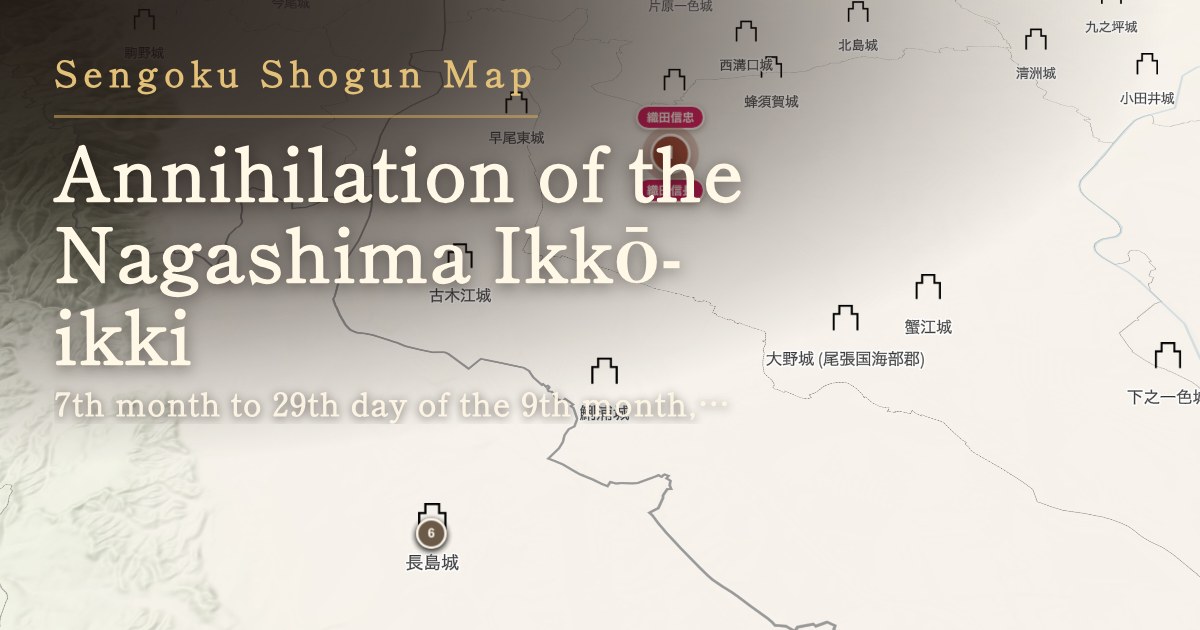
Course of the battle
1 12th to 14th day, 7th month, Tenshō 2 (1574)
Departure and arrival at Tsushima
Nobunaga and his son Nobutada set out to punish the Kawachi Nagashima, and that same day took up camp at Tsushima in Owari. Their arrival at Tsushima is said to have been on 13 July.
Sources differ – details
Points of debate
The date of departure varies by source among the 12th, 13th and 14th.
Sources125·Certainty: High
2 14th to 15th day, 7th month, Tenshō 2 (1574)
Deployment: three land fronts and a naval blockade
Nobunaga pitched a field camp at Gomyō and burned places such as Ejima, then on the 15th boarded the atakebune of four men including Kuki Yoshitaka and Takigawa Kazumasu and ordered each front to take up positions. Ichienoguchi in the east was held by his heir Nobutada; Kagatoriguchi in the west by Sakuma Nobumori, Shibata Katsuie, Inaba Ittetsu, Hachiya Yoritaka and others; and Nakasuji and Hayaoguchi by Nobunaga's main force, with Hashiba Hidenaga (then Kinoshita Koichirō), Niwa Nagahide, Maeda Toshiie and Kawajiri Hidetaka in the vanguard. At sea, atakebune and enclosed boats held the water, and ships gathered from the coastal villages of Owari and Ise numbered in the hundreds. In a vermilion-seal order dated the 23rd day of the 7th month, Nobunaga signaled his intent to grant no pardon and to cut Nagashima down to the roots.
Took the eastern front at Ichienoguchi
Took the western front at Kagatoriguchi
Deployed at Kagatoriguchi
Joined the vanguard at Nakasuji and Hayaoguchi
Recorded at Ōshimaguchi
Held the sea with atakebune
Held the sea with atakebune
Sources differ – details
Points of debate
The locations of Gomyō, Imajima, Sakate and other sites are unclear, so the map shows only a representative point for Nagashima.
Sources12346·Certainty: Medium
3 7th to 8th month, Tenshō 2 (1574)
The siege and the fall of Shinohashi and Ōtorii
The insurgents fled with their families into Nagashima, Yanagashima and Nakae and holed up in five forts: Shinohashi, Ōtorii, Yanagashima, Nakae and Nagashima. Shinohashi and Ōtorii, whose walls and turrets were brought down by heavy guns, begged for pardon but were refused; on the night of the 2nd day of the 8th month, about a thousand men and women who tried to slip out of Ōtorii under cover of wind and rain were cut down. On the 12th, the defenders of Shinohashi swore to follow the head priest at Nagashima, were spared, and were driven into Nagashima.
Sources differ – details
Points of debate
The fall of Ōtorii differs by one day: one record has the escape and slaughter on the night of 2 August, and another has the castle falling on 3 August. The locations of Shinohashi and Ōtorii are not clear.
Sources1246·Certainty: Medium
4 8th to 9th month, Tenshō 2 (1574)
Cornering the defenders in Nagashima
After Shinohashi fell, the Oda side pressed toward the one remaining Nagashima castle. A letter dated 7 August notes that Nagashima had been reduced to a place only a river's width away. The siege lasted three months, and it is said that more than half of the Ikkō forces starved to death.
Sources differ – details
Points of debate
The statement that more than half starved to death appears in only one record.
Sources1246·Certainty: Medium
5 29th day, 9th month, Tenshō 2 (1574)
Gunfire on the withdrawing insurgents and the burning of Nakae and Yanagashima
As the Nagashima side, having sought pardon, tried to leave by boat, guns were lined up and fired on them, and many were cut down into the river. Among them, some seven or eight hundred stripped bare and attacked with only long swords, and the Oda side also lost many men, including members of the family. The men and women left in Nakae Castle and Yanagashima were enclosed by repeated rings of fences and set alight from all sides. Their number is said to have been about twenty thousand.
Sources differ – details
Points of debate
The number of men and women left, 'about 20,000', is not a count of the dead in the records. The personal names of the Oda side's fallen differ among genealogies and cannot be settled.
Sources12346·Certainty: High
6 End of the 9th month to the 10th month, Tenshō 2 (1574)
Aftermath: return to Gifu and Takigawa Kazumasu
Nobunaga returned to Gifu. One record says Takigawa Kazumasu was stationed at Nagashima, and another article says northern Ise was granted to Kazumasu.
Is said to have been stationed at Nagashima
Sources differ – details
Points of debate
Nobunaga's return to Gifu is recorded as the 29th of the 9th month in one reading and the 5th of the 10th month in another. The date of the grant of northern Ise is unclear.
Sources1246·Certainty: Medium
Historical significance
The conflict with the Nagashima Ikkō-ikki, which had begun in 1570, was settled here. After the war, Takigawa Kazumasu is said to have been stationed at Nagashima, and northern Ise came under Oda control.
Read it from the victims’ side
Our companion site "Sengoku no Senka" (Japanese only) tells this event from the side of those who were killed and plundered.
Advertisement
Key figures
織田氏
16

Supreme commander
Arrived at Tsushima on the 13th day of the 7th month and led the main force at Nakasuji and Hayaoguchi. In a vermilion-seal order dated the 23rd day of the 7th month, he signaled his intent to cut the defenders down to the roots.
Sources
Sources12·Certainty: High
Commander at Ichienoguchi
Led the main force at Ichienoguchi on the east side. Oda Nobukane, Ikeda Tsuneoki, Mori Nagayoshi and others are listed among his attendants.
Sources
Sources1·Certainty: High
Commander at Kagatoriguchi
Held Kagatoriguchi on the west side, and with his son Nobuhide took position at Sakate village as the holding force for the attack on Ōtorii.
Sources
Sources1·Certainty: High

Commander at Kagatoriguchi and in the attack on Ōtorii
Deployed at Kagatoriguchi and, with Inaba Ittetsu, Hachiya Yoritaka and others, camped at Imajima to attack Ōtorii.
Sources
Sources1·Certainty: High
Commander at Kagatoriguchi and in the attack on Ōtorii
Deployed at Kagatoriguchi and attacked Ōtorii together with Shibata Katsuie and others.
Sources
Sources1·Certainty: High
Commander at Kagatoriguchi and in the attack on Ōtorii
Deployed at Kagatoriguchi and attacked Ōtorii together with Shibata Katsuie and others.
Sources
Sources1·Certainty: High

Vanguard at Nakasuji and Hayaoguchi
Joined the vanguard at Nakasuji and Hayaoguchi, and later also took position at Oshitsuki village east of Nagashima.
Sources
Sources1·Certainty: High
Vanguard at Nakasuji and Hayaoguchi
Joined the vanguard at Nakasuji and Hayaoguchi, and is listed first among the vanguard.
Sources
Sources1·Certainty: High

Vanguard at Nakasuji and Hayaoguchi
Joined the vanguard at Nakasuji and Hayaoguchi.
Sources
Sources1·Certainty: High
Vanguard at Nakasuji and Hayaoguchi
Joined the vanguard at Nakasuji and Hayaoguchi. The vermilion-seal order of the 23rd day of the 7th month and the letter of the 7th day of the 8th month were addressed to Kawajiri Hidetaka.
Sources
Sources12·Certainty: High
Attendant at Ichienoguchi and commander at Karōtojimaguchi
Joined Nobutada's attendants, and his name also appears at Karōtojimaguchi.
Sources
Sources1·Certainty: Medium

Attendant at Ichienoguchi
Joined Nobutada's attendants.
Sources
Sources1·Certainty: Medium

Attendant at Ichienoguchi
Joined Nobutada's attendants.
Sources
Sources1·Certainty: Medium
Commander at Ōshimaguchi
Took position at Ōshimaguchi together with the Kuwana forces.
Sources
Sources1·Certainty: Medium

Commander of the naval blockade
Held the sea with atakebune warships. On the 15th, Nobunaga is said to have boarded the atakebune of Yoshitaka and three others and ordered the positions at each gate. Several hundred ships, centered on the Kuki navy, are said to have moved.
Sources
Sources13·Certainty: High

Commander of the naval blockade
Put out atakebune together with Kuki Yoshitaka and others to hold the sea. He is said to have been stationed at Nagashima after the battle.
Sources
Sources12·Certainty: Medium
本願寺・一向一揆
1
Leader of Ganshōji
Said to be the leader of the Honganji believers centered on Ganshō-ji.
Sources
Sources3·Certainty: Medium
Other events of 1574
Notes on the data
The present-day locations of Shinohashi, Ōtorii, Yanagashima, Nakae, Gomyō, Sakate and Imajima cannot be confirmed from municipal or museum sources, so none is placed on the map; the scene markers use the site of Nagashima Castle as a representative point for Nagashima. The date of departure varies among sources (the 12th, 13th or 14th), so the text centers on the Shinchō Kōki's landing at Tsushima on the 13th while avoiding a firm claim. The identification of 'Gohonjo' as Kitabatake Nobukatsu, the personal names of Oda-side dead (which differ among genealogies), and the names of Ikkō-ikki individuals found in later temple traditions are not adopted.
Sources consulted
- 太田牛一『信長公記』巻七(国立国会図書館所蔵)
- 『大日本史料』第10編23・24(東京大学史料編纂所)
- 三重県文化振興課「信長の伊勢攻略と長島一向一揆」
- 桑名市「長島城跡」
- 国土地理院 住所検索(愛知県津島市)
- 国土地理院 住所検索(桑名市長島町西外面2175)
The numbers in the text refer to the list above. Certainty indicates how far a statement is supported by the cited sources; it does not refer to the precision of the coordinates or the dating.
Territories before and after the battle
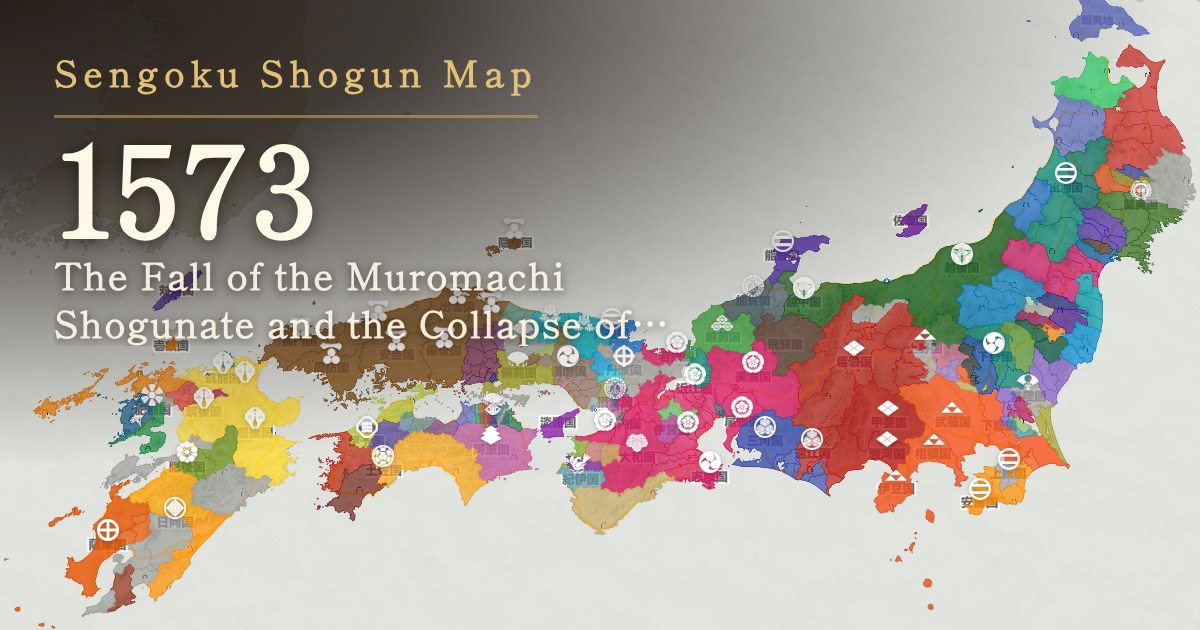
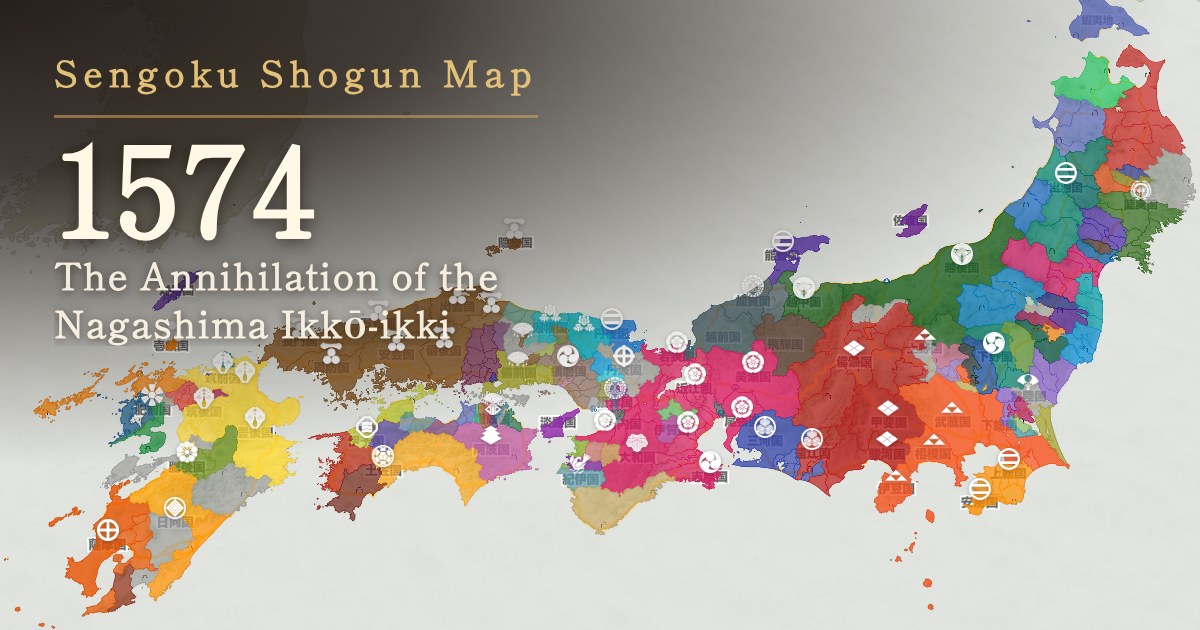
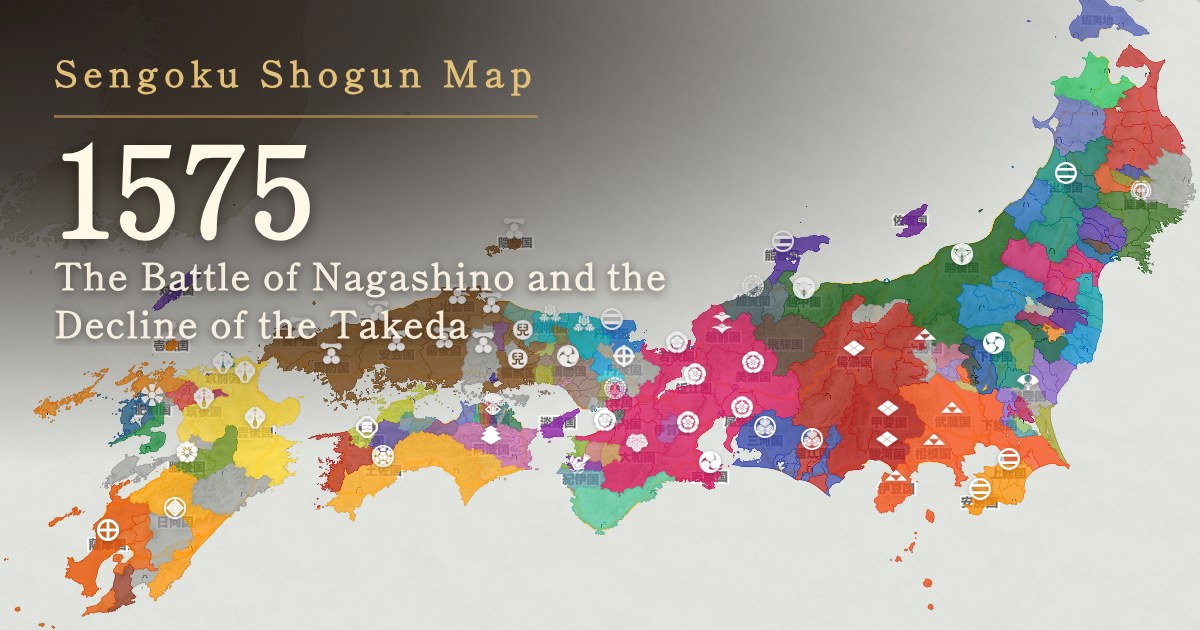
The year before, the year of the battle, and the year after, side by side. Tap a map to open that year.
Advertisement