INTERACTIVE BATTLE
Battle of Okehazama
12 June 1560 · Okehazama and Dengakuhazama, Owari Province
On June 12, 1560, at Okehazama and Dengakuhazama in Owari (present-day Toyoake and Midori Ward, Nagoya, Aichi Prefecture), Oda Nobunaga attacked the main force of Imagawa Yoshimoto and killed Yoshimoto. The Imagawa army withdrew from Owari.
織田氏: Oda Nobunaga, Sakuma Nobumori, 千秋季忠, 佐久間盛重, 織田秀敏, 飯尾定宗 et al. / 今川氏: Imagawa Yoshimoto, Tokugawa Ieyasu, 岡部元信, 瀬名氏俊
Explore the 1560 map
Change the year to watch territories shift
Background
In the southeastern part of Owari, Narumi, Odaka and Kutsukake castles were held by the Imagawa. To counter them, the Oda had placed forts at Marune and Washizu against Odaka, and at Tange, Zenshōji and Nakajima against Narumi. In June 1560, Imagawa Yoshimoto advanced into Owari to supply Odaka Castle and to clear the Oda forts. It is not known whether Yoshimoto's aim was to advance on Kyoto, and the battle was a decisive clash over the routes of castle supply and provisions.
Outcome
Oda Nobunaga attacked the Imagawa main force around Okehazama and Dengakuhazama, and in the melee Imagawa Yoshimoto was killed. The Imagawa army, having lost its commander, withdrew from Owari, and the invasion of Owari failed.
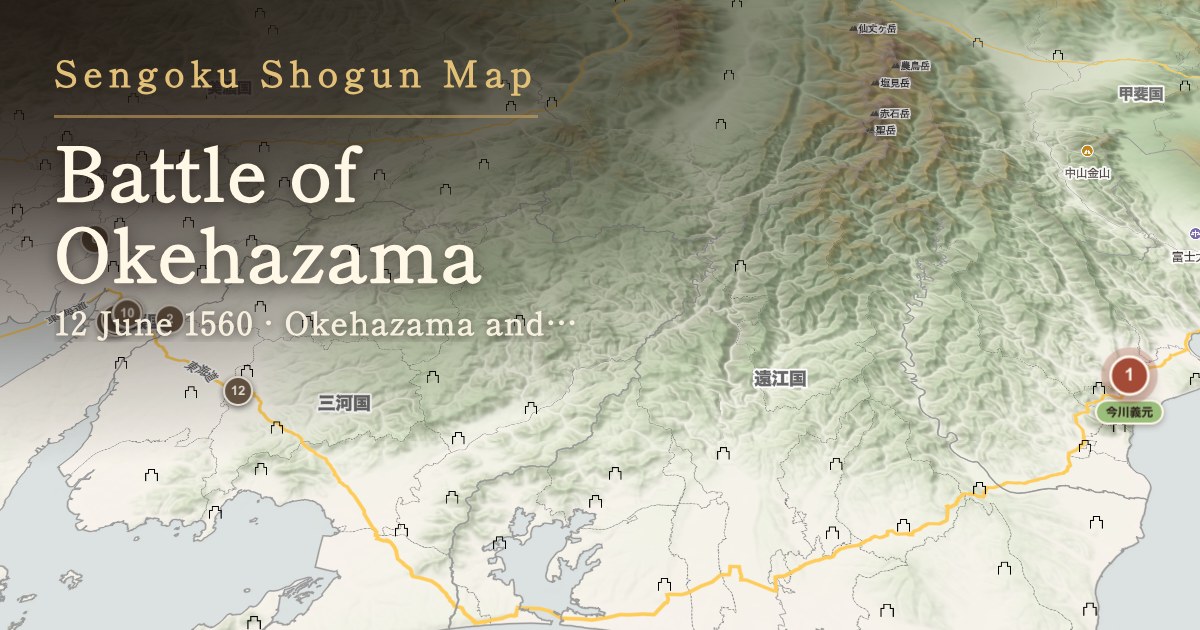
Course of the battle
1 3–5 June
The Imagawa army leaves Sunpu
Imagawa Yoshimoto led forces from Suruga, Totomi and Mikawa towards Owari.
Leads the main force out of Sunpu
Sources differ – details
Points of debate
Nobunaga's schedule of stays in various places depends in part on sources compiled in later times and is not certain.
Sources25·Certainty: Medium
2 11 June
Yoshimoto's main force enters Kutsukake castle
Yoshimoto's main force entered Imagawa-held Kutsukake castle and is said to have prepared for operations in south-eastern Owari the next day.
Holds council at Kutsukake castle
Sources differ – details
Points of debate
The participants in the council and its precise plans are not fixed.
Sources56·Certainty: Medium
3 Night of 11–12 June
Matsudaira Motoyasu supplies Odaka castle
Motoyasu, serving the Imagawa, successfully supplied Odaka castle, which was pressed by Oda forts, and rested inside it.
Runs supplies into Odaka castle
Sources differ – details
Points of debate
The route, diversion and exact timing of the supply operation remain disputed.
Sources15·Certainty: High
4 Before dawn, 12 June
Marune fort falls
Imagawa troops including Matsudaira Motoyasu attacked Marune fort; its defender Sakuma Morishige and others are said to have fallen as the fort was taken.
Holds Marune fort
Attacks Marune fort
Sources differ – details
Points of debate
Troop numbers and details of firearm use rely partly on later sources and are not treated as fixed.
Sources7·Certainty: Medium
5 Before dawn, 12 June
Washizu fort falls
Imagawa troops under Asahina Yasutomo and others attacked Washizu fort; defender Io Sadamune and many of the garrison are said to have fallen as it was taken.
Holds Washizu fort
Holds Washizu fort
Sources differ – details
Points of debate
Sources differ over the numbers and composition of both forces.
Sources8·Certainty: Medium
6 Before dawn to morning, 12 June
Oda Nobunaga leaves Kiyosu castle
After learning of the attacks on the forts, Nobunaga left Kiyosu castle and headed through Atsuta towards the front in south-eastern Owari.
Rides out from Kiyosu castle
Sources differ – details
Points of debate
The Atsumori episode, the number present at departure and the prayer at Atsuta are famous Shinchoko-ki narratives and are kept distinct from the departure itself.
Sources25·Certainty: Medium
7 Morning, 12 June
Nobunaga advances to Zenshoji fort
Nobunaga advanced to Zenshoji fort and is said to have assembled his arriving troops there.
Sources differ – details
Points of debate
Sources differ over the assembled strength, so no fixed number is given.
Sources9·Certainty: Medium
8 Late morning, 12 June
The Oda advance from Zenshoji to Nakajima fort
Nobunaga advanced from Zenshoji to Nakajima fort, approaching the Imagawa troops and main force around Okehazama.
Encamped at Zenshoji fort
Holds Nakajima fort
Moves forward from Zenshoji to Nakajima fort
Sources differ – details
Points of debate
Several routes are proposed beyond Nakajima fort; the map line is not a single fixed route.
Sources9·Certainty: Disputed
9 Around noon, 12 June
The Oda attack the Imagawa main force
The Oda attacked the Imagawa main force, said to have been resting around Okehazama and Dengakuhazama, and the fighting became a melee.
Attacked while resting at Okehazama
Feints against the Imagawa vanguard
Attacks the Imagawa main force
Sources differ – details
Points of debate
Flanking-surprise and frontal-attack interpretations coexist; the rain's role and the location of Yoshimoto's headquarters are also unsettled.
Sources234·Certainty: Disputed
10 12 June
Yoshimoto is killed and the Imagawa withdraw
Yoshimoto was killed in the melee. Having lost its commander-in-chief, the Imagawa army turned to withdrawal from Owari.
Killed in action
Holds Narumi castle
Sources differ – details
Points of debate
The individual who killed Yoshimoto, the final combat and a single death site are separated as source narratives or traditions. Troop and casualty figures are also unsettled.
Sources23·Certainty: High
11 Night of 12 June to 16 June
Motoyasu leaves Odaka and withdraws towards Okazaki
After confirming Yoshimoto's death, Motoyasu left Odaka castle and entered Daijuji in Okazaki, the Matsudaira family temple.
Leaves Odaka and withdraws towards Okazaki
Sources
Sources15·Certainty: High
12 16 June 1560 to 1561
Motoyasu returns to Okazaki as Owari-Mikawa relations shift
After the Imagawa left Okazaki castle, Motoyasu entered it on the 23rd day of the fifth lunar month and regrouped the Matsudaira family and retainers. He initially still fought the Oda as an Imagawa adherent, making peace and alliance with Nobunaga in 1561.
Returns to Okazaki and later allies with Nobunaga
Makes peace with Motoyasu and enters alliance
Sources differ – details
Points of debate
The return to Okazaki is not equated with immediate independence from the Imagawa or the formation of the Kiyosu alliance.
Sources15·Certainty: High
Historical significance
Nobunaga regained the initiative in southeastern Owari. Matsudaira Motoyasu (later Tokugawa Ieyasu), who was at Odaka Castle, confirmed Yoshimoto's death and returned to Okazaki Castle, where he worked to rebuild the Matsudaira retainer corps. He did not switch to the Oda side at once. For a time he fought the Oda while remaining on the Imagawa side, and in 1561 he reconciled with Nobunaga and formed an alliance. The Imagawa house did not perish immediately, as Imagawa Ujizane succeeded to the family.
Advertisement
Key figures
織田氏
8

Commander-in-chief of the Oda army
The main force, said to have moved up from Kiyosu castle by way of Nakajima fort towards Okehazama.
Sources
Sources210·Certainty: Medium
Oda fort garrison and forward troops
Said to have been stationed as an Oda unit around Zenshōji fort.
Sources
Sources11·Certainty: Disputed
Oda vanguard
An Oda vanguard said to have been involved in a feint against the vanguard of the Imagawa army.
Sources
Sources11·Certainty: Disputed
Defender of Marune fort
Held Marune fort against the Imagawa attack and is said to have died with it.
Sources
Sources7·Certainty: Medium
Defender of Washizu fort
An Oda commander posted to Washizu fort. The Shinchoko-ki names him Oda Genba.
Sources
Sources48·Certainty: Medium
Defender of Washizu fort
Said to have been posted to Washizu fort with his son Naokiyo. The Shinchoko-ki names them the Io father and son.
Sources
Sources8·Certainty: Medium
Defender of Nakajima fort
Said to have held Nakajima fort, to which Nobunaga moved forward before making for Okehazama.
Sources
Sources14·Certainty: Medium
Defender of Tange fort
One of the Oda commanders posted to Tange fort, which held down Narumi castle.
Sources
Sources15·Certainty: Medium
今川氏
4

Commander-in-chief of the Imagawa
Said to have moved from Kutsukake castle towards Odaka and to have been attacked while resting near Okehazama and Dengakuhazama.
Sources
Sources12·Certainty: High

Imagawa commander
Succeeded in bringing supplies into Odaka castle and is said to have taken part in the attacks on Marune and Washizu. Later known as Tokugawa Ieyasu.
Sources
Sources17·Certainty: High
Imagawa defender of Narumi castle
Imagawa commander who held Narumi Castle as his base. Even after Yoshimoto's death he did not withdraw at once, and some troops stayed in the castle.
Sources
Sources12·Certainty: Medium
Imagawa officer
Said to have set up camp around Okehazama, and traditions about the camp site remain.
Sources
Sources13·Certainty: Traditional account
Other events of 1560
Notes on the data
Dates use the Western Julian calendar; 12 June corresponds to the 19th day of the fifth month of Eiroku 3. Lines and points on the map are approximate aids for understanding historic and traditional sites and movements. They do not establish a single route of attack, the battlefield's extent, or the exact locations of Yoshimoto's headquarters and death.
Sources consulted
- 国立公文書館「桶狭間の戦い」
- 豊明市「桶狭間古戦場伝説地」
- 名古屋市緑区「桶狭間周辺のみどころ一覧」
- 名古屋市博物館「五月の信長」
- 城郭マスタ(shiro.geojson)
- 豊明市「豊明市指定文化財・沓掛城址」
- 名古屋市緑区「大高周辺のみどころ一覧4」
- 名古屋市緑区「大高周辺のみどころ一覧3」
- 名古屋市緑区公式ウェブサイト
- 名古屋市緑区「鳴海周辺のみどころ」
- 名古屋市緑区資料(伝承を含む)
- 名古屋市緑区「鳴海周辺のみどころ一覧1」
- 名古屋市文化財資料(瀬名氏俊陣地跡)
- 名古屋市緑区公式ウェブサイト(中島砦周辺資料)
- 名古屋市緑区公式ウェブサイト(丹下砦周辺資料)
The numbers in the text refer to the list above. Certainty indicates how far a statement is supported by the cited sources; it does not refer to the precision of the coordinates or the dating.
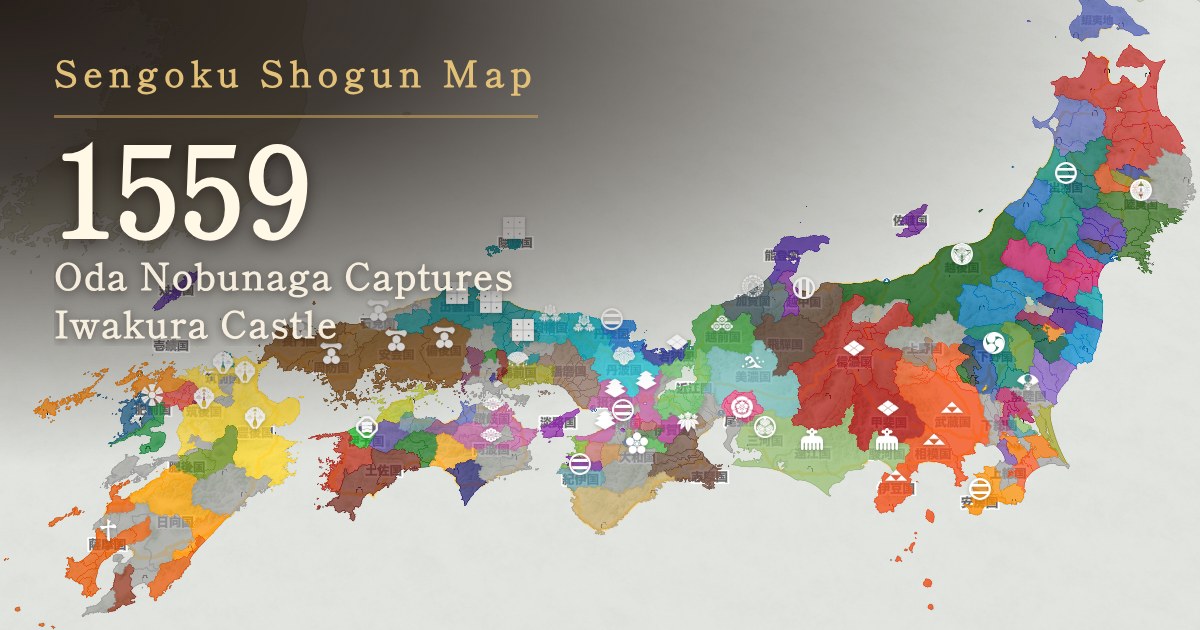
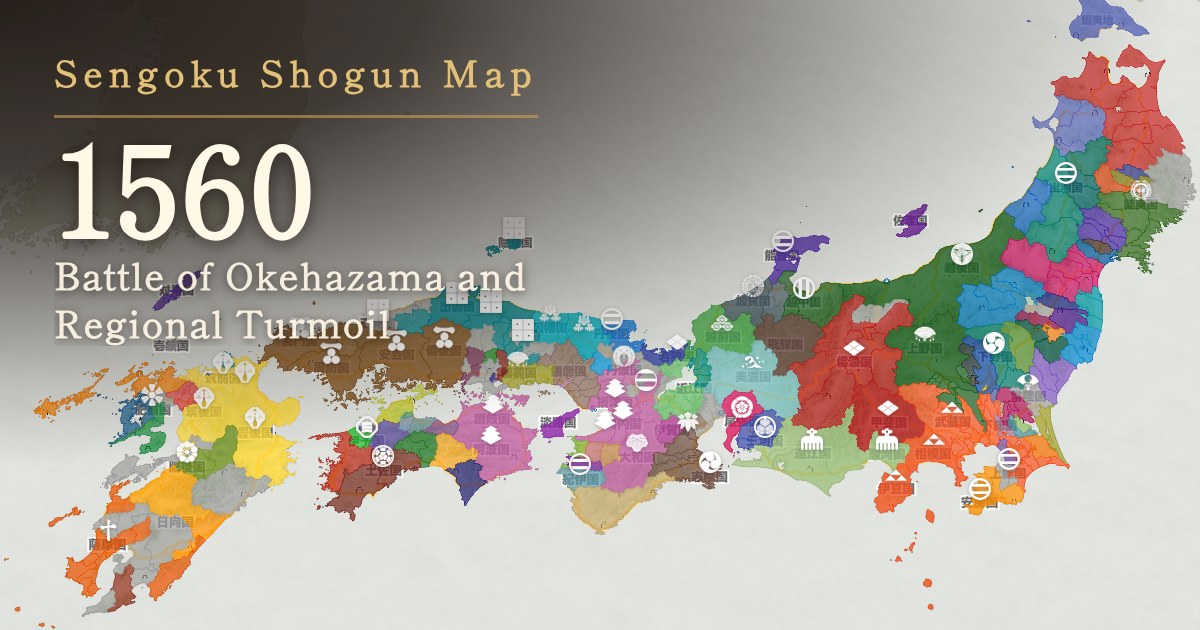
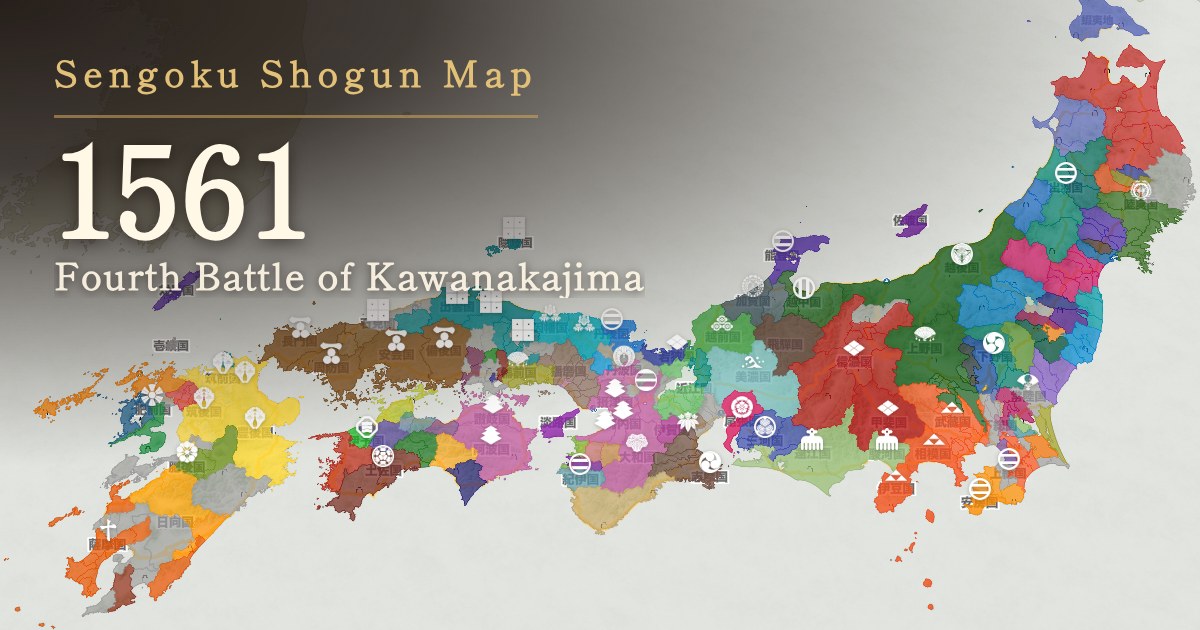
Territories before and after the battle
The year before, the year of the battle, and the year after, side by side. Tap a map to open that year.
Advertisement