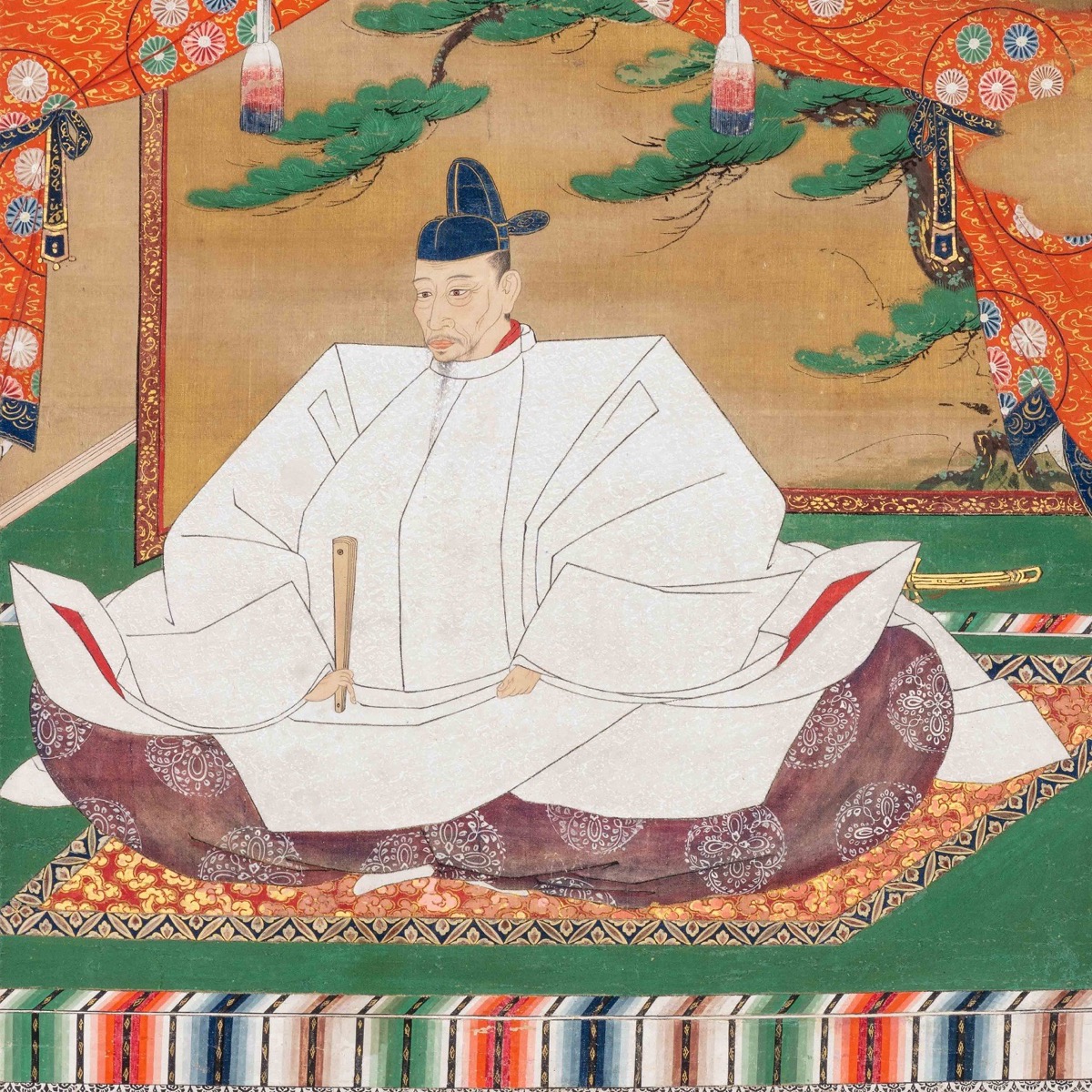
 狩野光信「豊臣秀吉像」
First Kampaku of the Toyotomi Regime
Toyotomi Hideyoshi
豊臣秀吉
1537 – 1598
As a retainer of Oda Nobunaga, he gained experience governing castle towns and directing logistics and sieges in Ōmi and the Chūgoku region, rising to prominence through the sieges of Miki, Tottori, and Takamatsu. After Nobunaga's death he made peace with the Mōri, defeated Akechi Mitsuhide at Yamazaki, and after defeating Shibata Katsuie at Shizugatake he built Osaka Castle as his base of power. As kampaku he pursued a policy of ending private warfare among daimyo, land surveys, and the sword hunt, and completed the unification of Japan by subduing Shikoku, Kyushu, and Odawara. In his later years his regime was destabilized by the purge of his nephew Hidetsugu and the invasions of Korea (the Bunroku and Keichō campaigns); he died in 1598, entrusting the future of his young son Hideyori to the Five Great Elders and Five Commissioners.
Sources 九州国立博物館メールマガジン/長崎県「年表で学ぼう」/熊本市「加藤清正」資料
Explore the 1574 map
Change the year to watch territories shift
Life of Toyotomi Hideyoshi
Serving Oda Nobunaga and becoming lord of Nagahama Castle
Map of 1573Toyotomi Hideyoshi was born in Nakamura in Owari, said to be the son of a foot soldier or of a farming family. His birth year is not settled, with theories of 1536 and 1537. He first served Matsushita Yukitsuna, then served Oda Nobunaga, taking the name Kinoshita Tōkichirō, and became Hashiba Chikuzen-no-kami. In 1573 he was given northern Ōmi and became lord of a castle, and he renamed Imahama as Nagahama. He is traditionally said to have gathered merchants from the castle town of Odani and elsewhere to set up the castle town. It was the first castle Hideyoshi, who had risen from the ranks of foot soldiers, held, and the place where he first governed a domain.
Defeating Mitsuhide at Yamazaki
Map of 1582In June 1582, when Nobunaga was killed in the Honnōji incident, Hideyoshi was facing the Mōri clan in the west. He hurried back to the Kinai and on the thirteenth day of the sixth month by the lunar calendar defeated Akechi Mitsuhide at Yamazaki in Yamashiro Province. About eleven days after the Honnōji incident, Mitsuhide's rule was short-lived. The battlefield lay at the foot of Tennōzan, in what is now Ōyamazaki town, Kyoto Prefecture. After the victory, Hideyoshi built Yamazaki Castle on Tennōzan and used it as a temporary base. There are also newer views on whether Hideyoshi arrived at the battlefield in time.
Winning at Shizugatake and building Osaka Castle
Map of 1583Hideyoshi came into conflict with Shibata Katsuie, a senior retainer of the Oda house, over the succession to Nobunaga. Early on April 20, 1583, at Shizugatake in northern Ōmi, the battle began with a surprise attack from Katsuie's side, and Hideyoshi's side won in under two days. Katsuie is said to have killed himself with his wife, Oichi no Kata, at Kitanoshō Castle in Echizen on April 23. This shifted leadership of the Oda house to Hideyoshi. From around August of that year, Hideyoshi began building a castle in Osaka. The main keep was completed in spring 1585 and became the base of the later Toyotomi regime.
Becoming kampaku and bringing Ieyasu to heel
Map of 1585In 1584 Hideyoshi fought at Komaki and Nagakute against Tokugawa Ieyasu, who had allied with Oda Nobukatsu. He suffered a military setback, but through political means he reached a settlement with Nobukatsu. In 1585 he destroyed the Negoro and Saika in Kii and subdued Chōsokabe Motochika of Shikoku. On July 11 he was appointed Junior First Rank and kampaku. In 1586 he became Daijō-daijin and was granted the surname Toyotomi. He had his younger sister Asahime married to Ieyasu, and in October Ieyasu met Hideyoshi at Osaka Castle and submitted to him.
Subjugating Kyushu and ordering the sword hunt
Map of 1588In 1587 Hideyoshi subdued the Shimazu of Kyushu and carried out a division of provinces, placing Hakata and Nagasaki under direct control. Around the same time he issued an anti-Christian edict. In 1588 he received Emperor Go-Yōzei at Jurakudai in Kyoto and had the daimyo swear loyalty to the emperor and to Hideyoshi. In the same year he issued the Sword Hunt edict, banning farmers from possessing weapons, and advanced the system of expressing land in koku through land surveys. Land surveys were actively carried out during the Bunroku era (1592–96) and later came to be called the Taikō surveys. The social order that divided samurai from commoners began to solidify from here.
Attacking Odawara and unifying the realm
Map of 1590In March 1590 Hideyoshi attacked Odawara Castle in Sagami with about 180,000 troops. The Hōjō clan defended the castle with about 50,000 men. Hideyoshi built a castle at Ishigaki-yama in Hayakawa to prepare for a long campaign. This castle, said to have been built in a single night, is reported to have actually taken about 80 days. On July 5 Hōjō Ujinao surrendered, and on the 9th the castle was handed over. Ujinao's father, Ujimasa, and uncle, Ujiteru, committed seppuku, and Ujinao was banished to Mount Koya. After this, Hideyoshi also pacified Ōshū and achieved the unification of the realm.
Sending troops to Korea
Map of 1592In 1591 Hideyoshi lost his young son Tsurumaru, and he handed the kampaku post to his nephew Hidetsugu and called himself Taikō. From October of that year he began building a castle at Nagoya in Hizen Province, completing it in under a year, mainly with Kyushu daimyo. In 1592 Hideyoshi organized an army of about 160,000 and went to Nagoya himself, sending troops to Korea (the Bunroku campaign). They took the capital early on, but with Ming reinforcements and Korean resistance the fighting stalled, and peace talks broke down. He sent troops again in 1597 (the Keichō campaign), but it achieved no results.
Entrusting Hideyori and dying at Fushimi Castle
Map of 1598On August 18, 1598, Hideyoshi died at Fushimi Castle. Accounts say he was 62 or 63. Just before his death, he is said to have written a will entrusting the future of his young son Hideyori to the Five Elders. Hideyori was not yet able to conduct affairs of state, so the Five Elders and the Five Commissioners ran the government. The daimyo who had been in Korea also withdrew after Hideyoshi's death. Eventually, after Maeda Toshiie and others died, the balance between the Five Elders and the Five Commissioners collapsed, and Tokugawa Ieyasu came to stand at the center of government.
Sources 日本大百科全書・精選版日本国語大辞典ほか(コトバンク「豊臣秀吉」)/国立公文書館「国立公文書館の家康」/大山崎町「山崎合戦の地を歩くコース」/文化遺産オンライン「大坂城跡」「肥前名護屋城跡図」/小田原市「小田原合戦」「石垣山一夜城」/佐賀県立名護屋城博物館「名護屋城とは」
Territory map of Toyotomi Hideyoshi
From 3 provinces in 1580 to 23 provinces in 1585.
The territory of the Toyotomi clan, limited to the years when he led the house. Lighter colour: provinces held only in part (some districts).Castles Toyotomi Hideyoshi used as his seat
In the order he moved his base. Years show when he entered and left.- Nagahama Castle (Ōmi Province)1573–1582
- Himeji Castle1580–1583
- Ōsaka Castle1583–1598
- Fushimi Castle1594–1598
Family tree
Toyotomi Hidenaga
Sibling
Toyotomi Hideyoshi
This person
Toyotomi Hidekatsu
Adopted child
Hashiba Hidekatsu
Adopted child
Toyotomi Hidetsugu
Adopted child
Advertisement
Related events
78
1537
Toyotomi Hideyoshi Is Born
BornToyotomi Hideyoshi, who would later complete the unification of Japan, is traditionally said to have been born in Nakamura, Aichi District, Owari Province; an alternative birth year of 1536 also exists.
1577
10/23
Hashiba Hideyoshi Marches into Harima
Took part / involvedOrdered by Oda Nobunaga to campaign against the Mōri in western Japan, Hashiba Hideyoshi marched into Harima and began the Chūgoku campaign in earnest.
12/3
Hashiba Hideyoshi Captures Kōzuki Castle
Oda commander in chiefAfter entering Harima, Hashiba Hideyoshi captured Kōzuki Castle, a stronghold linked to the Mōri side, and pushed the front of the Chūgoku campaign westward.
Hashiba Hidenaga Becomes Castellan of Takeda Castle
Related figureDuring Hashiba Hideyoshi's campaign in Tajima, his brother Hidenaga became castellan of Takeda Castle and assumed a key role in the Hashiba advance into western Japan.
1578
Month 3
Siege of Miki Begins
Took part / involvedBessho Nagaharu of Miki Castle broke with the Oda and aligned with the Mōri, prompting Hashiba Hideyoshi to begin the siege of Miki.
Month 7
Oda Nobutada Builds Forts Around Miki Castle
Took part / involvedOda Nobunaga's heir Nobutada joined the Miki campaign and strengthened the siege by constructing forts, including the hilltop fort at Hiraiyama that served as Hashiba Hideyoshi's headquarters.
1580
2/2
Miki Castle Falls
Oda commander in chiefAfter a siege lasting about twenty-two months, Bessho Nagaharu and his family took their own lives in exchange for sparing the garrison and townspeople, and Miki Castle surrendered to Hashiba Hideyoshi.
Hashiba Hideyoshi Makes Himeji Castle His Base
Commander in chief of the Chugoku campaignAfter pacifying Harima, Hashiba Hideyoshi received Himeji Castle from Kuroda Yoshitaka, rebuilt it, and made it the base for campaigns into Tajima, Inaba, and Bitchū.
1581
Month 10
Fall of Tottori Castle
Directed the starvation siegeThrough starvation tactics, Hideyoshi captures Tottori Castle, securing all of Inaba and depriving Mōri of a San’in base.
1582
Month 4
Siege of Bitchū Takamatsu Castle
Took part / involvedHashiba Hideyoshi besieged Bitchū Takamatsu Castle, defended for the Mōri by Shimizu Muneharu, and conducted a water siege.
Month 6
Oda Nobutaka Abandons the Shikoku Expedition and Joins the Yamazaki Campaign
Took part / involvedOda Nobutaka had assembled near Osaka for an expedition to Shikoku, but abandoned it after the Honnōji Incident. He then joined Hashiba Hideyoshi's army against Akechi Mitsuhide at Yamazaki.
6/23
Shimizu Muneharu's Death and the Surrender of Takamatsu Castle
Hashiba commander in chief who besieged Takamatsu CastleShimizu Muneharu took his own life, after which the Hashiba and Mōri sides concluded peace and Bitchū Takamatsu Castle surrendered.
6/25
The Chūgoku Great Return
Directed the Great Return from ChugokuAfter making peace with the Mōri, Hashiba Hideyoshi's army hurried from Bitchū through Himeji Castle toward the Kinai to confront Akechi Mitsuhide.
Month 7
Council at Kiyosu
Senior retainerAt Kiyosu Castle, Oda succession and territorial redistribution were discussed. Nobunaga's grandson Sanbōshi was chosen as heir over Oda Nobukatsu and Nobutaka, strengthening Hashiba Hideyoshi's influence.
7/2
Battle of Yamazaki
Hideyoshi's armyHashiba Hideyoshi defeated Akechi Mitsuhide near Yamazaki. Mitsuhide withdrew to Shōryūji Castle, escaped during the night, and died while attempting to reach Sakamoto Castle.
Month 10
Oda Nobunaga's Funeral Held at Daitoku-ji
Hosted the funeral of NobunagaHashiba Hideyoshi conducted Oda Nobunaga's funeral at Daitoku-ji in Kyoto, presiding over it together with Hashiba Hidekatsu, Nobunaga's son who had become Hideyoshi's adopted heir. The ceremony served as a demonstration of Hideyoshi's leadership following the Kiyosu Conference.
1583
6/11
Battle of Shizugatake
Took part / involvedThe armies of Hashiba Hideyoshi and Shibata Katsuie fought around Shizugatake in Ika District, Ōmi Province, and the Shibata army was defeated.
6/14
Fall of Kitanoshō Castle
Commander in chief of the force that attacked the ShibataAfter retreating from Shizugatake, Shibata Katsuie was attacked by Hashiba forces at Kitanoshō Castle and took his own life with Lady Oichi.
6/20
Yoshishige replies to Hideyoshi and opens friendly relations
Sent the letterHe replied to Hideyoshi's letter, reported his fighting with the Hōjō, and opened friendly relations. It is considered the beginning of exchanges between the Satake and the Hashiba.
Month 9
Construction of Osaka Castle Begins
Led the castle constructionHashiba Hideyoshi began constructing Osaka Castle on the former site of Ishiyama Hongan-ji as a political and military base for unifying the realm.
1584
Month 3
Komaki-Nagakute Campaign Begins
Took part / involvedHashiba Hideyoshi's army and the allied forces of Tokugawa Ieyasu and Oda Nobukatsu confronted one another mainly in Owari Province, beginning a campaign that lasted about eight months.
Month 11
Peace between Oda Nobukatsu and Hashiba Hideyoshi
Made peace with NobukatsuOda Nobukatsu and Hashiba Hideyoshi made a separate peace while confronting one another near Nagashima. Tokugawa Ieyasu then withdrew, ending the Komaki-Nagakute campaign.
1585
Month 3
Kii Campaign
Took part / involvedThe armies of Hashiba Hideyoshi and Hidenaga attacked the Negoro and Saika groups and advanced their conquest of Kii Province.
Month 7
Hashiba Hideyoshi Becomes Kampaku
Became kampakuHashiba Hideyoshi was appointed kampaku, gaining an imperial office through which to advance his rule over the country.
Nakagawa Hidemasa Transferred to Miki Castle
Related figureAs Settsu came entirely under Hideyoshi's direct control through his settlement of Settsu, Nakagawa Hidemasa was transferred to Miki in Harima.
Takayama Ukon Transferred to Akashi, Harima
Related figureUnder Toyotomi Hideyoshi's settlement of Settsu, Takayama was transferred from Takatsuki to Akashi in Harima and undertook construction of Funage Castle and development of the castle town.
1586
Month 2
Construction of Jurakudai Begins
Led the constructionToyotomi Hideyoshi began building Jurakudai in Kyoto as a government center and residence.
10/27
Tokugawa Ieyasu Meets Hideyoshi at Osaka Castle
Received Ieyasu's submissionTokugawa Ieyasu entered Osaka Castle and met Toyotomi Hideyoshi, entering the daimyō order under the Toyotomi government.
Toyotomi Hideyoshi Becomes Chancellor of the Realm
Principal partyToyotomi Hideyoshi was appointed daijō-daijin, the highest office of the imperial court.
1587
Month 3
Kyushu Campaign
Toyotomi Hideyoshi — 豊臣軍総指揮In 1587, Toyotomi Hideyoshi answered a request from the Ōtomo and sent a large army to Kyushu, forcing Shimazu Yoshihisa, who had continued to push northward, to surrender. This was the pacification of Kyushu (the Kyushu Campaign). The Shimazu were confirmed in possession of Satsuma and other provinces and submitted to the Toyotomi regime.
5/8
Shimazu Yoshihisa Submits to Hideyoshi
Received Shimazu Yoshihisa's surrenderFollowing the Toyotomi advance into Kyushu, Shimazu Yoshihisa submitted to Hideyoshi at Taiheiji in Sendai.
Month 6
Takayama Ukon Stripped of Domain and Title
Related figureDue to Toyotomi Hideyoshi's edict banishing Westerners (Bateren), Takayama Ukon, who refused to abandon his Christian faith, lost his domain in Akashi and his status as daimyo.
Month 9
Jurakudai Is Completed
Led the construction and made it a seat of governmentJurakudai was completed in Kyoto and became Toyotomi Hideyoshi's center for government and control of the daimyō.
10/1
Grand Kitano Tea Gathering
HostToyotomi Hideyoshi held a large tea gathering at Kitano Tenmangū that was open to participants regardless of social rank.
1588
Month 4
Imperial Visit to Jurakudai
Received the imperial visitEmperor Go-Yōzei visited Jurakudai, where Toyotomi Hideyoshi had the assembled daimyō pledge loyalty to the emperor and to himself.
Month 7
Sword Hunt Edict
Issuer of the orderToyotomi Hideyoshi issued the Sword Hunt Edict, ordering weapons such as swords, spears, and firearms to be taken from peasants.
1589
Month 10
Seizure of Nagurumi Castle
Ruled a breach of the Sobuji edictInomata Norinao, the Later Hōjō castellan of Numata, seized Nagurumi Castle, which Toyotomi Hideyoshi's settlement had assigned to the Sanada.
11/24
Hideyoshi Declares War on the Later Hōjō
Declared war and resolved on the Odawara campaignToyotomi Hideyoshi treated the seizure of Nagurumi Castle as a violation of his peace order and issued a declaration of war to Hōjō Ujinao.
Expansion of Yamanaka Castle
Rival against whom the extension was builtThe Later Hōjō strengthened Yamanaka Castle against an anticipated conflict with Toyotomi Hideyoshi, including the addition of the Daisaki outer enclosure.
1590
3/29
Battle of Yamanaka Castle
Toyotomi sideThe Toyotomi army attacked Yamanaka Castle, a Later Hōjō stronghold guarding the route to Odawara, and captured it within half a day.
4/3
Siege of Odawara Begins
Took part / involvedToyotomi Hideyoshi arrived at Odawara and his assembled armies began the siege of the Later Hōjō stronghold.
5/27
Yoshinobu has his first audience with Hideyoshi at Odawara
Received the audienceSatake Yoshinobu entered Odawara with Utsunomiya Kunitsuna and others, and had his first audience with Toyotomi Hideyoshi on the 27th day of the fifth lunar month. He presented swords, horses, gold and other gifts.
Month 7
Yoshishige's third son succeeds to the Iwaki clan
Ordered the successionAfter hearing of the death of Iwaki Tsunetaka, Hideyoshi had Yoshishige's third son, Nōkemaru (later Iwaki Sadataka), succeed to the Iwaki clan.
7/5
Hōjō Ujinao Surrenders
Accepted the surrender and closed the Odawara campaignHōjö Ujinao, who had held out in Odawara Castle, surrendered to Toyotomi Hideyoshi, ending the Odawara campaign.
8/1
Hideyoshi confirms Satake domains at Utsunomiya
Issued the red-seal letterOn the 1st day of the 8th lunar month, Hideyoshi issued a red-seal letter at his camp in Utsunomiya, recognizing the Satake's actual holdings (tōchigyō) in Hitachi and Shimotsuke at 216,758 kanmon.
Month 11
Kasai-Osaki Uprising
Toyotomi Hideyoshi — 奥羽仕置を主導In November 1590, in the former Kasai and Ōsaki domains (present-day northern Miyagi and southern Iwate Prefectures), former retainers of the two houses, who had been stripped of their domains, rose against the new lord, the Kimura. The uprising ended in July 1591, when it was crushed at Sanuma Castle.
12/23
Yoshinobu becomes Junior Fourth Rank, Lower Grade, and chamberlain
RecommendedOn the 23rd day of the 12th lunar month, on Hideyoshi's recommendation, Satake Yoshinobu was appointed Junior Fourth Rank, Lower Grade, and chamberlain (jijū), and was granted the surname Hashiba.
Ōshū Reorganization
Led the Oshu settlementToyotomi Hideyoshi entered Aizu and settled the territories of the northern daimyō. Date Masamune lost Aizu, which was granted to Gamō Ujisato.
Ishikawa Kazumasa Enters Matsumoto
Related figureIn connection with Toyotomi Hideyoshi's settlement of Kantō and Ōu, Ishikawa Kazumasa entered Matsumoto and undertook renovation of the castle fortifications and development of the castle town. There are theories that his domain was valued at either 80,000 or 100,000 koku.
1591
9/4
Kunohe Masazane Surrenders
The Toyotomi regimeSurrounded at Kunohe Castle by the Toyotomi government's northern army, Kunohe Masazane surrendered, ending major organized resistance in Ōshū.
10/10
Construction of Nagoya Castle Begins
Led the castle building and the Korean campaignConstruction began on Nagoya Castle in Hizen as Toyotomi Hideyoshi's base for the invasion of Korea, with daimyō from across Japan assigned to the works.
Month 12
Toyotomi Hidetsugu Becomes Kampaku
Passed the office of kampaku to HidetsuguToyotomi Hideyoshi transferred the office of kampaku to his nephew Hidetsugu, who took up government duties at Jurakudai.
1592
Month 3
Nagoya Castle Completed and Armies Assemble
Led the dispatch of troopsNagoya Castle, the domestic base for the invasion of Korea, was completed as daimyō armies from across Japan assembled in camps around it.
Month 3
Crossing to Korea Begins
Ordered the invasion of KoreaDaimyō armies ordered by Toyotomi Hideyoshi began departing from Nagoya for the Korean Peninsula, opening the Bunroku campaign.
Month 4
The Bunroku Campaign
General-in-ChiefIn April 1592, on Toyotomi Hideyoshi's orders, Japanese forces crossed the sea and landed at Busan, advancing as far as the Korean capital Hanseong and Pyongyang. They were pushed back by naval forces, righteous armies and Ming troops, withdrew to the southern coast in 1593, and entered peace negotiations.
Month 8
Construction Begins at Fushimi
Related figureAfter transferring the office of kampaku to Hidetsugu, Toyotomi Hideyoshi began building a retirement residence at Shigetsu Hill in Fushimi, the origin of Fushimi Castle.
1593
5/22
Hideyoshi Reports Peace Negotiations from Nagoya
Related figureWhile based at Nagoya, Toyotomi Hideyoshi wrote to Kita-no-Mandokoro reporting that Ming envoys had presented peace terms.
Month 8
Hideyoshi Moves to Fushimi
Related figureAfter Hideyori's birth, Toyotomi Hideyoshi moved to his Shigetsu residence in Fushimi and developed it into a full castle and new center of government.
Month 8
Birth of Toyotomi Hideyori
Father; birth of the heirToyotomi Hideyoshi's son Hiroi, later known as Hideyori, was born at Osaka Castle, changing the political situation surrounding the Toyotomi succession.
1594
Month 1
Major Reconstruction of Fushimi Castle Begins
Related figureToyotomi Hideyoshi began transforming Fushimi Castle at Shigetsu into a full-scale fortress and political center intended to receive Ming envoys.
Month 8
Shigetsu Fushimi Castle Is Completed
Related figureShigetsu Fushimi Castle was completed and Toyotomi Hideyoshi entered it, making Fushimi a new center of government and transportation.
Nakagawa Hidenari Transferred to Oita, Bungo
Related figureNakagawa Hidenari, who succeeded to the headship following the death of his elder brother Hidemasa, was transferred from Miki in Harima to Oita in Bungo Province by order of Toyotomi Hideyoshi and built a castle town.
Development of Fushimi Port and the Taikō Embankment
Led the improvement worksAlongside the construction of Fushimi Castle, Fushimi Port was opened and major works including the Taikō Embankment improved river and land transport.
1595
6/19
Hideyoshi sets the Satake chigyōwari
Issued the red-seal letterBy red-seal letter, Hideyoshi set the Satake chigyōwari and assigned the Satake domains at 545,800 koku. Yoshinobu received 150,000 koku and Yoshishige 50,000 koku.
Month 7
Toyotomi Hidetsugu Dies at Mount Kōya
Banished Hidetsugu to Mount KoyaAfter being stripped of the office of kampaku and exiled to Mount Kōya, Toyotomi Hidetsugu was ordered by Toyotomi Hideyoshi to take his own life.
7/28
Order to Demolish Jurakudai
Ordered the demolitionFollowing Toyotomi Hidetsugu's downfall, Toyotomi Hideyoshi ordered the demolition of Jurakudai, Hidetsugu's residence.
Month 8
Demolition of Jurakudai
Ordered the demolitionJurakudai was comprehensively dismantled, with some buildings and materials transferred to Fushimi Castle and other sites.
Tōdō Takatora Becomes Direct Retainer of Hideyoshi and Commands Iyo
Related figureWhen his lord's house ended with Hideyasu's death, Takatori entered Mount Kōya, but was summoned by Hideyoshi to enter service and received 70,000 koku at Iyo Uwajima with a 50,000-koku increase, becoming Hideyoshi's direct retainer.
1596
Leap 7/13
Keichō Fushimi Earthquake
Lord of Shigetsu Fushimi CastleA major earthquake struck the Kinai region, destroying the recently completed Shigetsu Fushimi Castle and causing severe damage across Kyoto and Fushimi.
Leap 7/23
Rebuilding of Fushimi Castle Begins at Kohatayama
Related figureAbout ten days after Shigetsu Castle collapsed, Toyotomi Hideyoshi began building a new Fushimi Castle on Mount Kohata.
San Felipe Runs Aground in Tosa
Ruler who ordered the cargo seized and examinedThe Spanish ship San Felipe ran aground at Urado in Tosa. The seizure of its cargo and interrogation of its crew contributed to intensified persecution of Christians.
1597
2/5
Martyrdom of the Twenty-Six Saints of Japan
Ruler who ordered the executionTwenty-six missionaries and believers arrested in Kyoto, Osaka, and nearby areas were executed at Nishizaka in Nagasaki.
Month 7
The Keichō Campaign
General-in-ChiefIn 1597, with peace talks stalled, Toyotomi Hideyoshi again ordered an invasion. Japanese forces crossed to southern Korea and took Jeolla Province, but could not halt their advance northward. They withdrew after Hideyoshi died in August 1598, and the campaign ended with the Battle of Noryang in November.
Second Invasion of Korea Begins
Led the dispatch of troopsThe Toyotomi government ordered a renewed invasion of Korea, and daimyō armies again crossed from the domestic base at Nagoya in Hizen.
1598
3/15
Daigo Flower Viewing
HostToyotomi Hideyoshi held a grand cherry-blossom viewing at Daigoji with Hideyori, Kita-no-Mandokoro, Yodo-dono, and a large entourage.
Month 9
Death of Toyotomi Hideyoshi
Died at Fushimi CastleToyotomi Hideyoshi died at Fushimi Castle. A new system of governance was established with the five regents (Go-Tairō) and five commissioners (Go-Bugyō) supporting the young Hideyori. The withdrawal of forces from Korea commenced.
Withdrawal from Korea
Took part / involvedAfter Toyotomi Hideyoshi's death, the daimyō armies withdrew from Korea, ending the invasions launched from Nagoya in Hizen.
1599
Tokugawa Ieyasu Enters Fushimi Castle
The regime after his deathAfter Toyotomi Hideyoshi's death, senior regent Tokugawa Ieyasu entered Fushimi Castle and used it as a base for governing within the Toyotomi administration.
Advertisement