1588 territory map and events: The Imperial Visit to Jurakudai and the Sword Hunt Edict
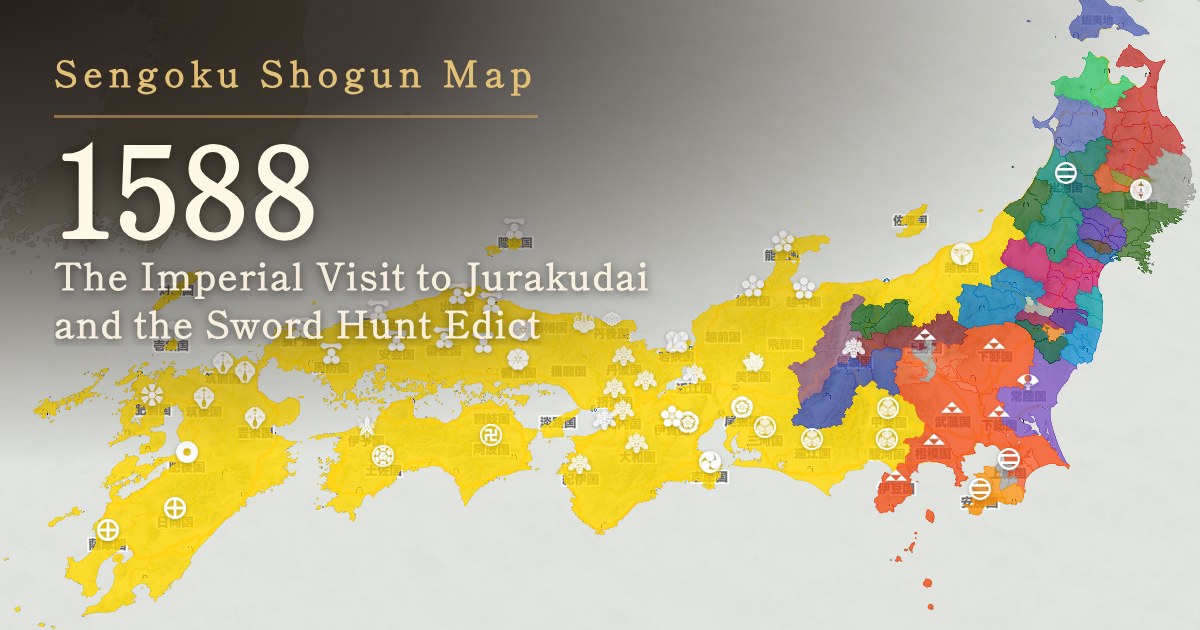
1588 was Tenshō 16 (tsuchinoe-ne).
In April, Emperor Go-Yōzei made a formal visit to Hideyoshi's residence, Jurakudai, where the assembled daimyo signed oaths of loyalty to Hideyoshi before the emperor, an event that showcased the union of court and warrior authority and marked the peak of the Toyotomi regime's prestige. That July, Hideyoshi issued the Sword Hunt Edict, confiscating weapons from the peasantry to advance the separation of warrior and farmer classes and solidify his unified rule.
1588 territory map: major daimyo and their provinces
Each province is counted under its main power. The map shows the finer division by district.
- 山城国 (Toyotomi Hideyoshi), 大和国 (Toyotomi Hidenaga), 河内国 (Toyotomi Hidenaga, Lords of Kawachi and others), 和泉国 (Toyotomi Hidenaga), 摂津国 (Toyotomi Hideyoshi and others), 伊賀国 (Tsutsui Sadatsugu), 伊勢国 (Oda Nobukatsu, Gamō Ujisato and others), 志摩国 (Kuki Yoshitaka), 尾張国 (Oda Nobukatsu), 三河国 (Tokugawa Ieyasu), 遠江国 (Tokugawa Ieyasu), 駿河国 (Tokugawa Ieyasu), 甲斐国 (Tokugawa Ieyasu), 近江国 (Toyotomi Hidetsugu, Lords of Ōmi), 美濃国 (Ikeda Terumasa), 飛驒国 (Kanamori Nagachika), 信濃国 (Tokugawa Ieyasu and others), 若狭国 (Asano Nagamasa(若狭一国)), 越前国 (Hori Hidemasa, Hasegawa Hidekazu and others), 加賀国 (Maeda Toshiie), 能登国 (Maeda Toshiie), 越中国 (Maeda Toshinaga), 越後国 (Uesugi Kagekatsu), 佐渡国 (Honma clan), 丹波国 (Toyotomi Hideyoshi and others), 丹後国 (Hosokawa Tadaoki), 但馬国 (前野長康), 因幡国 (Miyabe Keijun, Kamei Korenori and others), 伯耆国 (Mōri Terumoto, Nanjo Mototsugu), 出雲国 (Mōri Terumoto), 石見国 (Mōri Terumoto), 隠岐国 (Mōri Terumoto), 播磨国 (Kinoshita Iesada, Lords of Harima and others), 美作国 (Ukita Hideie), 備前国 (Ukita Hideie), 備中国 (Mōri Terumoto, Ukita Hideie), 備後国 (Mōri Terumoto), 安芸国 (Mōri Terumoto), 周防国 (Mōri Terumoto), 長門国 (Mōri Terumoto), 紀伊国 (Toyotomi Hidenaga), 淡路国 (Wakisaka Yasuharu), 阿波国 (Hachisuka Iemasa), 讃岐国 (Ikoma Chikamasa(讃岐一国)), 伊予国 (Fukushima Masanori and others), 土佐国 (Chōsokabe Motochika), 筑前国 (Kobayakawa Takakage), 筑後国 (Tachibana Muneshige, 毛利秀包, 筑紫広門 and others), 豊前国 (Kuroda Yoshitaka, 毛利勝信), 豊後国 (Ōtomo Yoshimune), 肥前国 (Ryūzōji Masaie, Nabeshima Naoshige), 肥後国 (Katō Kiyomasa and others), 日向国 (Shimazu Yoshihiro, Itō Suketake, Takahashi Mototane, Akizuki Tanenaga, 島津豊久 and others), 大隅国 (Shimazu Yoshihiro and others), 薩摩国 (Shimazu Yoshihisa), 壱岐国 (Matsura Shigenobu), 対馬国 (Sō clan)
Toyotomi clan57 provinces
- 伊豆国 (Hōjō Ujinao), 相模国 (Hōjō Ujinao), 武蔵国 (Hōjō Ujinao), 下総国 (Hōjō Ujimasa and others), 下野国 (Hōjō Ujinao)
Later Hōjō clan5 provinces
- 蝦夷地 (Kakizaki Suehiro)
Andō clan1 province
- 安房国 (Satomi Yoshiyasu)
Satomi clan1 province
Provinces divided among several powers5 provinces
上総国 (Satomi Yoshiyasu, Hōjō Ujimasa and others), 常陸国 (Satake Yoshishige and others), 上野国 (Hōjō Ujinao and others), 陸奥国 (Nanbu Nobunao and others), 出羽国 (Mogami Yoshiaki and others)
Events this year
Spring
Satake Yoshishige joined forces with Edo Shigemichi and attacked Daijō Kiyomoto of Fuchū, taking Tamari Castle and other positions and pressing up to the town of Fuchū. At the Daijō's request they made peace and withdrew. The exact date differs between records.
Sources 水戸市史 上巻 第八章 第三節(府中合戦)
Month 4
Emperor Go-Yōzei visited Jurakudai, where Toyotomi Hideyoshi had the assembled daimyō pledge loyalty to the emperor and to himself.
Month 5
石川弾正 of 小手森城 turned against the Date clan. Masamune attacked 石川弾正, who is said to have allied with Sōma Yoshitane, and took 小手森城, 百目木城, and other castles.
Month 6
Date Masamune and the Satake-Ashina side fought and faced each other around Koriyama before a negotiated settlement.
See this battle in detail →Sources 郡山市地域史資料/南奥州の佐竹・伊達抗争に関する調査ノート
Month 7
Toyotomi Hideyoshi issued the Sword Hunt Edict, ordering weapons such as swords, spears, and firearms to be taken from peasants.
Mōri Terumoto went up to Kyoto for the first time, was received by Toyotomi Hideyoshi at Jurakudai and performed the ceremony of submission. He was appointed sangi and was granted the Toyotomi surname.
Sources 広島城「しろうニャ79号(毛利輝元『天正記』)」
Autumn
After being stripped of his domain by the Bateren edict, Takayama moved to Kanazawa at the invitation of Maeda Toshiie, where he served as a guest general of the Maeda clan, utilizing his castle-building expertise.
Month 8
The Mutō clan, seeking to recover its former domain in Shōnai, won against the Mogami side with the help of Honjō Shigenaga of Echigo, who was on the Uesugi side. This was the start of the Uesugi advance into Shōnai.
Sources 鶴岡市「庄内歴史ハンドブック」(座標は鶴岡市大山の町丁代表点で概)
Winter
Chōsokabe Motochika moved his seat from Okō Castle to Ōtakasaka and began building a castle town. Within only three years he would move to Urado.
Date Masamune took advantage of an internal dispute in the Ōsaki clan and attacked, but was defeated by the Ōsaki side. Masamune also made a truce with Mogami Yoshiaki.
Hōjō Ujinori visited Jurakudai and pledged submission to Toyotomi Hideyoshi, advancing the Later Hōjō incorporation into the Toyotomi polity.
Utsunomiya Shigefusa, the former lord of Buzen who resisted the Kuroda's cadastral survey and new rule, was killed within Nakatsu Castle.
Sources 中津市『在地領主野仲氏と中津の中世』
Ikoma Chikamasa began construction at Nohara and renamed the place Takamatsu. Takamatsu Castle is known as a castle that never saw battle.
Sources 史跡高松城跡の歴史 - 高松市
Kanamori Nagachika chose the site of the old Tenjinyama castle in Nada-gō and began construction, building a castle town with separate districts for samurai and townspeople.
Sources 高山城跡 - 高山市
Chōsokabe Motochika, who had lost his eldest son Nobuchika at Hetsugigawa, named his fourth son Morichika as his successor. His nephew Kira Chikazane and Hieyama Chikaoki, who opposed this, were ordered to commit seppuku.