1597 territory map and events: The Renewed Keichō Campaign and the Martyrdom of the Twenty-Six Saints
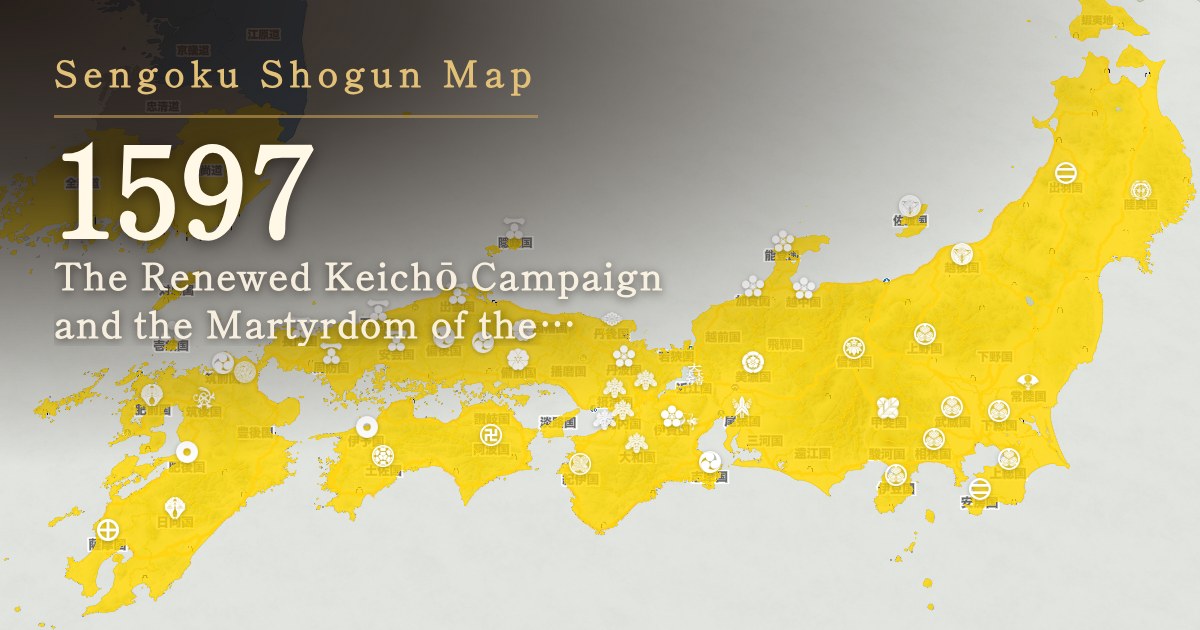
1597 was Keichō 2 (hinoto-tori).
When peace negotiations collapsed, Hideyoshi ordered a second invasion of Korea, the Keichō Campaign. The Japanese navy annihilated the Korean fleet at the Battle of Chilcheollyang and pressed the offensive on land, capturing Namwon Fortress. At home, the 26 missionaries and believers arrested the previous year were executed at Nagasaki, marking a new stage in the persecution of Japan's Christians.
1597 territory map: major daimyo and their provinces
Each province is counted under its main power. The map shows the finer division by district.
- 山城国 (Toyotomi Hideyoshi), 大和国 (Toyotomi Hideyoshi, Mashita Nagamori and others), 河内国 (Toyotomi Hideyoshi), 和泉国 (Toyotomi Hideyoshi), 摂津国 (Toyotomi Hideyoshi and others), 伊賀国 (Tsutsui Sadatsugu), 伊勢国 (Gamō Hideyuki), 志摩国 (Kuki Yoshitaka), 尾張国 (Fukushima Masanori), 三河国 (Tanaka Yoshimasa, Ikeda Terumasa and others), 遠江国 (Horio Yoshiharu), 駿河国 (Nakamura Kazuuji), 甲斐国 (Asano Nagamasa, Asano Yoshinaga), 伊豆国 (Tokugawa Ieyasu), 相模国 (Tokugawa Ieyasu), 武蔵国 (Tokugawa Ieyasu), 安房国 (Satomi Yoshiyasu), 上総国 (Tokugawa Ieyasu, Honda Tadakatsu and others), 下総国 (Tokugawa Ieyasu), 常陸国 (Satake Yoshinobu), 近江国 (Ishida Mitsunari and others), 美濃国 (Oda Hidenobu and others), 飛驒国 (Kanamori Nagachika), 信濃国 (Ishikawa Kazumasa and others), 上野国 (Tokugawa Ieyasu and others), 下野国 (Utsunomiya Kunitsuna and others), 陸奥国 (Date Masamune and others), 出羽国 (Mogami Yoshiaki and others), 若狭国 (Kinoshita Katsutoshi and others), 越前国 (Hori Hideharu and others), 加賀国 (Maeda Toshiie), 能登国 (Maeda Toshimasa), 越中国 (Maeda Toshinaga), 越後国 (Uesugi Kagekatsu), 佐渡国 (Uesugi Kagekatsu), 丹波国 (Maeda Gen'i), 丹後国 (Hosokawa Tadaoki), 但馬国 (Koide Yoshimasa and others), 因幡国 (Mori Tadamasa), 伯耆国 (Nanjō Mototada, Kikkawa Hiroie), 出雲国 (Kikkawa Hiroie), 石見国 (Mōri Terumoto), 隠岐国 (Mōri Terumoto), 播磨国 (Kinoshita Iesada and others), 美作国 (Ukita Hideie), 備前国 (Ukita Hideie), 備中国 (Mōri Terumoto, Ukita Hideie), 備後国 (Kobayakawa Takakage), 安芸国 (Mōri Terumoto), 周防国 (Mōri Terumoto), 長門国 (Mōri Terumoto), 紀伊国 (Kuwayama Kazuharu and others), 淡路国 (Wakisaka Yasuharu), 阿波国 (Hachisuka Iemasa), 讃岐国 (Ikoma Chikamasa(讃岐一国)), 伊予国 (Katō Yoshiaki, Tōdō Takatora and others), 土佐国 (Chōsokabe Motochika), 筑前国 (Kobayakawa Hideaki), 筑後国 (Tachibana Muneshige, 毛利秀包, 筑紫広門 and others), 豊前国 (Kuroda Yoshitaka, 毛利勝信), 豊後国 (Hayakawa Nagamasa and others), 肥前国 (龍造寺高房, Nabeshima Naoshige), 肥後国 (Katō Kiyomasa and others), 日向国 (Shimazu Yoshihiro, Itō Suketake, Takahashi Mototane, Akizuki Tanenaga, 島津豊久 and others), 大隅国 (Shimazu Yoshihiro and others), 薩摩国 (Shimazu Yoshihisa), 壱岐国 (Matsura Shigenobu), 対馬国 (Sō clan), 蝦夷地 (Kakizaki Yoshihiro)
Toyotomi clan69 provinces
Events this year
2/5
Twenty-six missionaries and believers arrested in Kyoto, Osaka, and nearby areas were executed at Nishizaka in Nagasaki.
5/16
In preparation for the Keichō campaign, Mōri Terumoto drew up rules for the crossing to Korea and handed them to the magistrates at Akamagaseki and Hakata.
Sources 広島県史年表(中世2)
Month 6
Kobayakawa Takakage, third son of Mōri Motonari and one of the "Ryōkawa," died at Mihara Castle. It was the year before Hideyoshi's death.
Sources コトバンク「小早川隆景」/文化庁「三原城跡」
Winter
At the unfinished Ulsan Fortress, Katō Kiyomasa, Asano Yoshinaga and others were besieged by the combined Ming and Korean army. They endured hunger and cold, and the arrival of reinforcements drove off the allied army.
Sources コトバンク「蔚山城の戦い」
Toyotomi Hideyoshi ordered a renewed invasion of Korea. Japanese daimyō forces crossed over, but peace negotiations stalled. After Hideyoshi's death, the armies withdrew from the Korean peninsula.
The Toyotomi government ordered a renewed invasion of Korea, and daimyō armies again crossed from the domestic base at Nagoya in Hizen.
See this event in detail →Ikoma Chikamasa and his son Kazumasa began building a castle on Kameyama and named it Marugame Castle. Kazumasa later became lord of Sanuki.
Sources 丸亀城の歴史年表 - 丸亀市
Kuki Yoshitaka, who had led the Shima navy, retired, and his son Moritaka inherited the 30,000-koku domain. Yoshitaka's base had been Toba.
Sources 県史Q&A「九鬼家と家臣生熊氏の資料」 - 三重県
The redeployed Japanese navy defeated Won Gyun's Korean fleet at Chilcheollyang, and the land forces also took Hwangseoksan Fortress and Namwon Fortress and entered Jeolla Province.
Sources 国史編纂委員会 우리역사넷「정유재란」/コトバンク「文禄・慶長の役」
The reinstated Yi Sun-sin met the Japanese fleet in the Myeongnyang Strait with only a few warships. The Korean side regards it as Yi Sun-sin's victory and a turning point of the war.
Sources 韓国学中央研究院「명량대첩」/国史編纂委員会 우리역사넷
Placed in the care of Maeda Toshiie and serving as one of his retainers, Hōjō Ujikuni is said to have died at Kanazawa in Keichō 2.
Sources https://kotobank.jp/word/%E5%8C%97%E6%9D%A1%E6%B0%8F%E9%82%A6/https://www.pref.gunma.jp/uploaded/attachment/714767.pdf
Chōsokabe Motochika and Morichika drew up and promulgated the Chōsokabe Motochika Hyakkajō, a code of law applying to retainers, peasants, townspeople and even monks of the domain.
Ukita Hideie crossed to Korea in the Keichō campaign as well, following the Bunroku campaign. A reference work records that he went with Mōri Hidemoto as a supervising commander.
Sources コトバンク「宇喜多秀家」