1593 territory map and events: Ming Intervention and the Japanese Retreat
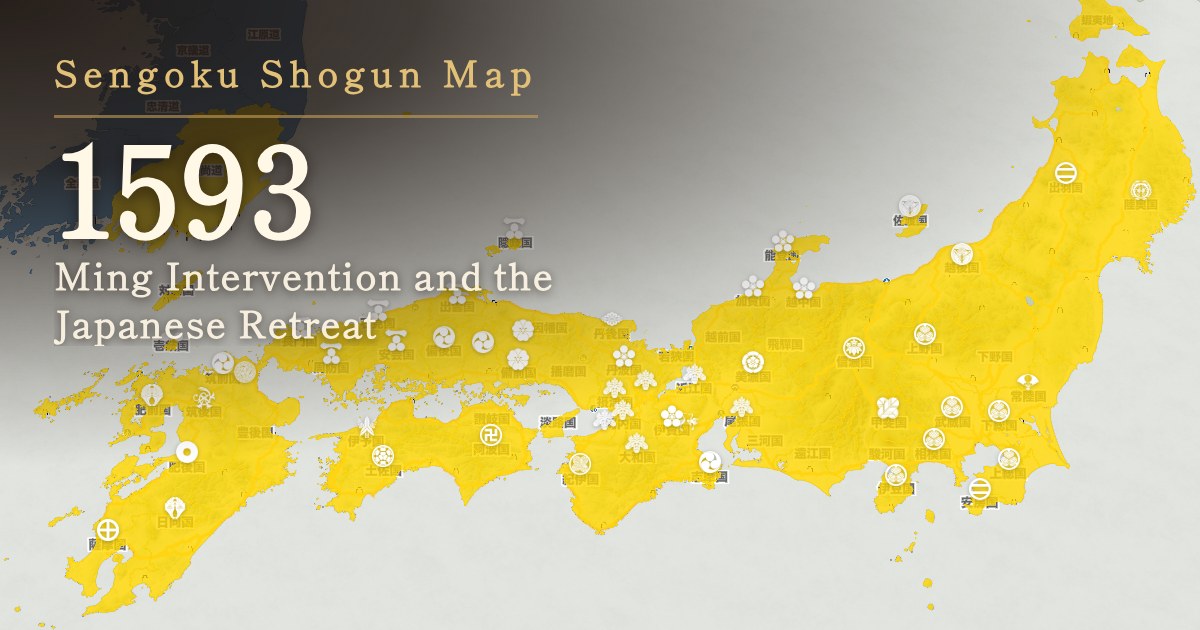
1593 was Bunroku 2 (mizunoto-mi).
After Ming reinforcements recaptured Pyongyang, the Japanese repelled the advancing Ming army at the Battle of Byeokjegwan, but their subsequent assault on Haengju Fortress failed. With the front stalemated, Japanese forces abandoned Hanseong and withdrew to the southern coast as peace talks began. At home, Hideyoshi's long-awaited biological son Hideyori was born, sowing the seeds of a new succession dispute.
1593 territory map: major daimyo and their provinces
Each province is counted under its main power. The map shows the finer division by district.
- 山城国 (Toyotomi Hideyoshi), 大和国 (Toyotomi Hideyasu), 河内国 (Toyotomi Hideyasu), 和泉国 (Toyotomi Hideyasu), 摂津国 (Toyotomi Hideyoshi and others), 伊賀国 (Tsutsui Sadatsugu), 伊勢国 (Lords of Ise), 志摩国 (Kuki Yoshitaka), 尾張国 (Toyotomi Hidetsugu), 三河国 (Tanaka Yoshimasa, Ikeda Terumasa and others), 遠江国 (Horio Yoshiharu), 駿河国 (Nakamura Kazuuji), 甲斐国 (Asano Nagamasa, Asano Yoshinaga), 伊豆国 (Tokugawa Ieyasu), 相模国 (Tokugawa Ieyasu), 武蔵国 (Tokugawa Ieyasu), 安房国 (Satomi Yoshiyasu), 上総国 (Tokugawa Ieyasu, Honda Tadakatsu and others), 下総国 (Tokugawa Ieyasu), 常陸国 (Satake Yoshinobu), 近江国 (Ishida Mitsunari and others), 美濃国 (Oda Hidenobu and others), 飛驒国 (Kanamori Nagachika), 信濃国 (Ishikawa Kazumasa and others), 上野国 (Tokugawa Ieyasu and others), 下野国 (Utsunomiya Kunitsuna and others), 陸奥国 (Date Masamune and others), 出羽国 (Mogami Yoshiaki and others), 若狭国 (Kinoshita Katsutoshi and others), 越前国 (Hori Hideharu and others), 加賀国 (Maeda Toshiie), 能登国 (Maeda Toshimasa), 越中国 (Maeda Toshinaga), 越後国 (Uesugi Kagekatsu), 佐渡国 (Uesugi Kagekatsu), 丹波国 (Maeda Gen'i), 丹後国 (Hosokawa Tadaoki), 但馬国 (前野長康), 因幡国 (Mori Tadamasa), 伯耆国 (Nanjō Mototada, Kikkawa Hiroie), 出雲国 (Kikkawa Hiroie), 石見国 (Mōri Terumoto), 隠岐国 (Mōri Terumoto), 播磨国 (Kinoshita Iesada and others), 美作国 (Ukita Hideie), 備前国 (Ukita Hideie), 備中国 (Mōri Terumoto, Ukita Hideie), 備後国 (Kobayakawa Takakage), 安芸国 (Mōri Terumoto), 周防国 (Mōri Terumoto), 長門国 (Mōri Terumoto), 紀伊国 (Toyotomi Hideyasu), 淡路国 (Wakisaka Yasuharu), 阿波国 (Hachisuka Iemasa), 讃岐国 (Ikoma Chikamasa(讃岐一国)), 伊予国 (Fukushima Masanori and others), 土佐国 (Chōsokabe Motochika), 筑前国 (Kobayakawa Takakage), 筑後国 (Tachibana Muneshige, 毛利秀包, 筑紫広門 and others), 豊前国 (Kuroda Yoshitaka, 毛利勝信), 豊後国 (Hayakawa Nagamasa and others), 肥前国 (龍造寺高房, Nabeshima Naoshige), 肥後国 (Katō Kiyomasa and others), 日向国 (Shimazu Yoshihiro, Itō Suketake, Takahashi Mototane, Akizuki Tanenaga, 島津豊久 and others), 大隅国 (Shimazu Yoshihiro and others), 薩摩国 (Shimazu Yoshihisa), 壱岐国 (Matsura Shigenobu), 対馬国 (Sō clan), 蝦夷地 (Kakizaki Yoshihiro)
Toyotomi clan69 provinces
Events this year
Month 4
Date Masamune led 3,000 troops as reinforcements in the Bunroku campaign and landed at Busan in Korea. He returned home in the ninth month of the same year.
Facing a Ming counteroffensive and shortages of provisions, Japanese forces abandoned Hanseong and withdrew to southern Korea. They thereafter held coastal fortresses while negotiations proceeded with Ming and Joseon representatives.
See this event in detail →Sources 国立公文書館「年表―歴史と物語」/九州国立博物館「メールマガジン341号」
5/22
While based at Nagoya, Toyotomi Hideyoshi wrote to Kita-no-Mandokoro reporting that Ming envoys had presented peace terms.
Month 6
At Nagoya, Hideyoshi presented the Ming envoys with seven peace terms. Konishi Yukinaga and Shen Weijing are said to have conveyed accounts differing from the facts to each side.
Sources コトバンク「文禄・慶長の役」
Month 8
After Hideyori's birth, Toyotomi Hideyoshi moved to his Shigetsu residence in Fushimi and developed it into a full castle and new center of government.
Toyotomi Hideyoshi's son Hiroi, later known as Hideyori, was born at Osaka Castle, changing the political situation surrounding the Toyotomi succession.
Leap month 9
After returning from Nagoya, Yoshinobu widened the moats of Mito Castle, built earthen ramparts, and personally directed the allotment of retainers' residences.
Sources 水戸市史 上巻 第十一章 第三節
Asano Nagayoshi was transferred to Kai, and the whole of Wakasa was granted to Kinoshita Katsutoshi and Toshifusa, nephews of Kōdai-in. Katsutoshi entered Obama and Toshifusa Takahama.
Sources 史跡後瀬山城跡整備基本計画 - 小浜市教育委員会
The Nishimikawa gold sand mine on Sado was redeveloped. Control of the mines by rising powers lay behind the repeated warfare on the island.
Sources 佐渡金銀山遺跡 世界遺産関係資料「第Ⅱ章」 - 佐渡市
The Ming army retook Pyongyang and advanced south, but at Byeokjegwan the Japanese forces under Kobayakawa Takakage and others counterattacked, and the Ming army fell back to Pyongyang.
Sources コトバンク「碧蹄館の戦い」「文禄の役」/国史編纂委員会 우리역사넷
The Japanese army attacked Jinju Fortress again. Volunteer militia and government troops under Kim Cheon-il and others fought for about ten days, but the fortress fell. Many of the soldiers, officials and civilians inside were killed.
Sources 韓国学中央研究院「진주전투」/国史編纂委員会 우리역사넷
Ōtomo Yoshimune, who had withdrawn from the battlefield early in the Bunroku campaign, had his domain taken away by Toyotomi Hideyoshi. The Ōtomo clan's rule of Bungo, which had lasted about 400 years, came to an end.
Sources 大分市フォーラム冊子ほか