INTERACTIVE MARCH
The Bunroku Campaign
April 1592 – July 1593 · Korean Peninsula
On Hideyoshi's orders 160,000 Japanese troops crossed to Busan, took Hanseong in twenty days and Pyongyang in two months. Yi Sun-sin's navy then cut the sea route, and righteous armies and Ming reinforcements pushed them back. In 1593 they withdrew from Hanseong to coastal forts in the south and opened talks.
Background
After pacifying Kyushu, Hideyoshi entrusted Sō Yoshitoshi of Tsushima to negotiate with Korea and built Nagoya Castle in Hizen to concentrate daimyo from across the realm. When negotiations broke down, he ordered an invasion with the aim of ultimately reaching Ming China through the Korean peninsula.
Outcome
The Japanese forces advanced to Hanseong and Pyongyang but saw their supply lines cut by Yi Sun-sin's navy and were forced back by righteous armies and Ming reinforcements. In 1593, the Japanese withdrew from Hanseong and established themselves in coastal fortifications in the south, opening peace negotiations.
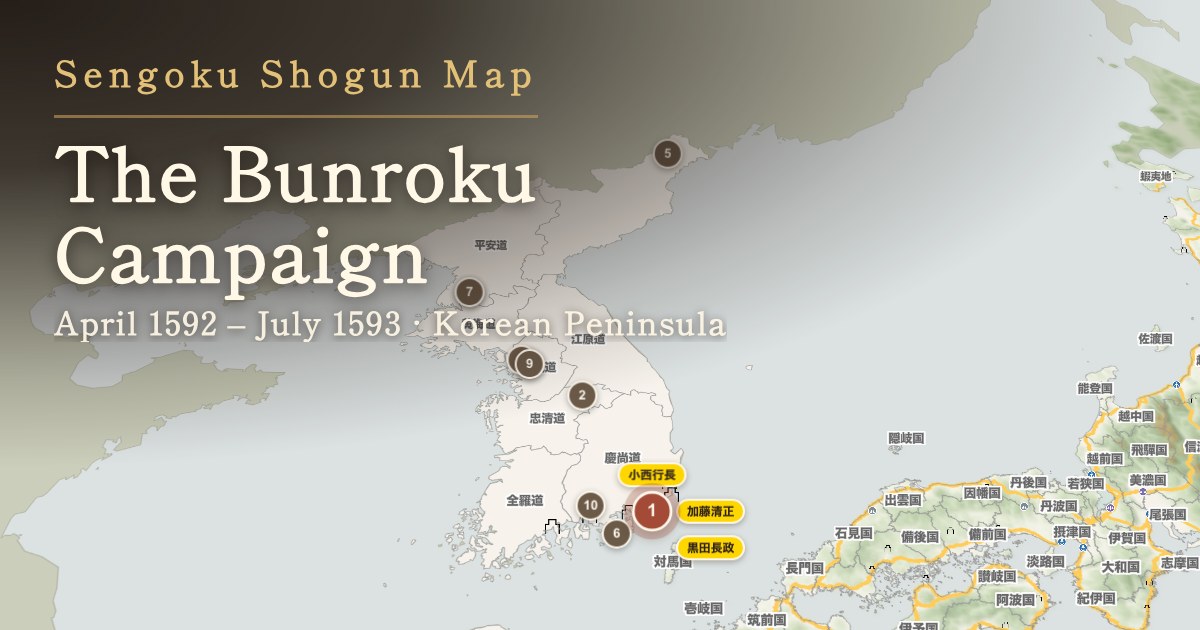
Course of the battle
1 13 April 1592
Landing at Busan
Konishi Yukinaga's first division took Busanjin and then Dongnae. The divisions of Kato Kiyomasa and Kuroda Nagamasa followed, opening the crossing of 160,000 men.
Leads the first division and takes Busanjin fortress
Crosses over behind the first division
Crosses over behind the first division
Directs the expedition from Nagoya in Hizen
Sources5·Certainty: Medium
2 28 April 1592
Battle of Chungju
The Korean general Shin Rip charged with cavalry but was broken by Konishi's arquebuses, opening the road to Hanseong.
Charges with cavalry and is defeated
Breaks the Joseon army with firearms
Sources5·Certainty: Medium
3 3 May 1592
Entry into Hanseong
The capital fell twenty days after the landing. King Seonjo had already fled north, and the Japanese entered an empty city.
Enters the abandoned capital of Hanseong
Sources5·Certainty: Medium
4 15 June 1592
Taking Pyongyang
Konishi Yukinaga entered Pyongyang. This was the northernmost point the Japanese reached; they advanced no further.
Enters Pyongyang
Sources5·Certainty: Medium
5 July 1592
Kato Kiyomasa into Hamgyong
Kiyomasa pushed north through Hamgyong and captured two Korean princes at Hoeryong. He even crossed the Tumen into Jurchen territory.
Captures the two Joseon princes at Hoeryong
Sources5·Certainty: Medium
6 8 July 1592
Battle of Hansando
Yi Sun-sin enveloped the Japanese fleet in a crane-wing formation and won decisively. Cutting the sea supply route was the main reason the land advance stalled.
Destroys the Japanese fleet with the crane-wing formation
Sources5·Certainty: Medium
7 8 January 1593
Loss of Pyongyang
Li Rusong of Ming attacked Pyongyang with over 40,000 men; Konishi abandoned the city and fell back south. The tide of the war turned.
Attacks Pyongyang with over forty thousand men
Abandons Pyongyang and withdraws south
Sources5·Certainty: Medium
8 26 January 1593
Battle of Byeokjegwan
9 April 1593
Withdrawal from Hanseong
Out of provisions, the Japanese abandoned Hanseong and pulled back to the southern coast. From here on they garrisoned the coastal forts of Gyeongsang.
Withdraws from Hanseong as commander in Joseon
Sources5·Certainty: Medium
10 29 June 1593
Second Siege of Jinju
The Japanese besieged Jinju, which had held out the year before, with over 90,000 men and took it in nine days. It was the last major battle of the Bunroku campaign.
Besieges Jinju fortress
Sources5·Certainty: Medium
Historical significance
This international conflict involving Korea and Ming placed enormous logistical and manpower burdens on the Toyotomi regime, drawing on daimyo from throughout Kyushu. The inconclusive peace talks led Hideyoshi to order a second invasion in 1597, launching the Keichō campaign.
Advertisement
Key figures
豊臣氏
7

General-in-Chief
Commanded from Nagoya Castle in Hizen without crossing the sea
Sources1234·Certainty: Medium

Commander of the campaign in Korea
Entered Hanseong and commanded all forces
Sources1234·Certainty: Medium


Second division
Advanced northward through Hamgyong province and captured the two princes
Sources1234·Certainty: Medium


Sixth division
Advanced toward Jeolla province and later defeated Ming forces at Byeokjeqwan
Sources1234·Certainty: Medium

朝鮮軍
3
Admiral of Left Jeolla
Defeated the Japanese fleet at Hansan Island and cut off the sea route
Sources1234·Certainty: Medium
Inspector of Jeolla province
Defeated Japanese forces at Hejusan Castle
Sources1234·Certainty: Medium
Chief inspector of three provinces
Died in battle commanding cavalry at Dangeumtae in Chungju
Sources1234·Certainty: Medium
明軍
1
Admiral
Led over 40,000 troops and retook Pyongyang
Sources1234·Certainty: Medium
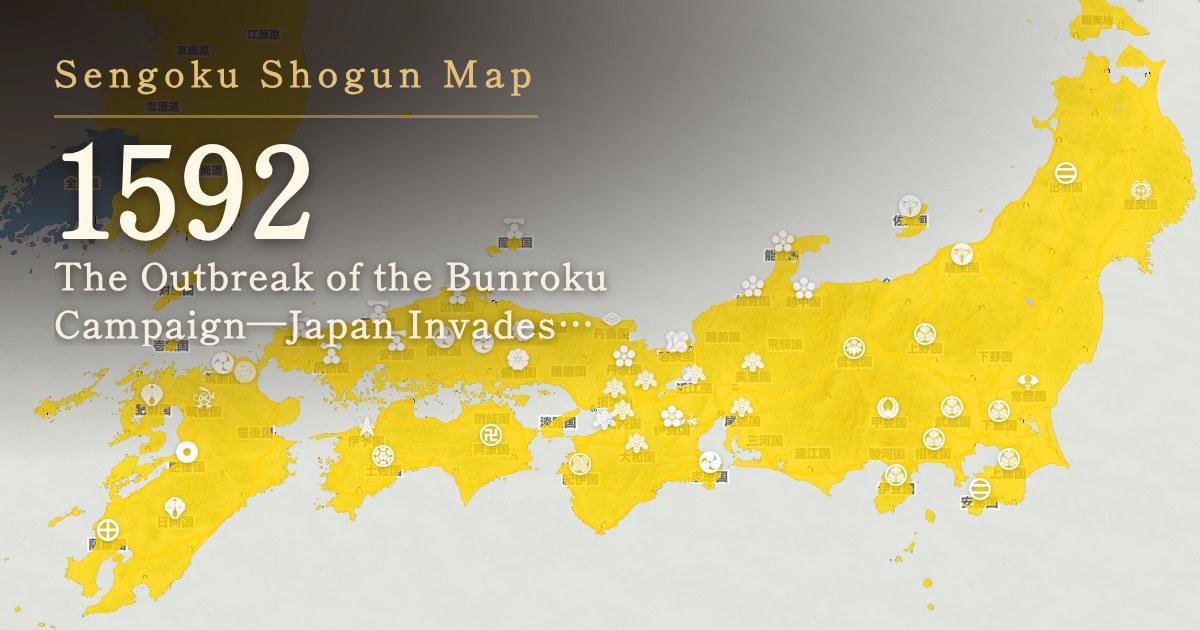
Other events of 1592
Notes on the data
Scene coordinates are given at city or county level, not to the street. The peninsula is drawn from the eight Joseon provinces derived from Natural Earth.
Sources consulted
- 国立公文書館「年表―歴史と物語」
- 九州国立博物館メールマガジン341号
- 長崎県文化財データベース「文禄の役松浦家供養塔」
- 熊本市「加藤清正の実像(13)朝鮮出兵」
- (公的資料での裏付けが取れていない)
The numbers in the text refer to the list above. Certainty indicates how far a statement is supported by the cited sources; it does not refer to the precision of the coordinates or the dating.
Advertisement