1590 territory map and events: On the Eve of Unification
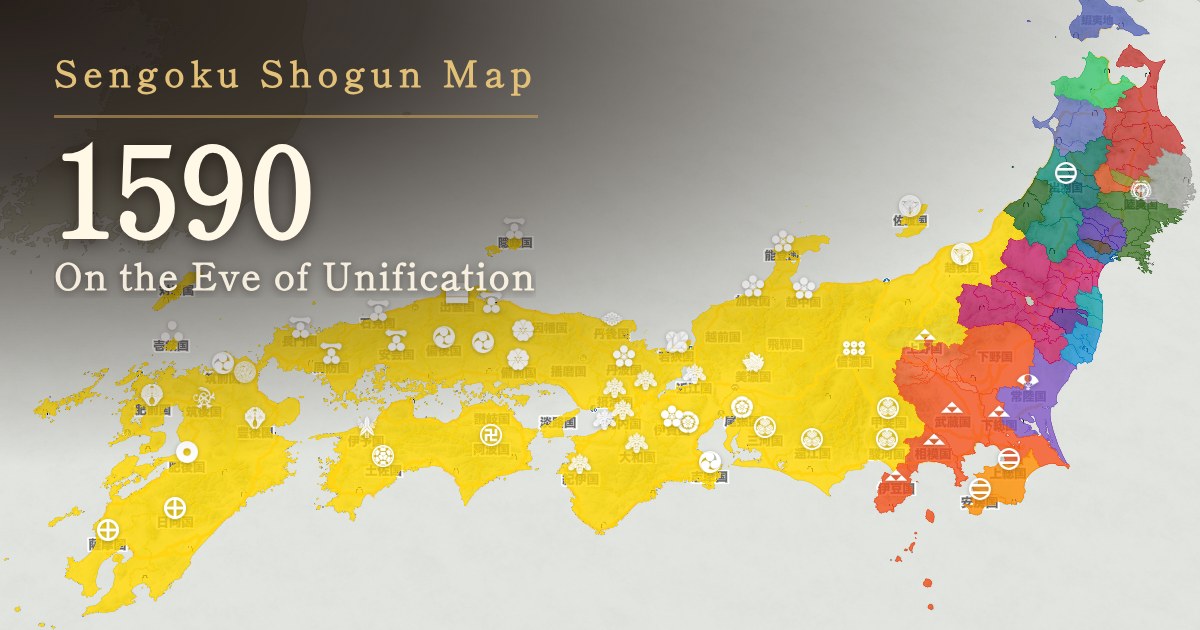
1590 was Tenshō 18 (kanoe-tora).
The western provinces, Kinai, and central Japan were already under Toyotomi control, and all major lords nationwide were in a state of submission. The Odawara Campaign destroyed the Hojo in Kanto, and the Pacification of Oshu brought the Tohoku lords into submission, eliminating remaining independent forces. The last obstacles to national unification were removed.
1590 territory map: major daimyo and their provinces
Each province is counted under its main power. The map shows the finer division by district.
- 山城国 (Toyotomi Hideyoshi), 大和国 (Toyotomi Hidenaga), 河内国 (Toyotomi Hidenaga), 和泉国 (Toyotomi Hidenaga), 摂津国 (Toyotomi Hideyoshi and others), 伊賀国 (Tsutsui Sadatsugu), 伊勢国 (Oda Nobukatsu, Gamō Ujisato and others), 志摩国 (Kuki Yoshitaka), 尾張国 (Oda Nobukatsu), 三河国 (Tokugawa Ieyasu), 遠江国 (Tokugawa Ieyasu), 駿河国 (Tokugawa Ieyasu), 甲斐国 (Tokugawa Ieyasu), 近江国 (Toyotomi Hidetsugu and others), 美濃国 (Ikeda Terumasa), 飛驒国 (Kanamori Nagachika), 信濃国 (Sanada Masayuki and others), 若狭国 (Asano Nagamasa(若狭一国)), 越前国 (Hori Hideharu and others), 加賀国 (Maeda Toshiie), 能登国 (Maeda Toshiie), 越中国 (Maeda Toshinaga), 越後国 (Uesugi Kagekatsu), 佐渡国 (Uesugi Kagekatsu), 丹波国 (Maeda Gen'i), 丹後国 (Hosokawa Tadaoki), 但馬国 (前野長康), 因幡国 (Miyabe Keijun), 伯耆国 (Mōri Terumoto, Nanjo Mototsugu), 出雲国 (Mōri Terumoto), 石見国 (Mōri Terumoto), 隠岐国 (Mōri Terumoto), 播磨国 (Kinoshita Iesada and others), 美作国 (Ukita Hideie), 備前国 (Ukita Hideie), 備中国 (Mōri Terumoto, Ukita Hideie), 備後国 (Kobayakawa Takakage), 安芸国 (Mōri Terumoto), 周防国 (Mōri Terumoto), 長門国 (Mōri Terumoto), 紀伊国 (Toyotomi Hidenaga), 淡路国 (Wakisaka Yasuharu), 阿波国 (Hachisuka Iemasa), 讃岐国 (Ikoma Chikamasa(讃岐一国)), 伊予国 (Fukushima Masanori and others), 土佐国 (Chōsokabe Motochika), 筑前国 (Kobayakawa Takakage), 筑後国 (Tachibana Muneshige, 毛利秀包, 筑紫広門 and others), 豊前国 (Kuroda Yoshitaka, 毛利勝信), 豊後国 (Ōtomo Yoshimune), 肥前国 (龍造寺高房, Nabeshima Naoshige), 肥後国 (Katō Kiyomasa and others), 日向国 (Shimazu Yoshihiro, Itō Suketake, Takahashi Mototane, Akizuki Tanenaga, 島津豊久 and others), 大隅国 (Shimazu Yoshihiro and others), 薩摩国 (Shimazu Yoshihisa), 壱岐国 (Matsura Shigenobu), 対馬国 (Sō clan)
Toyotomi clan57 provinces
- 伊豆国 (Hōjō Ujinao), 相模国 (Hōjō Ujinao), 武蔵国 (Hōjō Ujinao), 下総国 (Hōjō Ujinao, Chiba Shigetane and others), 上野国 (Hōjō Ujinao and others), 下野国 (Minagawa Hiroteru)
Later Hōjō clan6 provinces
- 安房国 (Satomi Yoshiyasu), 上総国 (Satomi Yoshiyasu)
Satomi clan2 provinces
- 蝦夷地 (Kakizaki Yoshihiro)
Andō clan1 province
Provinces divided among several powers3 provinces
常陸国 (Satake Yoshinobu and others), 陸奥国 (Date Masamune and others), 出羽国 (Mogami Yoshiaki and others)
Events this year
1/14
Asahihime, Ieyasu's principal wife and Hideyoshi's half-sister by a different father, died in Kyoto. It was shortly before the campaign against Odawara, and the date is in the lunar calendar.
Sources コトバンク「朝日の方」
3/29
The Toyotomi army attacked Yamanaka Castle, a Later Hōjō stronghold guarding the route to Odawara, and captured it within half a day.
See this battle in detail →Sources 三島市「山中城跡(国指定文化財「史跡」)」/三島市「戦国・安土桃山時代」/静岡県「しずおか文化財ナビ 山中城跡」
Month 4
Hōjō Ujikatsu, who had retreated from Yamanaka Castle to Tamanawa Castle, surrendered following Ieyasu's advice. He later received 10,000 koku at Iwatomi in Shimōsa.
Sources https://kotobank.jp/word/%E5%8C%97%E6%9D%A1%E6%B0%8F%E5%8B%9D-1107520
During the Odawara campaign, the 北国勢 of the Toyotomi side attacked Matsuida Castle and, after a prolonged siege, forced its surrender. Sanada Masayuki and Sanada Nobuyuki also joined this campaign and distinguished themselves.
Sources コトバンク「松井田城」(日本の城がわかる事典)/群馬県「真田信之・真田信繁」
4/3
Toyotomi Hideyoshi arrived at Odawara and his assembled armies began the siege of the Later Hōjō stronghold.
See this battle in detail →Sources 小田原市「小田原合戦」/小田原市「石垣山一夜城」/小田原市「史跡・石垣山」
5/27
Satake Yoshinobu entered Odawara with Utsunomiya Kunitsuna and others, and had his first audience with Toyotomi Hideyoshi on the 27th day of the fifth lunar month. He presented swords, horses, gold and other gifts.
Sources 水戸市史 上巻 第十一章 第一節
6/14
After being besieged for about a month by Maeda Toshiie and Uesugi Kagekatsu under the Toyotomi, Hachigata Castle surrendered. The loss of this stronghold ended Hōjō Ujikuni's control over northern Kantō.
Sources 寄居町「鉢形城跡」
6/23
Toyotomi's northern army under commanders including Maeda Toshiie and Uesugi Kagekatsu attacked Hachiōji Castle and captured it in one day.
6/24
On the twenty-fourth day of the sixth month of Tenshō 18 (1590, lunar calendar), Hōjō Ujinori, the castellan of Nirayama Castle, surrendered the castle on the advice of Tokugawa Ieyasu, after it had been surrounded by Toyotomi forces for about three months.
Month 7
After Odawara Castle surrendered, Numata Castle was given to Sanada Nobuyuki, Masayuki's eldest son, and its domain was set at 27,000 koku.
Sources https://www.city.numata.gunma.jp/kanko/1004186/1004286/sanada/1001161.html
At the surrender of Odawara Castle, Matsuda Norihide, a senior Hōjō retainer, is said to have taken his own life on Toyotomi Hideyoshi's order.
Sources https://kotobank.jp/word/%E6%9D%BE%E7%94%B0%E6%86%B2%E7%A7%80-1111008
After hearing of the death of Iwaki Tsunetaka, Hideyoshi had Yoshishige's third son, Nōkemaru (later Iwaki Sadataka), succeed to the Iwaki clan.
Sources 水戸市史 上巻 第十一章 第一節
After the Odawara campaign was settled, Toyotomi Hideyoshi ordered Tokugawa Ieyasu to transfer to the Kantō, including the former Hōjō lands, in place of Mikawa, Tōtōmi, Suruga, Kai and Shinano.
Sources 国立公文書館「徳川家康 関係年表」/静岡市歴史博物館「徳川家康と豊臣政権」
Autumn
In connection with relocation to Kantō, Tadakatsu was given command of Ōtaki in Kazusa Province with 100,000 koku and became its lord, remaining in residence for approximately eleven years until 1601.
Sources 千葉県立中央博物館「当館について」(大多喜城分館)
7/5
Hōjö Ujinao, who had held out in Odawara Castle, surrendered to Toyotomi Hideyoshi, ending the Odawara campaign.
7/11
On the eleventh day of the seventh month of Tenshō 18 (1590, lunar calendar), Hōjō Ujimasa and his younger brother Ujiteru, held responsible for the Odawara campaign, committed seppuku at Odawara. Ujinao was exiled to Mount Kōya.
8/1
After being transferred to the Kantō region, Tokugawa Ieyasu entered Edo Castle and made Edo the center of his domain.
On the 1st day of the 8th lunar month, Hideyoshi issued a red-seal letter at his camp in Utsunomiya, recognizing the Satake's actual holdings (tōchigyō) in Hitachi and Shimotsuke at 216,758 kanmon.
Sources 水戸市史 上巻 第十一章 第一節
Month 9
After Hidemasa's death, sixteen-year-old Hideharu inherited the 180,000-koku domain of Kitanoshō. He led approximately six thousand troops to Nagoya to participate in the Korean campaign as supply administrator.
Sources 佐賀県立名護屋城博物館「堀秀治」
Month 10
Uesugi Kagekatsu conducted a land survey in Shōnai and suppressed an uprising that opposed it. The three districts of Shōnai became Kagekatsu's domain.
Sources 鶴岡市「庄内歴史ハンドブック」(座標は鶴ヶ岡城)
Month 11
Former retainers in the confiscated Kasai and Osaki territories rose against the newly installed Kimura house before being defeated at Sanuma Castle.
See this battle in detail →Sources 仙台市博物館「伊達政宗に関する資料(2)」/登米市「首壇」/文化遺産オンライン「伊達政宗書状」
Month 12
The Satake attacked Mito Castle, and Edo Shigemichi lost the castle and his domain and fled to Yūki Harutomo. Yoshinobu was then in Kyoto.
Sources 水戸市史 上巻 第十一章 第一節
Following Mito Castle, the Satake attacked Fuchū Castle and took it within a few days. Tradition holds that the lord, Daijō Kiyomoto, took his own life and the Daijō house came to an end.
Sources 水戸市史 上巻 第十一章 第一節
12/23
On the 23rd day of the 12th lunar month, on Hideyoshi's recommendation, Satake Yoshinobu was appointed Junior Fourth Rank, Lower Grade, and chamberlain (jijū), and was granted the surname Hashiba.
Sources 水戸市史 上巻 第十一章 第一節
Toyotomi Hideyoshi entered Aizu and settled the territories of the northern daimyō. Date Masamune lost Aizu, which was granted to Gamō Ujisato.
The 総構, an outer defense line about nine kilometers long built in the great construction work that began in 1587, is said to have been completed just before the Odawara campaign. It brought the entire castle town, where retainers, townspeople, merchants, and temples and shrines lived, within the defensive zone.
Sources 小田原市文化財保存活用地域計画
In connection with Toyotomi Hideyoshi's settlement of Kantō and Ōu, Ishikawa Kazumasa entered Matsumoto and undertook renovation of the castle fortifications and development of the castle town. There are theories that his domain was valued at either 80,000 or 100,000 koku.
Sources 松本城管理事務所「松本城の歴史」
At Hideyoshi's insistence, Date Masamune participated in the Odawara campaign and submitted to Hideyoshi's authority. During the Ōshū Settlement, his Aizu domain was confiscated.
Sources 仙台市博物館「主な収蔵品11 伊達政宗に関する資料(2)」
On Hideyoshi's advice, Ukita Hideie began remodeling Okayama Castle into an early modern castle, diverting the Asahi River to serve as an outer moat and building high stone walls.
Sources 天下統一と近世城郭の誕生(おかやまの中世争乱史)
As Toyotomi Hideyoshi took the Hōjō's Odawara Castle and completed the unification of the realm, Oyama Hidetsuna, who had sided with the Hōjō, had his lands confiscated.
Sources 小山市の年表(付録) - 小山市
With the fall of the Hōjō, Tentokuji Hōen (Sano Fusatsuna) returned to Karasawayama Castle and adopted Tomita Nobutane, who had close ties to Hideyoshi.
Sources 戦国・近世初頭における佐野氏と唐沢山城 - 佐野市
After Tokugawa Ieyasu was transferred to the Kantō, Nakamura Kazuuji entered Sunpu, Horio Yoshiharu Hamamatsu, Ikeda Terumasa Yoshida and Yamauchi Kazutoyo Kakegawa. Oda Nobukatsu refused the transfer and lost his territory.
Sources 国立公文書館「秀吉への臣従」/静岡市/浜松市/愛知県/掛川市
Gamō Ujisato, who had been at Matsusaka in Ise, was transferred to Aizu, where Date Masamune had been, with 420,000 koku. He later became a daimyo of 920,000 koku.
Sources 松阪市「松阪の礎を築いた戦国武将『蒲生氏郷』」
After Hideyoshi allotted Hizen's stipends in the first month of the same year, Ryūzōji Masaie retired and moved to Kubota, and his son Takafusa succeeded to the headship. Nabeshima Naoshige handled the government of the domain.
Mogami Yoshiaki served in the Odawara campaign, submitted to Toyotomi Hideyoshi, and had his home domains of Mogami and Murayama districts confirmed.
With Ieyasu's entry into the Kantō, Ii Naomasa was given 120,000 koku at Minowa in Kōzuke Province. It was the largest stipend among the retainers, and the castle was later moved to Takasaki.
Sources 高崎市「箕輪城跡」/館林市「榊原康政公ゆかり館林まちあるきマップ」
With Ieyasu's entry into the Kantō, Sakakibara Yasumasa became lord of Tatebayashi in Kōzuke Province with 100,000 koku. From 1593 he later began construction of a sōgamae enclosing the town below the castle.
Sources 館林市「榊原康政公ゆかり館林まちあるきマップ」