1582 territory map and events: The Honnoji Incident and the Beginning of the Struggle for Supremacy
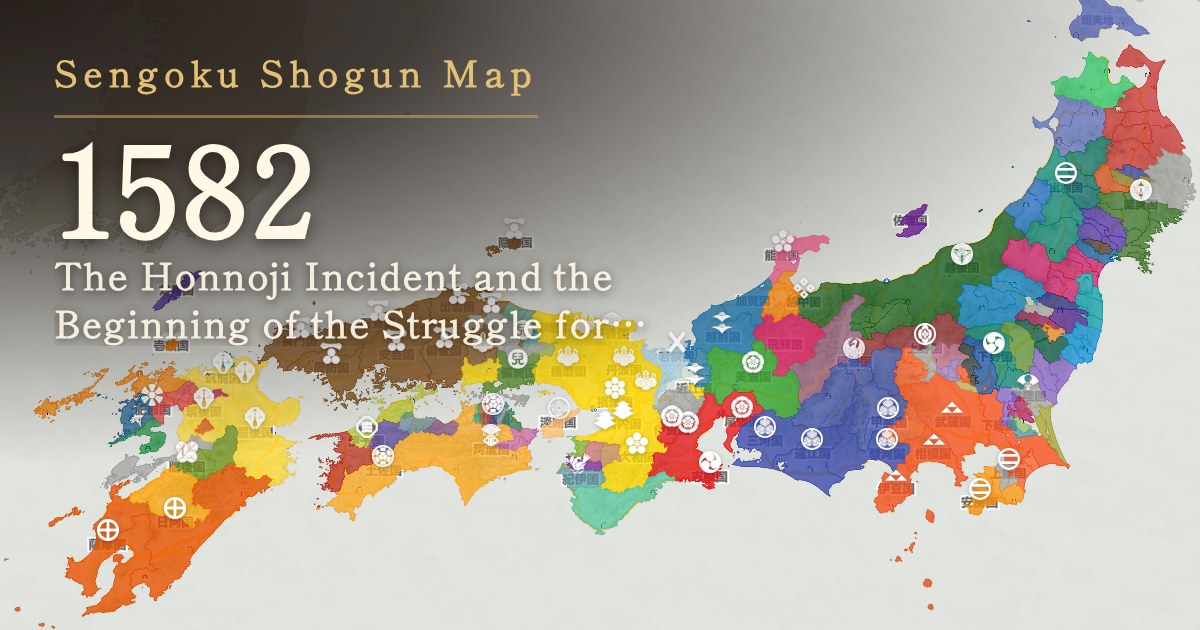
1582 was Tenshō 10 (mizunoe-uma).
Nobunaga fell in the Honnoji Incident, and Hideyoshi won the Battle of Yamazaki after his rapid “Great Return” from the Chugoku front. The Takeda clan perished in the Koshu Campaign, expanding Oda authority, but succession struggles erupted after Nobunaga’s death.
1582 territory map: major daimyo and their provinces
Each province is counted under its main power. The map shows the finer division by district.
- 山城国 (Hashiba Hideyoshi), 大和国 (Tsutsui Junkei), 河内国 (Miyoshi Yasunaga), 和泉国 (Miyoshi Yasunaga), 摂津国 (Takayama Ukon, Lords of Settsu and others), 丹波国 (Hashiba Hideyoshi and others), 丹後国 (Hosokawa Fujitaka), 但馬国 (Hashiba Hidenaga), 因幡国 (Miyabe Keijun, Kamei Korenori and others), 播磨国 (Hashiba Hideyoshi)
Hashiba clan10 provinces
- 出雲国 (Mōri Terumoto), 石見国 (Mōri Terumoto), 隠岐国 (Mōri Terumoto), 備後国 (Mōri Terumoto), 安芸国 (Mōri Terumoto), 周防国 (Mōri Terumoto), 長門国 (Mōri Terumoto)
Mōri clan7 provinces
- 伊豆国 (Hōjō Ujinao), 相模国 (Hōjō Ujinao), 武蔵国 (Hōjō Ujinao), 下総国 (Chiba Kunitane)
Later Hōjō clan4 provinces
- 伊賀国 (Oda Nobukatsu), 伊勢国 (Oda Nobukatsu), 志摩国 (Kuki Yoshitaka), 尾張国 (Oda Nobukatsu)
Oda Nobukatsu faction4 provinces
- 筑前国 (Ōtomo Yoshimune), 筑後国 (Ōtomo Yoshimune), 豊前国 (Ōtomo Yoshimune), 豊後国 (Ōtomo Yoshimune)
Ōtomo clan4 provinces
- 日向国 (Shimazu Yoshihisa), 大隅国 (Shimazu Yoshihisa), 薩摩国 (Shimazu Yoshihisa)
Shimazu clan3 provinces
- 三河国 (Tokugawa Ieyasu), 遠江国 (Tokugawa Ieyasu), 駿河国 (Tokugawa Ieyasu)
Tokugawa clan3 provinces
- 越前国 (Shibata Katsuie), 加賀国 (Sakuma Morimasa)
Shibata clan2 provinces
- 蝦夷地 (Kakizaki Suehiro)
Andō clan1 province
- 備前国 (Ukita Naoie)
Ukita clan1 province
- 越中国 (Sassa Narimasa)
Sassa clan1 province
- 飛驒国 (Miki Yoritsuna)
Miki clan (Hida)1 province
- 対馬国
Sō clan1 province
- 壱岐国 (Matsuura Takanobu)
Matsuura clan1 province
- 越後国 (Uesugi Kagekatsu)
Uesugi clan1 province
- 美濃国 (Oda Nobutaka)
Oda Nobutaka faction1 province
- 淡路国 (Sengoku Hidehisa)
Sengoku clan1 province
- 能登国 (Maeda Toshiie)
Maeda clan1 province
- 若狭国 (Niwa Nagahide)
Niwa clan1 province
- 土佐国 (Chōsokabe Motochika)
Chōsokabe clan1 province
- 佐渡国 (Honma clan)
Honma clan (Sado)1 province
- 安房国 (Satomi Yoshiyori)
Satomi clan1 province
- 肥前国 (Ryūzōji Takanobu)
Ryūzōji clan1 province
Provinces divided among several powers17 provinces
甲斐国 (Tokugawa Ieyasu and others), 上総国 (Satomi Yoshiyori, Hōjō Ujimasa and others), 常陸国 (Satake Yoshishige and others), 近江国 (Shibata Katsutoyo and others), 信濃国 (Tokugawa Ieyasu and others), 上野国 (Hōjō Ujinao and others), 下野国 (Utsunomiya Kunitsuna and others), 陸奥国 (Nanbu Nobunao and others), 出羽国 (Mogami Yoshiaki and others), 伯耆国 (Mōri Terumoto and others), 美作国 (Ukita Hideie and others), 備中国 (Hashiba Hideyoshi and others), 紀伊国 (Saika Magoichi and others), 阿波国 (Chōsokabe Motochika and others), 讃岐国 (Chōsokabe Motochika and others), 伊予国 (Kōno Michinao and others), 肥後国 (Aso clan and others)
Events this year
2/3
Kiso Yoshimasa, who was also Shingen's son-in-law, turned from the Takeda to the Oda side on the 3rd day of the 2nd month (old calendar). Taking this as an opportunity, Oda Nobunaga began a campaign to destroy the Takeda clan.
Sources 飯田市「松尾・鈴岡小笠原氏略歴」/コトバンク「木曾義昌」「甲州征伐」(座標は木曽谷の代表として木曽福島の福島城)
2/14
On the 14th day of the 2nd month (old calendar), the kokujin of 下伊那 invited the Oda vanguard in through 梨子野峠. Seeing this, the garrison of 飯田城 withdrew from the castle that night.
Sources 飯田市「飯田城の歴史」「松尾・鈴岡小笠原氏略歴」
2/25
Anayama Nobutada, a Takeda kinsman (親族衆) who governed 河内領 and 江尻 in Suruga, defected to the Oda side and, on the 3rd day of the 3rd month (old calendar), advanced into Kai together with Tokugawa Ieyasu.
Sources 甲州市「歴史的風致維持向上計画 第2章」/コトバンク「穴山信君」(座標は国土地理院の住所検索による町域代表点・南部町。日付は旧暦)
Month 3
After the fall of the Takeda, Oda Nobunaga granted Suruga Province to Tokugawa Ieyasu, making him lord of Suruga as well as Mikawa and Tōtōmi.
After the fall of Oyama Gobo, resistance continued in the Sannai district in the Hakusan foothills until Sakuma Morimasa crushed it, ending the roughly century-long Kaga Ikkō-ikki.
See this battle in detail →Sources 白山市「史跡鳥越城跡附二曲城跡」
The party of Takeda Katsuyori heading for 岩殿城 was obstructed at its entrance gate by Oyamada Nobushige, lord of 郡内. The party could not cross Sasago Pass and changed its destination to Tenmokuzan.
Sources 甲州市「歴史的風致維持向上計画 第2章」/コトバンク「天目山の戦」(座標は国土地理院の住所検索による町域代表点・大月市笹子町。日付は旧暦3月上旬)
3/3
Judging that it would be difficult to meet the Oda and Tokugawa forces at Shinpu, Takeda Katsuyori set fire to Shinpu Castle, which had only just been completed, and headed east toward 岩殿城 in 郡内.
Sources 韮崎市「新府城跡」/コトバンク「天目山の戦」(座標は城郭マスタの新府城。日付は旧暦)
3/25
Oda Nobutada's army captured Takatō Castle from Nishina Morinobu, prompting Takeda Katsuyori to abandon Shinpu Castle and retreat eastward.
3/29
At his camp in Suwa, Nobunaga announced the division of the former Takeda lands. He gave Kai to Kawajiri Hidetaka, Kōzuke to Takigawa Kazumasu, and Suruga to Tokugawa Ieyasu and others, and issued kuniokite (provincial regulations) for Kai and Shinano.
Month 4
Hashiba Hideyoshi besieged Bitchū Takamatsu Castle, defended for the Mōri by Shimizu Muneharu, and conducted a water siege.
See this battle in detail →Sources 岡山県「備中高松城跡」/岡山市「高松城跡附水攻築堤跡」/岡山市「宇喜多氏と高松城水攻め~八幡山陣跡~」
Shiwaku, Noshima and Kurushima gave hostages to Hideyoshi and surrendered their castles. The Shiwaku Islands belong to Sanuki Province.
Sources 香川県史 別編2 歴史年表(香川県立図書館)
Erin-ji, the family temple of the Takeda clan, was burned by Oda forces on the grounds that it had harbored people of the 佐々木氏, who had opposed the Oda side. The abbot Kaisen Jōki died in the fire.
Sources 甲州市「歴史的風致維持向上計画 第2章」/コトバンク「快川紹喜」(旧暦4月3日。座標は恵林寺の住所の国土地理院住所検索)
4/3
Shibata Katsuie, Maeda Toshiie, Sassa Narimasa, and other Oda commanders surrounded Uozu Castle, a key Uesugi stronghold. The siege lasted about eighty days.
See this battle in detail →Sources 魚津市「魚津城と松倉城」/魚津市「魚津城の戦い」/魚津市「魚津の歴史と文化」
After abandoning Shinpu Castle, Takeda Katsuyori took his own life at Tano, bringing the Kai Takeda clan to an end.
Month 5
The court is said to have urged Oda Nobunaga to accept a high office, and an imperial envoy is said to have gone down to Azuchi. There are no reliable records of what was proposed or how Nobunaga replied, and accounts differ.
5/15
Oda Nobunaga entertained Tokugawa Ieyasu and Anayama Nobutada (Baisetsu), who had come to the capital region to give thanks for the fall of the Takeda clan, at Azuchi for three days. Akechi Mitsuhide was ordered to manage the entertainment.
5/28
Akechi Mitsuhide, who had arrived at Kameyama in Tanba for the campaign in the Chūgoku region, visited Mount Atago and held a renga session of one hundred verses at Nishi-no-bō. The opening verse was "Toki wa ima ame ga shita shiru satsuki kana."
Month 6
Oda Nobutaka had assembled near Osaka for an expedition to Shikoku, but abandoned it after the Honnōji Incident. He then joined Hashiba Hideyoshi's army against Akechi Mitsuhide at Yamazaki.
See this battle in detail →Sources 大山崎町「秀吉の道 陶板絵図」/大山崎町「山崎合戦の地を歩くコース」/長岡京市「京都防衛の要 勝龍寺城」/長岡京市「勝竜寺城公園」/京都市「京都のいしぶみデータベース HU008 明智薮」/大津市「坂本城跡リーフレット」/岡山県「備中高松城跡」/岡山市「図書館所蔵資料で見る高松城水攻」/九州大学学術情報リポジトリ 服部英雄「ほらの達人 秀吉・『中国大返し』考」
Hideyoshi pressed the Tottori Castle through supply line starvation and Takamatsu Castle through a dike-based water attack. After the Honnōji Incident, he concluded peace with the Mōri and withdrew.
See this battle in detail →Akechi Hidemitsu and other Akechi forces in Sakamoto Castle, surrounded by Hideyoshi's armies, set fire to the keep and committed suicide, leaving the castle in flames.
After the Honnōji Incident, the main buildings of Azuchi Castle in Ōmi, including the keep, burned down. The date has not been established.
6/7
Hideyoshi advanced eastward from Bitchū Takamatsu along the Sanyō Road to Himeji Castle. This was part of his rapid march, known as the Chūgoku Ōgaeshi.
6/13
After his defeat at the Battle of Yamazaki, Mitsuhide retreated to Shōryūji Castle. That night, he escaped through the north gate, heading toward Sakamoto Castle.
See this battle in detail →6/21
After learning of the Honnōji Incident, Oda Nobutada moved from Myōkakuji to Nijō Palace and resisted the Akechi army, but took his own life when escape became impossible. The deaths of Nobunaga and his heir on the same day created an Oda succession crisis.
Akechi Mitsuhide assassinates Oda Nobunaga at Honnō-ji in Kyoto. Nobunaga dies.
See this battle in detail →Sources 京都市「NA149 本能寺跡」/京都市「NA094 二条殿址」
While touring the Kinai after visiting Azuchi, Tokugawa Ieyasu learned at Sakai of the deaths of Nobunaga and Nobutada and hurried to return to his domains with a small retinue.
See this battle in detail →Sources 京都市「NA149 本能寺跡」/京都市「NA094 二条殿址」
6/22
Shibata Katsuie, Maeda Toshiie, Sassa Narimasa and other allied Oda forces took Uozu Castle, held by the Uesugi side. This was the 3rd day of the 6th month by the old calendar. When word of the Honnōji Incident reached them, the Oda side withdrew.
Sources 魚津市「魚津城と松倉城」/山形大学附属図書館「中条家文書」解説
6/23
Shimizu Muneharu took his own life, after which the Hashiba and Mōri sides concluded peace and Bitchū Takamatsu Castle surrendered.
Assisted by people in Kōka and Iga and by the merchant Chaya Shirōjirō, Tokugawa Ieyasu escaped through Iga and reached Okazaki Castle on June 4.
6/25
After making peace with the Mōri, Hashiba Hideyoshi's army hurried from Bitchū through Himeji Castle toward the Kinai to confront Akechi Mitsuhide.
See this event in detail →Sources 大山崎町「秀吉の中国大返し」
Month 7
At Kiyosu Castle, Oda succession and territorial redistribution were discussed. Nobunaga's grandson Sanbōshi was chosen as heir over Oda Nobukatsu and Nobutaka, strengthening Hashiba Hideyoshi's influence.
See this event in detail →Sources 清須市「清須の人物伝」/江南市「織田信雄禁制」/愛知県公文書館「愛知の歴史資料」/清須市「清洲城」/あいち歴史観光「愛知ゆかりの武将・姫『織田家』」/滋賀県「賤ヶ岳の戦いから小牧・長久手の戦いへ」/文教大学教育学部・中村修也「清須会議の意味」/大阪大学学術情報庫「豊臣政権形成過程」
At the Kiyosu Council, Oda Nobutada's young son Sanbōshi, later Oda Hidenobu, was selected to succeed his grandfather Nobunaga. Claims centered on Nobunaga's sons Nobukatsu and Nobutaka were not adopted.
After the Kiyosu Council, Oda Nobutaka became lord of Gifu Castle and guardian of Sanbōshi. He kept the young heir at Gifu as he sought to strengthen his position within the Oda house.
After the Kiyosu Council, Oda Nobunaga's second son Nobukatsu received Owari and became lord of Kiyosu Castle. He subsequently expanded the castle and its town on a large scale.
As the former Takeda territories fell into disorder after the Honnōji Incident, Tokugawa Ieyasu entered Kai, confronted the Later Hōjō near Shinpu, and recruited former Takeda retainers.
On the eighteenth and nineteenth days of the sixth month of Tenshō 10 (1582, lunar calendar), Hōjō Ujinao, Ujikuni, and others defeated Takigawa Kazumasu at 神流川原. Kazumasu fled to Ise Province.
Takeda Motoaki, accused of siding with Akechi Mitsuhide, was summoned to Hōdō-in in Kaizu, Ōmi, and was made to commit suicide by Niwa Nagahide. The Wakasa Takeda clan was destroyed.
Sources 史跡後瀬山城跡整備基本計画 - 小浜市教育委員会
7/2
Hashiba Hidenaga served in his brother Hideyoshi's army at the Battle of Yamazaki, a decisive step in Hideyoshi's rise after Akechi Mitsuhide's defeat.
See this battle in detail →Sources 大山崎町「秀吉の道 陶板絵図」/大山崎町「山崎合戦の地を歩くコース」/長岡京市「京都防衛の要 勝龍寺城」/長岡京市「勝竜寺城公園」/京都市「京都のいしぶみデータベース HU008 明智薮」/大津市「坂本城跡リーフレット」/岡山県「備中高松城跡」/岡山市「図書館所蔵資料で見る高松城水攻」/九州大学学術情報リポジトリ 服部英雄「ほらの達人 秀吉・『中国大返し』考」
Hashiba Hideyoshi defeated Akechi Mitsuhide near Yamazaki. Mitsuhide withdrew to Shōryūji Castle, escaped during the night, and died while attempting to reach Sakamoto Castle.
See this battle in detail →Sources 大山崎町「秀吉の道 陶板絵図」/大山崎町「山崎合戦の地を歩くコース」/長岡京市「京都防衛の要 勝龍寺城」/長岡京市「勝竜寺城公園」/京都市「京都のいしぶみデータベース HU008 明智薮」/大津市「坂本城跡リーフレット」/岡山県「備中高松城跡」/岡山市「図書館所蔵資料で見る高松城水攻」/九州大学学術情報リポジトリ 服部英雄「ほらの達人 秀吉・『中国大返し』考」
Month 8
With support from Tokugawa Ieyasu, Ogasawara Sadayoshi drove out his uncle Tōsetsusai, who had been installed with Uesugi backing, and entered Fukashi, his former domain.
Sources https://www.city.matsumoto.nagano.jp/uploaded/attachment/91478.pdf/https://kotobank.jp/word/%E5%B0%8F%E7%AC%A0%E5%8E%9F%E8%B2%9E%E6%85%B6-39728
Month 9
Ieyasu set up his headquarters at Shinpu Castle and faced Hōjō Ujinao, who had camped at Wakamiko in northern Kai. The standoff lasted until peace was concluded.
Sources https://www.pref.yamanashi.jp/documents/103741/shisekikofujo_seibikeikaku2.pdf
A separate Hōjō force crossed Misaka Pass from Gunnai and moved toward Kōfu, but Tokugawa forces including Torii Mototada are said to have turned it back at Kurokoma.
Sources https://sengokumap.net/history/1582-4/
Month 10
The Tokugawa and Later Hōjō ended their confrontation over the former Takeda lands after mediation encouraged by Oda Nobukatsu and Nobutaka. Ieyasu secured Kai and southern Shinano, becoming lord of five provinces together with Mikawa, Tōtōmi, and Suruga.
A conflict between Tokugawa Ieyasu and the Later Hōjō over former Takeda territories was resolved by peace treaty. Ieyasu became a major daimyō by adding Kai and Shinano provinces to his domain, bringing his holdings to five provinces.
Sources 山梨県「遺跡トピックスNo.547」/富士宮市「戦国時代の富士宮 第7回」
Hashiba Hideyoshi conducted Oda Nobunaga's funeral at Daitoku-ji in Kyoto, presiding over it together with Hashiba Hidekatsu, Nobunaga's son who had become Hideyoshi's adopted heir. The ceremony served as a demonstration of Hideyoshi's leadership following the Kiyosu Conference.
Sources 長浜市曳山博物館 特別展「秀吉と三人の秀勝たち」
Won over by Yoda Nobushige, Sanada Masayuki is said to have switched from the Hōjō side to the Tokugawa side. Sources differ on when the switch happened.
Sources https://sengokumap.net/history/1582-4/
After the Honnōji Incident created a power vacuum in the former Takeda territories, forces led by the Tokugawa and Later Hōjō fought across Kai, Shinano, and Kōzuke.
See this battle in detail →The Miyoshi clan, which had advanced into the capital region and come to hold power in the shogunate, was defeated in Tenshō 10 (1582) by Chōsokabe Motochika of Tosa. The Miyoshi seat was at Shōzui.
Sources 徳島県「歴史」
At Hachihama on Kojima in Bizen, Hoida Motokiyo on the Mōri side clashed with Ukita Tadaie and Ukita Motoie on the Ukita side, and Motoie was killed on the Ukita side.
Sources 毛利氏・三村氏・宇喜多氏と備中兵乱(おかやまの中世争乱史)
Amid infighting after the death of Sugihara Morishige, his second son Kagemori killed his elder brother Motomori in the ninomaru of Odaka Castle. Kagemori was later killed by the Mōri.
Sources 国史跡 尾高城跡リーフレット - 米子市
Sumoto Castle, which Chōsokabe forces had occupied after the Honnō-ji Incident, was retaken in a single day at Hideyoshi's request, and in November of the same year Sengoku Hidehisa became lord of Sumoto Castle.
Sources 史跡洲本城跡保存活用計画 - 洲本市
When Nobunaga killed himself in the Honnō-ji Incident, Hosokawa Fujitaka shaved his head, took the name Yūsai Genshi, handed Tango to Tadaoki, and made Tanabe Castle his retirement seat.
Sources 舞鶴市文化財調査報告書第51集
Oyama Hidetsuna, who had fled to Hitachi in 1576, was permitted by the Hōjō to return to Gion Castle.
Sources 小山市の年表(付録) - 小山市
After the Kiyosu Conference, Hashiba Hideyoshi ceded Nagahama Castle and the three districts of Sakata, Azai and Ika to Shibata Katsuie, and Katsuie's adopted son Shibata Katsutoyo entered the castle.
Sources 福井県文書館『福井県史』通史編3「清洲会議」
After the fall of the Takeda clan, Sanada Masayuki served Oda Nobunaga, had his domains confirmed, and came under Takigawa Kazumasu, who had been entrusted with Kōzuke.
Sources コトバンク「真田昌幸」/群馬県「真田信之・真田信繁」/沼田市「沼田城 年表」(座標は岩櫃城。昌幸の居所は概略)
When Mori Nagayoshi abandoned Kaizu Castle and withdrew after the Honnōji Incident, Uesugi Kagekatsu entered Shinano. He held the four Kawanakajima districts, with Kaizu Castle and Iiyama Castle as subordinate castles.
Sources 千曲市の企画展/新発田市の解説(座標は松代城)
Four boys, including Itō Mancio, who had studied at the seminario in Arima, left Nagasaki for Europe as representatives of the Christian daimyo.
Sources 大分市フォーラム冊子ほか