1560 territory map and events: Battle of Okehazama and Regional Turmoil
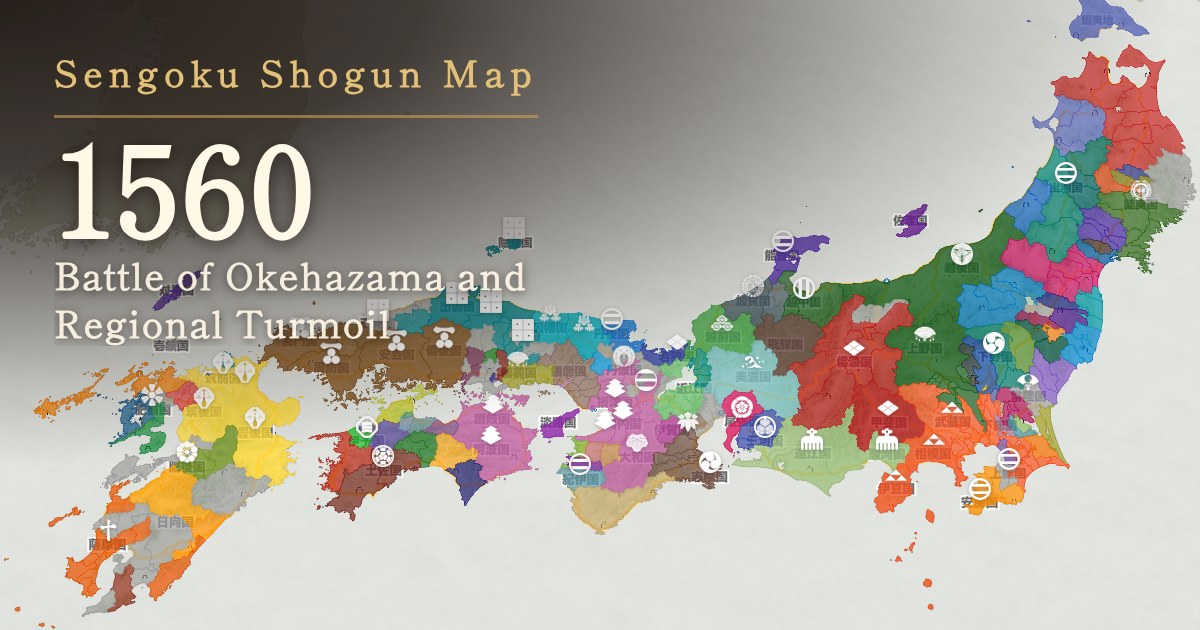
1560 was Eiroku 3 (kanoe-saru).
The death of Imagawa Yoshimoto at the Battle of Okehazama shocked the nation. Taking this opportunity, Oda Nobunaga consolidated control over Owari, while Matsudaira Motoyasu (later Tokugawa Ieyasu) strengthened his independence in Mikawa. That same year, Uesugi Kenshin (Nagao Kagetora) prepared for a Kanto expedition in Echigo, and tensions rose between the Otomo and Shimazu clans in Kyushu, with upheavals and battles continuing across the country.
1560 territory map: major daimyo and their provinces
Each province is counted under its main power. The map shows the finer division by district.
- 山城国 (Ashikaga Yoshiteru), 大和国 (Matsunaga Hisahide), 河内国 (Miyoshi Nagayoshi), 和泉国 (Miyoshi Nagayoshi), 摂津国 (Miyoshi Nagayoshi), 阿波国 (Miyoshi Nagayoshi), 讃岐国
Miyoshi clan7 provinces
- 伊豆国 (Hōjō Ujimasa), 相模国 (Hōjō Ujimasa), 武蔵国 (Hōjō Ujimasa), 下総国 (Chiba Tanetomi)
Later Hōjō clan4 provinces
- 筑前国 (Ōtomo Sōrin), 筑後国 (Ōtomo Sōrin), 豊前国 (Ōtomo Sōrin), 豊後国 (Ōtomo Sōrin)
Ōtomo clan4 provinces
- 備後国 (Mōri Motonari), 安芸国 (Mōri Motonari), 周防国 (Mōri Motonari), 長門国 (Mōri Motonari)
Mōri clan4 provinces
- 上野国 (Nagano Narimasa), 越中国 (Jinbō Nagamoto), 越後国 (Nagao Kagetora)
Uesugi clan3 provinces
- 伯耆国 (Amago Haruhisa), 出雲国 (Amago Haruhisa), 隠岐国 (Amago Haruhisa)
Amago clan3 provinces
- 遠江国 (Imagawa Ujizane), 駿河国 (Imagawa Ujizane)
Imagawa clan2 provinces
- 但馬国 (Yamana Suketomi), 因幡国
Yamana clan2 provinces
- 甲斐国 (Takeda Shingen), 信濃国 (Takeda Shingen)
Takeda clan2 provinces
- 淡路国 (Atagi Haruoki)
Atagi clan (Awaji)1 province
- 蝦夷地 (Kakizaki Suehiro)
Andō clan1 province
- 伊賀国
Iga Sokoku Ikki1 province
- 丹後国 (Isshiki Yoshimichi)
Isshiki clan1 province
- 志摩国 (Kuki Yoshitaka)
Kuki clan1 province
- 美濃国 (Saitō Yoshitatsu)
Saitō clan1 province
- 飛驒国 (Miki Yoshiyori)
Miki clan (Hida)1 province
- 若狭国 (Takeda Yoshimune and others)
Wakasa-Takeda clan1 province
- 対馬国
Sō clan1 province
- 尾張国 (Oda Nobunaga)
Oda clan1 province
- 越前国 (Asakura Yoshikage)
Asakura clan1 province
- 能登国 (Hatakeyama Yoshitsuna)
Hatakeyama clan (Noto)1 province
- 佐渡国 (Honma clan)
Honma clan (Sado)1 province
- 加賀国 (Honganji, Ikkō-ikki)
Honganji and Ikkō-ikki1 province
- 安房国 (Satomi Yoshihiro)
Satomi clan1 province
Provinces divided among several powers23 provinces
伊勢国 (Kitabatake Tomonori and others), 三河国 (Matsudaira Motoyasu and others), 上総国 (Satomi Yoshihiro and others), 常陸国 (Satake Yoshiaki and others), 近江国 (Rokkaku clan, Azai clan), 下野国 (Utsunomiya Hirotsuna and others), 陸奥国 (Date Harumune and others), 出羽国 (Mogami Yoshimori and others), 丹波国 (Naito Munekatsu and others), 石見国 (Amago Yoshihisa, Mōri Motonari), 播磨国 (Akamatsu Yoshisuke), 美作国 (Amago Haruhisa and others), 備前国 (Uragami Munekage and others), 備中国 (Mimura Iechika and others), 紀伊国 (Hatakeyama Takamasa and others), 伊予国 (Kōno Michinao and others), 土佐国 (Chōsokabe Motochika and others), 肥前国 (Ryūzōji Takanobu and others), 肥後国 (Sagara Yoshihisa and others), 日向国 (Itō Yoshisuke and others), 大隅国 (Shimazu Takahisa and others), 薩摩国 (Shimazu Takahisa and others), 壱岐国 (Hata and others)
Events this year
Month 2
Mōri Motonari secures control of the Iwami Silver Mine, further strengthening his financial base.
Mōri Motonari presented funds for the enthronement of Emperor Ōgimachi, and the emperor appointed Motonari Mutsu-no-kami. In the same month the shogun Ashikaga Yoshiteru appointed Takamoto shugo of Aki.
Sources 広島県文書館「広島県史年表(中世2)」
Month 3
Nagao Kagetora (later Uesugi Kenshin) prepares for an advance into the Kantō region, continuing his rivalry with Hōjō Ujiyasu.
Nagao Kagetora sent troops into Etchū to support Shiina Yasutane and others of 松倉城, and is said to have subjugated Jinbō Nagamoto, lord of Toyama Castle.
Sources 上越観光Navi「年表で見る上杉謙信公の生涯」(座標は富山城)
Month 5
Imagawa Yoshimoto leads troops from Suruga, Tōtōmi, and Mikawa to invade Owari, capturing strongholds such as Odaka Castle and increasing pressure.
Chōsokabe Kunichika and his son Motochika defeated the Motoyama forces at Nagahama in central Tosa, said to be Motochika's first battle. Kunichika died that year, and Motochika succeeded him and went on toward the unification of Tosa.
Sources 高知市「長宗我部元親 土佐の戦国武将」
Matsudaira Motoyasu of the Imagawa side carried provisions into Odaka Castle, which was surrounded by the Oda-side forts of Marune and Washizu and running short of supplies. It is regarded as a preliminary to the Battle of Okehazama.
Sources 名古屋市「大高城跡」/掛川市「徳川家康と掛川城のかかわり~掛川城の戦いを中心に~」
5/23
Matsudaira Motoyasu (later Tokugawa Ieyasu) returns to Mikawa’s Okazaki, advancing independence from Imagawa.
Month 6
Takeda Shingen strengthens forces near Kawanakajima, restraining Uesugi-aligned kokujin mobilization.
6/12
Oda Nobunaga launches a surprise attack and slays Imagawa Yoshimoto, seizing dominance in Owari.
See this battle in detail →Sources 豊明市「桶狭間古戦場伝説地」/国立公文書館デジタル展示「徳川家康」/名古屋市博物館「五月の信長」
6/15
Chōsokabe Kunichika died of illness on the 15th day of the sixth month by the lunar calendar, and his eldest son Motochika became the 21st head at the age of 22. Motochika took over the struggle with the Motoyama clan.
Month 7
Hōjō Ujiyasu brings several Kantō lords under his control, countering Uesugi influence.
Autumn
Nagao Kagetora crossed 三国峠 from Echigo and marched into Kantō, entering Kōzuke. He would repeatedly lead campaigns into Kantō thereafter.
Sources 上越観光Navi「年表で見る上杉謙信公の生涯」(座標は前橋城)
Month 9
Signs of intensifying territorial struggle between Ōtomo Yoshishige (Sōrin) and Shimazu Yoshihisa.
Local lords loyal to Ōtomo and Shimazu repeatedly clash along the border.
Azai Nagamasa beat Rokkaku Yoshikata's army across the Uso River, and thereafter ruled northern Ōmi as an independent domain.
See this battle in detail →Sources 滋賀県教育委員会「近江戦国探訪ガイドブック2 信長の城と戦国近江」
Month 10
Mōri Motonari attacks remnants of the Amago in San’in, expanding his sphere of influence.
Month 11
Nagao Kagetora advanced preparations for provisions and arms within Echigo, readying for the Kantō campaign of the following year.
Miyoshi Nagayoshi moved his base to Ii Castle in Kawachi. The Ii Castle ruins are designated as a national historic site.
Sources 四條畷市「国史跡 飯盛城跡について」/大東市「三好長慶と飯盛城」
Month 12
Amago Haruhisa, who had built up power in Izumo and the San'in, died, and his son Yoshihisa is said to have succeeded to the headship. Accounts of the year of his death differ.
Sources 広島県文書館「広島県史年表(中世2)」/コトバンク「尼子晴久」
Following Imagawa Yoshimoto's death in battle, Ujizane succeeded to the leadership of the Imagawa clan. However, beginning with Matsudaira Motoyasu's defection, the domain began to show progressive instability.
As Hōjō Ujiyasu attacked Kururi Castle, Satomi Yoshitaka requested Nagao Kagetora to mount a Kantō campaign. The alliance between the Satomi and the Nagao (Bō-Etsu alliance) was formed, and the Satomi and Masaki forces advanced into Shimōsa.
Sources 館山市「さとみ物語 要約版4章2」/館山市「さとみ物語 完全版4章2」
The Iga Sōkoku Ikki was a self-governing league of Iga's kokujin and jizamurai, and its code of rules (okitegaki) is said to have been drawn up around this time.
Sources 三重の文化「歴史年表」 - 三重県
Amid famine and epidemic in his domain, Ujimasa is said to have enacted a tokusei and set the ratio between good coin (seisen) and debased coin (jiaku-sen).
Sources https://kotobank.jp/word/%E5%8C%97%E6%9D%A1%E6%B0%8F%E6%94%BF-14951/https://odawara-digital-museum.jp/great/detail/150/
The embankment that controlled flooding of the Kamanashi River and 御勅使川 (the 竜王の川除, later known as Shingen Dike) is said to have been completed around 1560 (Eiroku 3).
Sources 甲斐市「信玄堤」/甲府市「武田信玄国主となる。信玄堤を造る」(座標は国土地理院の住所検索による町域代表点・竜王)。完成年・工期は説明により幅がある
Matsunaga Hisahide began building a castle on Mikenjiyama north of Nara, laid out samurai residences at its foot and also began developing a castle town. It is said to have been named after Tamonten of Mount Shigi.
Shimazu Yoshihiro is said to have been adopted by Shimazu Tadachika of the Hōshū branch and stationed at Obi, which was contested with the Itō clan. The adoption was dissolved in Eiroku 5 and he returned; accounts differ on the length of his posting.
Sources 姶良市「島津義弘公没後400年」年譜