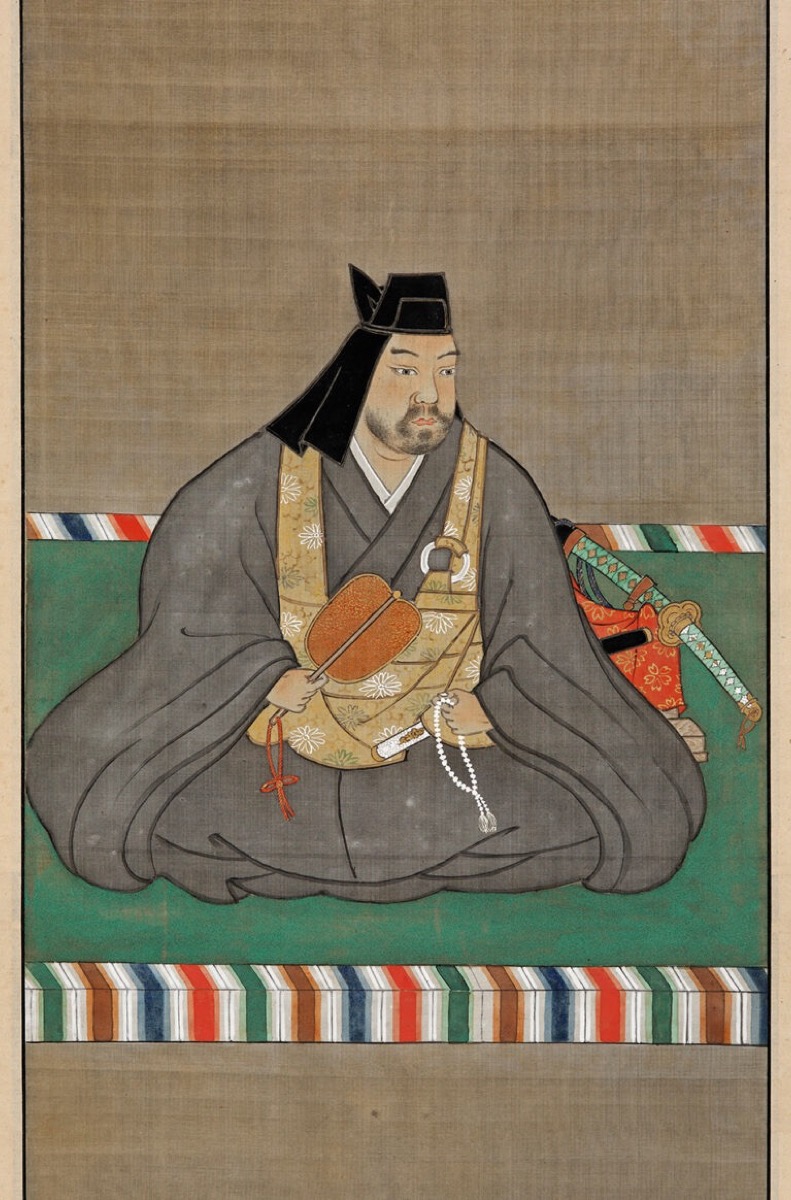
 作者不詳「上杉謙信像」

Deputy Governor of Echigo, Kantō Kanrei
Uesugi Kenshin
上杉謙信
1530 – 1578
Born as the son of Nagao Tamekage, the deputy governor of Echigo, he took over the clan headship from his brother Harukage and united the province's local lords. Receiving the Uesugi name and the title of Kantō Kanrei from Uesugi Norimasa, he repeatedly campaigned in the Kantō region and northern Shinano, facing Takeda Shingen in five confrontations at Kawanakajima. He also fought Oda forces at Tedorigawa and expanded his influence into Etchū, Noto, and Kaga. Based at Kasugayama Castle, he built his finances on ports handling ramie, rice, and salt and on toll revenues, and administered his domain through military-levy registers and sealed documents. Known for his devotion to the deity Bishamonten and often called a "righteous warrior," he died suddenly at Kasugayama Castle in 1578, and a succession struggle known as the Otate no Ran broke out afterward.
Sources 上越市「春日山城跡」/南魚沼市「坂戸城跡」/国立公文書館デジタルアーカイブ
Explore the 1548 map
Change the year to watch territories shift
Life of Uesugi Kenshin
Born the son of the Echigo shugo-dai
Map of 1530Uesugi Kenshin was born on January 21, 1530, as a son of Nagao Tamekage, shugo-dai of Echigo Province. His childhood name was Torachiyo, and he later called himself Kagetora. He did not take the Uesugi surname until more than thirty years later, so at this time the name was still Nagao. A shugo-dai was the official who actually governed in place of the shugo, and Tamekage was a powerful figure in Echigo. Kagetora later succeeded to the Uesugi name, changed it to Masatora, and would later take the name Kenshin.
Becomes shugo-dai and moves into Kasugayama Castle
Map of 1548In 1548, Kagetora replaced his elder brother Nagao Harukage as shugo-dai of Echigo and moved into Kasugayama Castle. He was 19. Kasugayama Castle was built on Mount Kasuga, 180 meters high, and is also called Hachigamine Castle. As the base of Echigo it was greatly developed from Kagetora's time through that of Kagekatsu and into the period of the Hori clan, and it is now designated a national historic site. When the shugo Uesugi Sadazane died in 1550, Kagetora became master of Echigo in both name and fact.
Sends troops to Kawanakajima
Map of 1553In 1552, Kagetora was appointed Danjō Shōhitsu, and went into the Kantō to aid Uesugi Norimasa, the Kantō kanrei. In 1553 he sent troops into Shinano to help the lords of northern Shinano who had been driven out by Takeda Shingen. This was the beginning of the Battle of Kawanakajima. From 1553 until 1564 the two armies faced each other many times around Kawanakajima in northern Shinano, and the major battles among these are said to number five. The struggle over Shinano would continue for more than ten years.
Besieges Odawara and inherits the Kantō kanrei post
Map of 1561In March 1561, Kagetora besieged Odawara Castle, held by Hōjō Ujiyasu and Ujimasa, but could not take it, as Ujimasa held out inside the castle. In the following month, on the intercalary 16th day of the third month, at Tsurugaoka Hachimangū in Kamakura, Uesugi Norimasa handed over the Uesugi surname and the post of Kantō kanrei, and Kagetora took the name Uesugi Masatora. From here Nagao Kagetora took over the Uesugi house and began to push into the Kantō in earnest. Later, receiving one character from the name of shogun Ashikaga Yoshiteru, he became Terutora, and after taking the tonsure he changed his name to Kenshin.
Fights Shingen at Hachimanbara
Map of 1561In September 1561, the Fourth Battle of Kawanakajima broke out between the Chikuma and Sai rivers. Masatora (Kenshin) clashed with the army of Takeda Shingen at Hachimanbara. It was the fiercest of the five engagements, and a story is told that Shingen and Kenshin fought in single combat, though this is considered a later anecdote. Accounts differ on the outcome: some say neither side gained a clear victory, and others say the Takeda side won. In Nagano City, the Hachiman shrine where Shingen set up his headquarters still stands.
Makes peace with the Hōjō
Map of 1569Kenshin marched into the Kantō many times, and these campaigns are said to have lasted seventeen years. In 1569 he made peace with Hōjō Ujiyasu, on the terms that he would receive all of Kōzuke Province and adopt Ujiyasu's son Ujihide (later Uesugi Kagetora). Ujihide became Kenshin's adopted son and took the name Uesugi Kagetora. The peace marked one point of division in the long struggle over the Kantō. The year Kenshin took the tonsure and the name Kenshin is given as either 1570 or 1574, and accounts differ.
Into Etchū, Noto and Kaga
Map of 1573In 1573, the year Takeda Shingen died, Kenshin subdued Etchū and advanced into Noto and Kaga. There he came into conflict with the army of Oda Nobunaga, which had destroyed the Asakura clan and the Ikkō uprisings and was closing in. In 1577 he took Nanao Castle in Noto, and is said to have repulsed the forces of Shibata Katsuie near the Tedori River in Kaga. In this way Kenshin became a daimyo ruling a broad domain reaching Echigo, Kōzuke, Etchū and Noto. With Kasugayama Castle as his base, his domain extended into the Hokuriku region.
Dies suddenly at Kasugayama Castle
Map of 1578On March 13, 1578, Kenshin died suddenly at Kasugayama Castle. He was 49, and the cause is given as a cerebral hemorrhage or another illness. He is said to have been on the verge of marching into the Kantō. Accounts give different causes of death: chūki (a stroke), apoplexy, or sudden death. Kenshin had no natural son, and a dispute over the succession between his adopted sons, Uesugi Kagekatsu and Uesugi Kagetora, broke out in the Otate Conflict. Echigo split in two for about three years, and Kagekatsu prevailed and succeeded to the Uesugi house.
Sources 日本大百科全書・山川日本史小辞典・世界大百科事典(コトバンク)/小田原市「北条氏政」/新潟県「県の歴史」/長野市「川中島古戦場史跡公園」/上越市「春日山城跡」
Territory map of Uesugi Kenshin
From 4 provinces in 1548 to 5 provinces in 1562.
The territory of the Uesugi clan, limited to the years when he led the house. Lighter colour: provinces held only in part (some districts).Castles Uesugi Kenshin used as his seat
In the order he moved his base. Years show when he entered and left.- Tochio Castle1543–1548
- Kasugayama Castle1548–
Family tree
Nagao Tamekage
Parent
Uesugi Norimasa
Adoptive parent
Nagao Harukage
Sibling
Sentōin
Sibling
Uesugi Kenshin
This person
Uesugi Kagetora
Adopted child
Uesugi Kagekatsu
Adopted child
Advertisement
Related events
12
1530
1/21
Nagao Kagetora (Later Uesugi Kenshin) Is Born
Born in the castle town of KasugayamaTorachiyo, the youngest son of Nagao Tamekage and later known as Nagao Kagetora and Uesugi Kenshin, was born at Kasugayama Castle.
1553
Month 7
First Battle of Kawanakajima
Nagao commander in chiefTakeda Harunobu and Nagao Kagetora confronted each other at Kawanakajima over control of northern Shinano.
1555
Month 8
Second Battle of Kawanakajima
Nagao commander in chiefTakeda Harunobu and Nagao Kagetora faced each other across the Sai River for a long time and came to terms through Imagawa Yoshimoto. No decisive battle was fought.
1557
Month 5
Third Battle of Kawanakajima
Nagao commander in chiefAfter the Takeda took Katsurayama Castle, Nagao Kagetora marched into northern Shinano, but the Takeda avoided a decisive engagement and nothing was settled.
1560
Month 3
Echigo and Kantō Situation
Prepared the advance into the KantoNagao Kagetora (later Uesugi Kenshin) prepares for an advance into the Kantō region, continuing his rivalry with Hōjō Ujiyasu.
Month 11
Military Preparations in Echigo
Prepared the Kanto expeditionNagao Kagetora advanced preparations for provisions and arms within Echigo, readying for the Kantō campaign of the following year.
1561
Month 3
Nagao Kagetora's Siege of Odawara Castle
Uesugi commander in chief; succeeded as Kanto kanreiNagao Kagetora, who had gathered the lords of Kantō, besieged Odawara Castle in the third month but could not take it. In the intercalary third month, he succeeded to the Kantō kanrei post at Kamakura and changed his name to Uesugi Masatora.
Month 10
Fourth Battle of Kawanakajima
Took part / involvedTakeda Shingen and Uesugi Masatora met head-on at Hachimanbara and both sides suffered heavily. Nothing was decided, and the hold on northern Shinano did not change.
1566
9/27
Uesugi Terutora asks to resume contact with Satake Yoshishige
Echigo daimyo who sent the letter (Terutora)Uesugi Terutora wrote to the Edo clan and the Satake kin, asking them to restore contact with Yoshishige. He also said he would soon cross the mountains into Kantō.
1571
Month 8
Close attention to forces in Hokuriku and the Eastern Provinces
Related figureThe actions of major daimyo such as Uesugi Kenshin and Takeda Shingen were seen as affecting the situation in Kinai. Both Nobunaga and Yoshiaki sought opportunities for broader alliances.
1573
Spring
Uesugi Kenshin's Pressure in Etchū and Noto
Related figureIn Hokuriku, Uesugi Kenshin continued his involvement in Etchū and Noto, and tensions persisted with Oda-aligned forces and the Ikko-ikki.
1577
9/23
Battle of Tedorigawa
Commander-in-chief of the Uesugi sideOn 23 September 1577, at the Tedori River in Kaga Province (around present-day Hakusan, Ishikawa Prefecture), the Oda Hokuriku army led by Shibata Katsuie, which had set out to relieve Nanao Castle, suffered a crushing defeat at the hands of Uesugi Kenshin's forces. Nanao Castle had already fallen.
Advertisement