1613 territory map and events: The Departure of the Keichō Embassy and the Nationwide Christian Ban
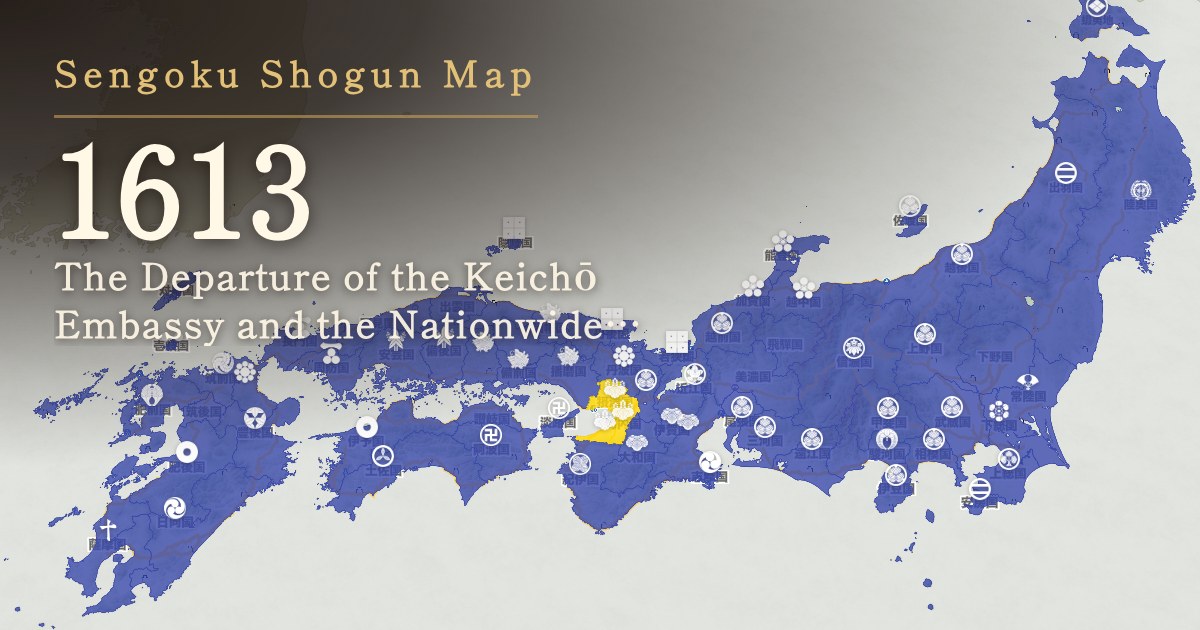
1613 was Keichō 18 (mizunoto-ushi).
Date Masamune, lord of Sendai, dispatched an embassy led by his retainer Hasekura Tsunenaga to Spanish Mexico and onward to the courts of the King of Spain and the Pope. Ironically, just after the mission's departure, the shogunate extended its Christian prohibition edict to daimyo domains across the entire country, making this a year in which the expansion of overseas contact and the tightening of domestic religious control advanced side by side.
1613 territory map: major daimyo and their provinces
Each province is counted under its main power. The map shows the finer division by district.
- 山城国 (Tokugawa Ieyasu, Itakura Katsushige), 大和国 (Honda Toshitomo, Fukushima Takaharu, Katagiri Sadataka, Tokugawa intendants and others), 伊賀国 (Tōdō Takatora), 伊勢国 (Tōdō Takatora, Honda Tadamasa and others), 志摩国 (Kuki Moritaka), 尾張国 (Tokugawa Yoshinao), 三河国 (Tokugawa Ieyasu), 遠江国 (Tokugawa Yorinobu and others), 駿河国 (Tokugawa Yorinobu, Tokugawa Ieyasu), 甲斐国 (Tokugawa Ieyasu), 伊豆国 (Tokugawa Ieyasu), 相模国 (Ōkubo Tadachika and others), 武蔵国 (Tokugawa Ieyasu), 安房国 (Satomi Tadayoshi), 上総国 (Honda Tadatomo and others), 下総国 (Doi Toshikatsu), 常陸国 (Tokugawa Yorifusa and others), 近江国 (Ii Naotsugu and others), 美濃国 (Okudaira Nobumasa and others), 飛驒国 (Kanamori Arishige), 信濃国 (Ogasawara Hidemasa and others), 上野国 (Sakai Shigetada and others), 下野国 (Okudaira Iemasa and others), 陸奥国 (Date Masamune and others), 出羽国 (Mogami Yoshiaki and others), 若狭国 (Kyōgoku Takatsugu, Kyōgoku Tadataka), 越前国 (Matsudaira Tadanao), 加賀国 (Maeda Toshitsune), 能登国 (Maeda Toshitsune), 越中国 (Maeda Toshinaga and others), 越後国 (Matsudaira Tadateru and others), 佐渡国 (Tokugawa intendants), 丹波国 (Okabe Nagamori, Arima Toyouji and others), 丹後国 (Kyōgoku Takatomo), 但馬国 (Koide Yoshihide, Sugihara Nagafusa and others), 因幡国 (Ikeda Nagayoshi, Kamei Korenori, Yamazaki Iemori and others), 伯耆国 (Katō Sadayasu, Seki Kazumasa and others), 出雲国 (Horio Tadaharu), 石見国 (Sakazaki Naomori, Tokugawa intendants and others), 隠岐国 (Horio Tadaharu), 播磨国 (Ikeda Toshitaka), 美作国 (Mori Tadamasa), 備前国 (Ikeda Tadatsugu), 備中国 (Tokugawa intendants, Kobori Masatsugu, Togawa Michiyasu and others), 備後国 (Fukushima Masanori), 安芸国 (Fukushima Masanori), 周防国 (Mōri Terumoto), 長門国 (Mōri Terumoto), 紀伊国 (Asano Nagaakira), 淡路国 (Ikeda Tadakatsu), 阿波国 (Hachisuka Yoshishige), 讃岐国 (Ikoma Masatoshi), 伊予国 (Katō Yoshiaki, Tomita Nobutaka, Wakisaka Yasuharu and others), 土佐国 (Yamauchi Tadayoshi), 筑前国 (Kuroda Nagamasa), 筑後国 (Tanaka Tadamasa), 豊前国 (Hosokawa Tadaoki), 豊後国 (Nakagawa Hidenari, Inaba Sadamichi, Hosokawa Tadaoki, Kinoshita Nobutoshi, Takenaka Shigetoshi and others), 肥前国 (Nabeshima Katsushige, Terasawa Hirotaka, Matsuura clan, Ōmura Yoshiaki and others), 肥後国 (Katō Tadahiro, Sagara Yorifusa and others), 日向国 (Itō Sukenori, Akizuki Tanenaga, Shimazu Yukihisa, Shimazu Tadatsune and others), 大隅国 (Shimazu Tadatsune), 薩摩国 (Shimazu Tadatsune), 壱岐国 (Matsuura clan), 対馬国 (Sō clan), 蝦夷地 (Matsumae Yoshihiro)
Tokugawa regime66 provinces
- 河内国 (Toyotomi Hideyori, Hōjō Ujimori and others), 和泉国 (Toyotomi Hideyori), 摂津国 (Toyotomi Hideyori, Shinjō Naoyori, Arima Toyouji and others)
Toyotomi clan3 provinces
Events this year
4/25
Following Okubo Nagayasu's death in Sunpu, an investigation of his subordinates revealed illicit wealth accumulation. Seven of his sons were ordered to commit seppuku, and the Okubo clan was extinguished.
Sources 新潟県佐渡市「史跡佐渡奉行所跡」
6/11
The English East India Company's ship Clove, carrying John Saris, entered Hirado harbor, and an English trading post was established there.
Sources 外務省「日英関係のあけぼの」
Month 9
The embassy sent by Date Masamune and led by Hasekura Tsunenaga departed Tsukinoura aboard the San Juan Bautista, bound for Mexico, Spain and Rome. The 9th month of Keichō 18 in the old calendar corresponds to October 1613.
10/18
Asano Yoshinaga died in 1613, and on the 18th day of the 10th month his younger brother Nagaakira, as lord of Wakayama Castle, inherited the domain in Kii.
Sources 和歌山城(史跡和歌山城)「和歌山城の生い立ち」/広島県立文書館「広島県史年表(近世1)」
Month 12
The shogunate banned Christianity and ordered missionaries expelled from the whole country. The 12th month of Keichō 18 falls in January 1614 in the Gregorian calendar, and some sources date the edict to 1614.
Sources 長崎歴史文化博物館「伝播と反映、弾圧」/長崎市「おらしょ物語(禁教令の発令と島原・天草一揆の勃発)」/国立国会図書館「江戸時代の日蘭交流 年表」
Ikeda Terumasa, lord of Harima Himeji (over 520,000 koku), died at Himeji at the age of fifty, and his eldest son Toshitaka inherited Himeji Castle and his domain.
Sources 岡山大学附属図書館「池田家文庫絵図展解説 戦さと城の絵図」/鳥取県「池田家墓所ガイド 鳥取池田家年譜」
Tadakatsu, third son of Ikeda Terumasa, who was granted all of Awaji, built Nariyama Castle at Yura. Its main purpose is thought to have been keeping watch on the Ōsaka side.
Sources 史跡洲本城跡保存活用計画 - 洲本市