1611 territory map and events: The Nijō Castle Meeting—Ieyasu Comes Face to Face with Hideyori
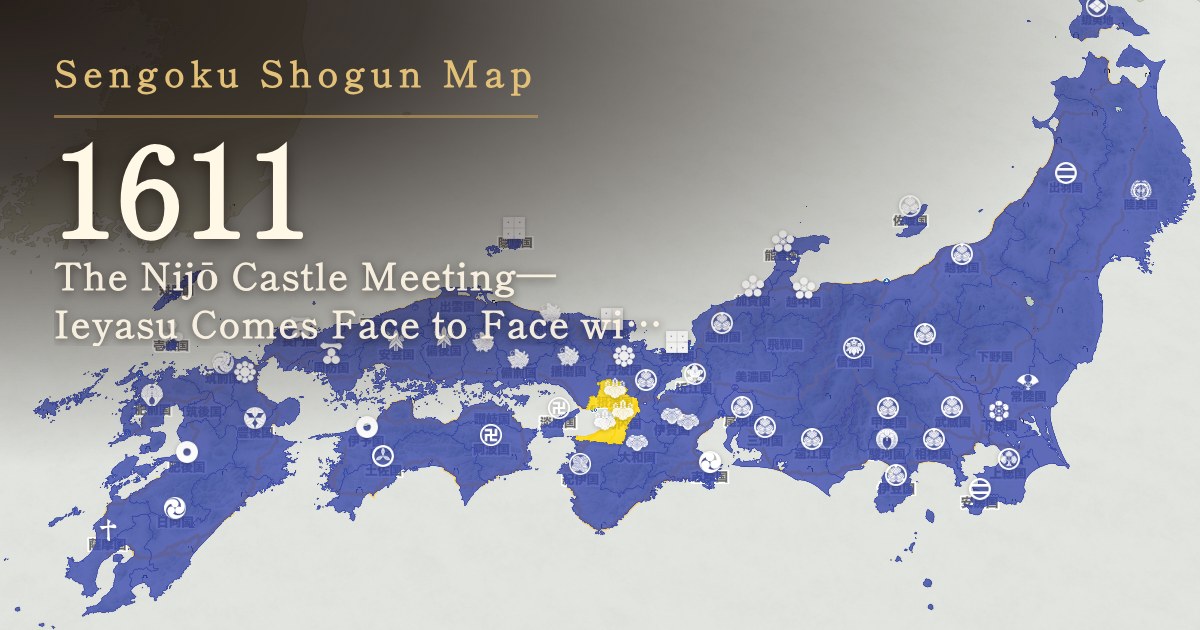
1611 was Keichō 16 (kanoto-i).
Traveling to Kyoto for the first time in four years to attend the abdication of Emperor Go-Yōzei and the enthronement of Emperor Go-Mizunoo, Ieyasu met face to face with Toyotomi Hideyori at Nijō Castle. Hideyori had grown into an imposing, capable young man far beyond expectations, and witnessing this firsthand is said to have deepened Ieyasu's wariness of the Toyotomi house, making the meeting a moment often viewed as a prelude to the later Siege of Ōsaka.
1611 territory map: major daimyo and their provinces
Each province is counted under its main power. The map shows the finer division by district.
- 山城国 (Tokugawa Ieyasu, Itakura Katsushige), 大和国 (Honda Toshitomo, Fukushima Takaharu, Katagiri Sadataka, Tokugawa intendants and others), 伊賀国 (Tōdō Takatora), 伊勢国 (Tōdō Takatora, Honda Tadamasa and others), 志摩国 (Kuki Moritaka), 尾張国 (Tokugawa Yoshinao), 三河国 (Tokugawa Ieyasu), 遠江国 (Tokugawa Yorinobu and others), 駿河国 (Tokugawa Yorinobu, Tokugawa Ieyasu), 甲斐国 (Tokugawa Ieyasu), 伊豆国 (Tokugawa Ieyasu), 相模国 (Ōkubo Tadachika and others), 武蔵国 (Tokugawa Ieyasu), 安房国 (Satomi Tadayoshi), 上総国 (Honda Tadatomo and others), 下総国 (Doi Toshikatsu), 常陸国 (Tokugawa Yorifusa and others), 近江国 (Ii Naotsugu and others), 美濃国 (Okudaira Nobumasa and others), 飛驒国 (Kanamori Arishige), 信濃国 (Ishikawa Yasunaga and others), 上野国 (Sakai Shigetada and others), 下野国 (Okudaira Iemasa and others), 陸奥国 (Date Masamune and others), 出羽国 (Mogami Yoshiaki and others), 若狭国 (Kyōgoku Takatsugu, Kyōgoku Tadataka), 越前国 (Matsudaira Tadanao), 加賀国 (Maeda Toshitsune), 能登国 (Maeda Toshitsune), 越中国 (Maeda Toshinaga and others), 越後国 (Matsudaira Tadateru and others), 佐渡国 (Tokugawa intendants), 丹波国 (Okabe Nagamori, Arima Toyouji and others), 丹後国 (Kyōgoku Takatomo), 但馬国 (Koide Yoshihide, Sugihara Nagafusa and others), 因幡国 (Ikeda Nagayoshi, Kamei Korenori, Yamazaki Iemori and others), 伯耆国 (Katō Sadayasu, Seki Kazumasa and others), 出雲国 (Horio Tadaharu), 石見国 (Tokugawa intendants, Ōkubo Nagayasu, Sakazaki Naomori and others), 隠岐国 (Horio Tadaharu), 播磨国 (Ikeda Terumasa), 美作国 (Mori Tadamasa), 備前国 (Ikeda Tadatsugu), 備中国 (Tokugawa intendants, Kobori Masatsugu, Togawa Michiyasu and others), 備後国 (Fukushima Masanori), 安芸国 (Fukushima Masanori), 周防国 (Mōri Terumoto), 長門国 (Mōri Terumoto), 紀伊国 (Asano Yoshinaga), 淡路国 (Hachisuka Yoshishige), 阿波国 (Hachisuka Yoshishige), 讃岐国 (Ikoma Masatoshi), 伊予国 (Katō Yoshiaki, Tomita Nobutaka, Wakisaka Yasuharu and others), 土佐国 (Yamauchi Tadayoshi), 筑前国 (Kuroda Nagamasa), 筑後国 (Tanaka Tadamasa), 豊前国 (Hosokawa Tadaoki), 豊後国 (Nakagawa Hidenari, Inaba Sadamichi, Hosokawa Tadaoki, Kinoshita Nobutoshi, Takenaka Shigetoshi and others), 肥前国 (Nabeshima Katsushige, Terasawa Hirotaka, Matsuura clan, Ōmura Yoshiaki and others), 肥後国 (Katō Tadahiro, Sagara Yorifusa and others), 日向国 (Takahashi Mototane, Itō Sukenori, Akizuki Tanenaga, Shimazu Yukihisa, Shimazu Tadatsune and others), 大隅国 (Shimazu Tadatsune), 薩摩国 (Shimazu Tadatsune), 壱岐国 (Matsuura clan), 対馬国 (Sō clan), 蝦夷地 (Matsumae Yoshihiro)
Tokugawa regime66 provinces
- 河内国 (Toyotomi Hideyori, Hōjō Ujimori and others), 和泉国 (Toyotomi Hideyori), 摂津国 (Toyotomi Hideyori, Shinjō Naoyori, Arima Toyouji and others)
Toyotomi clan3 provinces
Events this year
Month 1
Shimazu Yoshihisa (Ryūhaku), who had governed Satsuma, Ōsumi and Hyūga, died at the age of 79. His place of death is said to be either Tomikuma or Kokubu. His grave is in the Fukushōji cemetery in Kagoshima City.
Sources コトバンク「島津義久」/鹿児島市『鹿児島市史』
Month 3
In Kyoto, Tokugawa Ieyasu ordered daimyo including Fukushima Masanori, Ikeda Terumasa and Asano Yoshinaga to build the imperial palace, shortly before the accession of Emperor Go-Mizunoo.
Sources 広島県立文書館「広島県史年表(近世1)」
3/28
Tokugawa Ieyasu summoned nineteen-year-old Toyotomi Hideyori to Nijō Castle. Hideyori paid respects to Ieyasu, displaying the political relationship between the Tokugawa government and the Toyotomi house.
Sources 国立公文書館「徳川家康―将軍家蔵書からみるその生涯― 二条城会見」/広島県立文書館「広島県史年表(近世1)」
Month 4
Tokugawa Ieyasu required the daimyo residing in Kyoto to submit three oath pledges swearing to obey bakufu edicts and not to defy the shogun's commands.
Sources 国立公文書館 デジタル展示「徳川家康―将軍家蔵書からみるその生涯と遺産」二条城会見
4/12
Emperor Go-Mizunoo acceded to the throne following the abdication of Emperor Go-Yōzei and performed his enthronement ceremony. This succession occurred concurrently with Tokugawa Ieyasu's meeting at Nijō Castle.
Sources 国立公文書館 デジタル展示「徳川家康―将軍家蔵書からみるその生涯と遺産」二条城会見
6/4
Sanada Masayuki, who had been exiled to Kudoyama at the foot of Mount Koya after Sekigahara, died of illness at his place of exile on the 4th day of the 6th month (old calendar). Even the efforts of his eldest son, Sanada Nobuyuki, failed to win a pardon.
Sources 真田宝物館「真田家」/上田市立博物館「真田昌幸」
6/24
Katō Kiyomasa, who held the whole of Higo (540,000 koku), died and his son Tadahiro succeeded him. The place of his death is not confirmed in the sources.
Sources 熊本市(熊本城調査研究センター)鶴嶋俊彦「熊本城学 清正の本城と支城」資料/熊本市「書状にみる熊本城築城」資料
8/21
An inland earthquake struck the western edge of the Aizu basin, damaging the stone walls of Wakamatsu Castle and temples and shrines. A landslide dammed the Agano River and formed Lake Yamasaki-shinko.
Sources 高橋充・竹谷陽二郎「慶長会津地震と西会津町大杉山村の供養塔について」(『福島県立博物館紀要』第37号)/国土交通省北陸地方整備局 阿賀川河川事務所「阿賀川の歴史(山崎新湖)」/地震調査研究推進本部「会津盆地西縁断層帯・東縁断層帯」
Month 9
The Shimazu clan carried out a land survey of the Ryukyus, set the islands from Okinawa southward at 89,086 koku and fixed their tribute to Satsuma. The Amami Islands were made Shimazu directly held land.
Sources 山本弘文「慶長検地後の琉球王国の貢租制度」/コトバンク「琉球征服」
Month 10
Shō Nei, king of the Ryukyus, who had been back in Kagoshima, returned to the Ryukyus after about two and a half years. Immediately afterward, Shimazu Iehisa asked the Ryukyus to act as intermediary for trade with Ming.
Sources 豊見山和行「近世初期における琉球王国の対薩摩外交」(琉球大学)
10/28
A great earthquake off Sanriku was followed by a tsunami that struck the Pacific coast of Tōhoku (2 December in the Gregorian calendar). Deaths in the Sendai domain are put at 1,783.
Sources 蝦名裕一「1611年慶長奥州地震・津波を読み直す」(東北大学東北アジア研究センター)/仙台管区気象台「過去の主な被害地震・津波」/蝦名裕一「1611年慶長奥州地震津波に関する史料と評価をめぐって」
The major construction of Saga Castle undertaken by Nabeshima Naoshige and Katsushige was completed, and Katsushige entered the Honmaru.
The keep of Matsue Castle, built by the Horio, was completed. The surviving four-tiered, five-storey keep with one basement floor dates from this time.
Sources 文化庁「国指定文化財等データベース」(文化遺産オンライン)「松江城天守」/島根県「国宝 松江城天守」
Hirosaki Castle, begun by Tsugaru Nobuhira, was completed. Although the domain was then assessed at 47,000 koku, the castle was a large one with a five-storey keep, turrets and a residence.
Sources 青森県教育庁文化財保護課「津軽氏城跡(種里城跡・堀越城跡・弘前城跡)」