1610 territory map and events: The Return of Don Rodrigo and the Visit of King Shō Nei
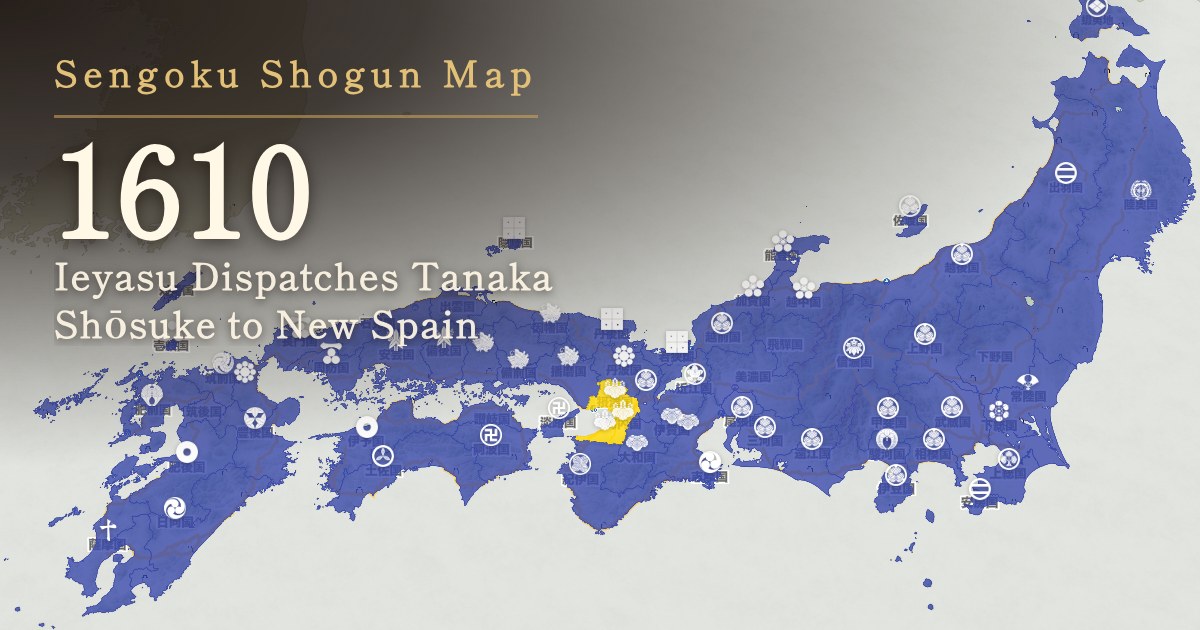
1610 was Keichō 15 (kanoe-inu).
The party of Spanish Don Rodrigo, who had been shipwrecked the previous year off Iwawada in Kazusa, returned to Mexico in the 6th month aboard a ship provided by Ieyasu, departing from Uraga. From the 8th to 9th months, Ryukyu's King Shō Nei met with Ieyasu in Sunpu and with Tokugawa Hidetada in Edo. In Owari, the construction of Nagoya Castle and the Kiyosu Relocation began.
1610 territory map: major daimyo and their provinces
Each province is counted under its main power. The map shows the finer division by district.
- 山城国 (Tokugawa Ieyasu, Itakura Katsushige), 大和国 (Honda Toshitomo, Fukushima Takaharu, Katagiri Sadataka, Tokugawa intendants and others), 伊賀国 (Tōdō Takatora), 伊勢国 (Tōdō Takatora, Honda Tadamasa and others), 志摩国 (Kuki Moritaka), 尾張国 (Tokugawa Yoshinao), 三河国 (Tokugawa Ieyasu), 遠江国 (Tokugawa Yorinobu and others), 駿河国 (Tokugawa Yorinobu, Tokugawa Ieyasu), 甲斐国 (Tokugawa Ieyasu), 伊豆国 (Tokugawa Ieyasu), 相模国 (Ōkubo Tadachika and others), 武蔵国 (Tokugawa Ieyasu), 安房国 (Satomi Tadayoshi), 上総国 (Honda Tadatomo and others), 下総国 (Doi Toshikatsu), 常陸国 (Tokugawa Yorifusa and others), 近江国 (Ii Naotsugu and others), 美濃国 (Okudaira Nobumasa and others), 飛驒国 (Kanamori Arishige), 信濃国 (Ishikawa Yasunaga and others), 上野国 (Sakai Shigetada and others), 下野国 (Okudaira Iemasa and others), 陸奥国 (Date Masamune and others), 出羽国 (Mogami Yoshiaki and others), 若狭国 (Kyōgoku Takatsugu, Kyōgoku Tadataka), 越前国 (Matsudaira Tadanao), 加賀国 (Maeda Toshitsune), 能登国 (Maeda Toshitsune), 越中国 (Maeda Toshinaga and others), 越後国 (Matsudaira Tadateru and others), 佐渡国 (Tokugawa intendants), 丹波国 (Okabe Nagamori, Arima Toyouji and others), 丹後国 (Kyōgoku Takatomo), 但馬国 (Koide Yoshihide, Sugihara Nagafusa and others), 因幡国 (Ikeda Nagayoshi, Kamei Korenori, Yamazaki Iemori and others), 伯耆国 (Katō Sadayasu, Seki Kazumasa and others), 出雲国 (Horio Yoshiharu, Horio Tadaharu), 石見国 (Tokugawa intendants, Ōkubo Nagayasu, Sakazaki Naomori and others), 隠岐国 (Horio Yoshiharu, Horio Tadaharu), 播磨国 (Ikeda Terumasa), 美作国 (Mori Tadamasa), 備前国 (Ikeda Tadatsugu), 備中国 (Tokugawa intendants, Kobori Masatsugu, Togawa Michiyasu and others), 備後国 (Fukushima Masanori), 安芸国 (Fukushima Masanori), 周防国 (Mōri Terumoto), 長門国 (Mōri Terumoto), 紀伊国 (Asano Yoshinaga), 淡路国 (Hachisuka Yoshishige), 阿波国 (Hachisuka Yoshishige), 讃岐国 (Ikoma Masatoshi), 伊予国 (Katō Yoshiaki, Tomita Nobutaka, Wakisaka Yasuharu and others), 土佐国 (Yamauchi Tadayoshi), 筑前国 (Kuroda Nagamasa), 筑後国 (Tanaka Tadamasa), 豊前国 (Hosokawa Tadaoki), 豊後国 (Nakagawa Hidenari, Inaba Sadamichi, Hosokawa Tadaoki, Kinoshita Nobutoshi, Takenaka Shigetoshi and others), 肥前国 (Nabeshima Katsushige, Terasawa Hirotaka, Matsuura clan, Ōmura Yoshiaki and others), 肥後国 (Katō Kiyomasa, Sagara Yorifusa and others), 日向国 (Takahashi Mototane, Itō Sukenori, Akizuki Tanenaga, Shimazu Yukihisa, Shimazu Tadatsune and others), 大隅国 (Shimazu Tadatsune), 薩摩国 (Shimazu Tadatsune), 壱岐国 (Matsuura clan), 対馬国 (Sō clan), 蝦夷地 (Matsumae Yoshihiro)
Tokugawa regime66 provinces
- 河内国 (Toyotomi Hideyori, Hōjō Ujimori and others), 和泉国 (Toyotomi Hideyori), 摂津国 (Toyotomi Hideyori, Shinjō Naoyori, Arima Toyouji and others)
Toyotomi clan3 provinces
Events this year
Month 6
Tokugawa Ieyasu lent the Western-style ship built by Miura Anjin (William Adams) to Don Rodrigo's party, who sailed from Uraga across the Pacific and returned to Mexico.
Sources 千葉県教育委員会「ドン・ロドリゴ上陸地」/伊豆・伊東観光ガイド「日本初の洋式帆船建造の歴史」
Month 8
Shō Nei, king of the Ryukyus, met Tokugawa Ieyasu at Sunpu and Hidetada at Edo. The Sunpu meeting is agreed to be the 16th of the eighth month, but for the Edo meeting the schedule in the Kian Nikki gives the 12th of the ninth month, while some studies give the 28th of the eighth month.
Sources 梅木哲人「尚寧王の駿府・江戸往還について―『喜安日記』の研究(1)―」(法政大学沖縄文化研究所『沖縄文化研究』42)
The main enclosure of Sunpu Castle, destroyed in a fire in Keichō 12, was rebuilt, and the tenshu (tower keep) was completed in Keichō 15.
Sources 駿府城公園公式サイト「駿府城公園の歴史」
Tokugawa Ieyasu mobilized twenty western and northern daimyo to begin building Nagoya Castle as a defense against Osaka and the seat of the Owari Tokugawa house.
Honda Tadakatsu, daimyo of Kuwana, died and was buried at Jōdo-ji, where Honda Tadakatsu Honbyō (Main Mausoleum) was established. This occurred approximately nine years after he became daimyo.
Sources 桑名市「本多忠勝」(きっずページ)
Alongside the building of Nagoya Castle, Tokugawa Ieyasu carried out a vast relocation that moved the whole town of Kiyosu, with its samurai, townspeople and temples, to Nagoya (Kiyosu-goshi).
Sources 名古屋市中区「中区のなりたち」/名古屋市緑政土木局「堀川の開削」/名古屋市図書館「名古屋と家康」関連展示資料
Fukushima Masanori dug the Hori River along the west of the Nagoya plateau to link Atsuta with the castle town of Nagoya. It was about six kilometres long.
Sources 名古屋市緑政土木局「堀川の開削」
Katō Sadayasu, lord of Kurono Castle in Mino, entered Yonago as lord of the Aimi and Aseiri districts of Hōki (60,000 koku).
Sources 米子市「米子城跡」関連資料(年表)
The land survey of the two provinces of Suō and Nagato, carried out under the survey regulations issued by Mōri Terumoto, was completed, and the total yield was found to be 539,286 koku.
Sources 兼重宗和「近世初期検地と物成高」(山口大学)/コトバンク「萩藩」
At Sendai Castle, which Date Masamune built, the great hall of the main enclosure was completed. The main parts of the castle are said to have been largely finished.
Sources 仙台市博物館「伊達政宗に関する資料(3)」