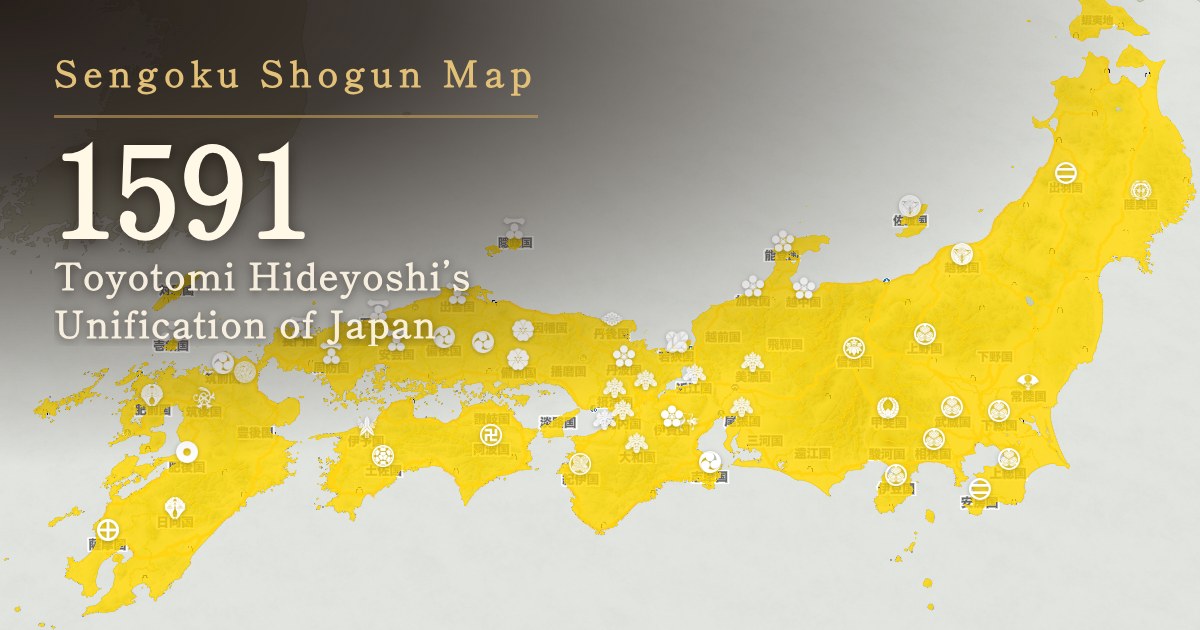
1591 territory map and events: Toyotomi Hideyoshi’s Unification of Japan
1591 was Tenshō 19 (kanoto-u).
After the Odawara Campaign, the Toyotomi regime reassigned the northern lords, firmly establishing its rule across the entire country.
1591 territory map: major daimyo and their provinces
Each province is counted under its main power. The map shows the finer division by district.
- 山城国 (Toyotomi Hideyoshi), 大和国 (Toyotomi Hidenaga), 河内国 (Toyotomi Hidenaga), 和泉国 (Toyotomi Hidenaga), 摂津国 (Toyotomi Hideyoshi and others), 伊賀国 (Tsutsui Sadatsugu), 伊勢国 (Lords of Ise), 志摩国 (Kuki Yoshitaka), 尾張国 (Toyotomi Hidetsugu), 三河国 (Tanaka Yoshimasa, Ikeda Terumasa and others), 遠江国 (Horio Yoshiharu), 駿河国 (Nakamura Kazuuji), 甲斐国 (Katō Mitsuyasu), 伊豆国 (Tokugawa Ieyasu), 相模国 (Tokugawa Ieyasu), 武蔵国 (Tokugawa Ieyasu), 安房国 (Satomi Yoshiyasu), 上総国 (Tokugawa Ieyasu, Honda Tadakatsu and others), 下総国 (Tokugawa Ieyasu), 常陸国 (Satake Yoshinobu), 近江国 (Ishida Mitsunari and others), 美濃国 (Toyotomi Hidekatsu and others), 飛驒国 (Kanamori Nagachika), 信濃国 (Ishikawa Kazumasa and others), 上野国 (Tokugawa Ieyasu and others), 下野国 (Utsunomiya Kunitsuna and others), 陸奥国 (Date Masamune and others), 出羽国 (Mogami Yoshiaki and others), 若狭国 (Asano Nagamasa(若狭一国)), 越前国 (Hori Hideharu and others), 加賀国 (Maeda Toshiie), 能登国 (Maeda Toshimasa), 越中国 (Maeda Toshinaga), 越後国 (Uesugi Kagekatsu), 佐渡国 (Uesugi Kagekatsu), 丹波国 (Maeda Gen'i), 丹後国 (Hosokawa Tadaoki), 但馬国 (前野長康), 因幡国 (Mori Tadamasa), 伯耆国 (Nanjō Mototada, Kikkawa Hiroie), 出雲国 (Kikkawa Hiroie), 石見国 (Mōri Terumoto), 隠岐国 (Mōri Terumoto), 播磨国 (Kinoshita Iesada and others), 美作国 (Ukita Hideie), 備前国 (Ukita Hideie), 備中国 (Mōri Terumoto, Ukita Hideie), 備後国 (Kobayakawa Takakage), 安芸国 (Mōri Terumoto), 周防国 (Mōri Terumoto), 長門国 (Mōri Terumoto), 紀伊国 (Toyotomi Hidenaga), 淡路国 (Wakisaka Yasuharu), 阿波国 (Hachisuka Iemasa), 讃岐国 (Ikoma Chikamasa(讃岐一国)), 伊予国 (Fukushima Masanori and others), 土佐国 (Chōsokabe Motochika), 筑前国 (Kobayakawa Takakage), 筑後国 (Tachibana Muneshige, 毛利秀包, 筑紫広門 and others), 豊前国 (Kuroda Yoshitaka, 毛利勝信), 豊後国 (Ōtomo Yoshimune), 肥前国 (龍造寺高房, Nabeshima Naoshige), 肥後国 (Katō Kiyomasa and others), 日向国 (Shimazu Yoshihiro, Itō Suketake, Takahashi Mototane, Akizuki Tanenaga, 島津豊久 and others), 大隅国 (Shimazu Yoshihiro and others), 薩摩国 (Shimazu Yoshihisa), 壱岐国 (Matsura Shigenobu), 対馬国 (Sō clan), 蝦夷地 (Kakizaki Yoshihiro)
Toyotomi clan69 provinces
Events this year
Month 2
Toyotomi Hidenaga died at Koriyama Castle. The loss of this key kinsman daimyō supporting Hideyoshi reshuffled succession issues within the Toyotomi house.
The lords of Kashima and Namekata are said to have been invited to Ōta and killed by the Satake. Afterward Kashima District was given to Higashi Yoshihisa.
Sources 水戸市史 上巻 第十一章
3/20
Satake Yoshinobu moved from Ōta to Mito Castle and made it the center of his domain. He left Ōta in the care of his father Yoshishige.
Sources 水戸市史 上巻 第十一章 第二節
Month 4
The tea master Sen no Rikyū committed seppuku in Kyoto on the orders of Toyotomi Hideyoshi. Charges such as the wooden statue at the Daitoku-ji gate were cited, but there is no accepted view on the true reason.
Sources コトバンク「千利休」
Month 9
After the Kasai-Ōsaki Uprising was suppressed, Masamune moved from the hereditary Yonezawa to Iwatezawa Castle, renamed Iwadeyama, making it his new base.
Sources 仙台市博物館「主な収蔵品11 伊達政宗に関する資料(2)」
9/4
Surrounded at Kunohe Castle by the Toyotomi government's northern army, Kunohe Masazane surrendered, ending major organized resistance in Ōshū.
See this battle in detail →Sources 岩手県「九戸政実とは」/二戸市九戸城跡資料
10/10
Construction began on Nagoya Castle in Hizen as Toyotomi Hideyoshi's base for the invasion of Korea, with daimyō from across Japan assigned to the works.
Sources 唐津市「特別史跡 名護屋城跡並陣跡」/佐賀県「名護屋城跡」
Month 12
Toyotomi Hideyoshi transferred the office of kampaku to his nephew Hidetsugu, who took up government duties at Jurakudai.
Ishida Mitsunari received Sawayama Castle from Hideyoshi. He improved both the fortress and its surrounding town. By issuing administrative codes throughout his domain, he established firm control. The castle became a key link between the Kinai region and the Northern provinces.
Sources 彦根市「佐和山城」
Hōjō Ujinao, who had been exiled to Mount Kōya, was pardoned. Hideyoshi granted him 10,000 koku, and he returned to the ranks of the daimyo. A path to restoring the Hōjō house opened, but Ujinao died later that same year.
Hōjō Ujinao, recently restored to daimyō status, died shortly after. The Later Hōjō clan's tenure as a great power, spanning five generations and a century from Odawara, ended in 1590; Ujinao's early death prevented any restoration of the main family's rule.
Toyotomi Hideyoshi built the Odoi earthwork fortifications surrounding Kyoto, combining military defense, flood control, and urban planning. Concurrently, temple town development and the relocation of Honganji progressed.
Katsumoto Castle, a satellite of Nagoya Castle, was built on Iki as a logistics base for the invasion of Korea. Matsura Shigenobu and others completed it in about four months.
Sources 勝本城跡 - 長崎県の文化財
For the invasion of Korea, Shimizuyama Castle was built on a hill west of Izuhara on Tsushima as a relay castle linking Nagoya Castle and Katsumoto Castle on Iki.
Sources 清水山城跡(文化遺産オンライン)
Kobayakawa Hidekane invited the Kōrasan head priest Rinkei and his son Ryōha to a banquet at Kurume Castle, then had his retainers attack and kill them as they left the castle.
Sources 久留米市「小早川・田中の時代をたずねて」
Kikkawa Hiroie, lord of eastern Izumo, western Hōki and Oki, is said to have begun building Yonago Castle as an early modern castle on Minatoyama.
Sources 米子城跡リーフレット(米子城関係年表) - 米子市
Satomi Yoshiyasu is said to have moved to Tateyama Castle and built a castle town there. Tateyama Castle became the base for governing Awa.
Sources 館山市景観計画(第1章〜第3章)
Chōsokabe Motochika moved his seat from Ōtakasaka to Urado. Thereafter, until it was handed over to the Yamanouchi clan after Sekigahara, Urado Castle was the Chōsokabe clan's base.
After about two years of construction the main parts were complete, and Mōri Terumoto led his retainer band and moved his base from Yoshida-Kōriyama Castle to Hiroshima Castle.
Sources 広島市「広島市の歴史(年表)」
Toyotomi Hideyoshi recognized Mōri Terumoto's domain of 1,120,000 koku, spanning most of the Chūgoku region, by a shuinjō (vermilion-seal document).
Sources コトバンク「毛利輝元」/広島市「広島市の歴史(年表)」
Kikkawa Hiroie was given lands in Izumo, Hōki and elsewhere by Hideyoshi and moved from Shinjō in Aki into Gassan-Toda Castle as his seat.
Sources コトバンク「吉川広家」