1580 territory map and events: The End of the Ishiyama War and the Fall of Miki Castle
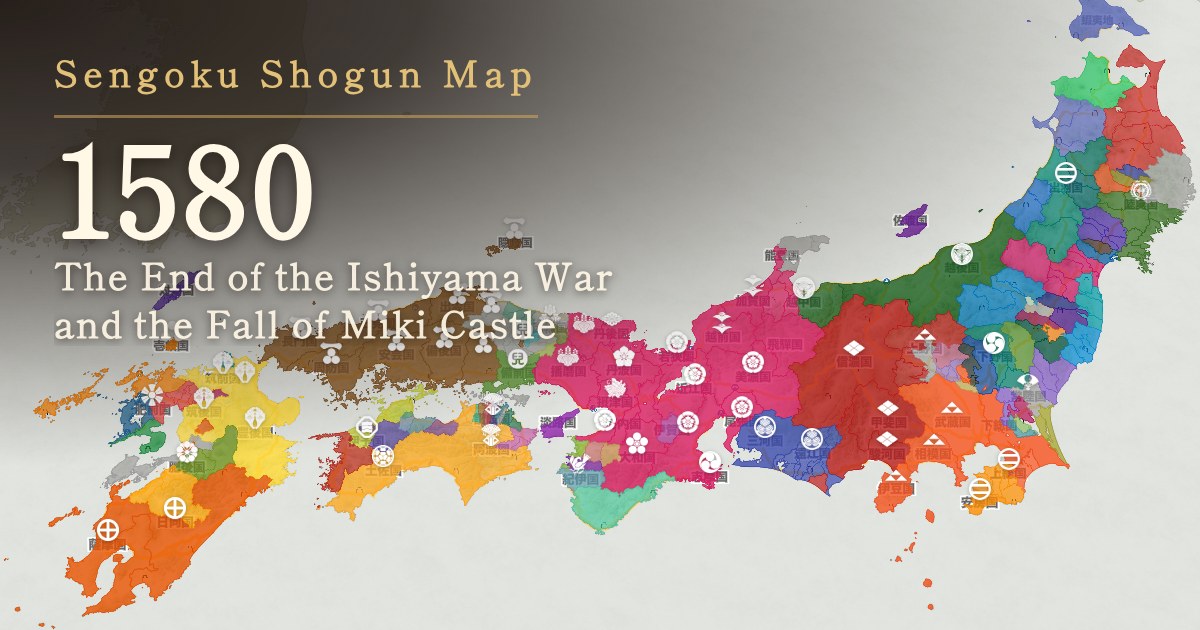
1580 was Tenshō 8 (kanoe-tatsu).
In January, after nearly two years of siege, Hashiba Hideyoshi forced the surrender of Bessho Nagaharu's Miki Castle, advancing his pacification of Harima. In April, Hongan-ji's leader Kennyo accepted a peace brokered by the imperial court and withdrew, and by August his son Kyōnyo, who had continued resistance, also surrendered the fortress, finally ending the decade-long Ishiyama War. In Echigo, the Otate no Ran also concluded with Uesugi Kagekatsu's victory, making this a year in which several long-running conflicts across the country reached their resolution.
1580 territory map: major daimyo and their provinces
Each province is counted under its main power. The map shows the finer division by district.
- 山城国 (Murai Sadakatsu), 大和国 (Tsutsui Junkei), 河内国 (Sakuma Nobumori, Miyoshi Yasunaga and others), 和泉国 (Oda Nobunaga, Lords of Izumi and others), 摂津国 (Ikeda Tsuneoki, Takayama Ukon, Nakagawa Kiyohide and others), 伊勢国 (Oda Nobunaga and others), 志摩国 (Kuki Yoshitaka), 尾張国 (Oda Nobunaga), 近江国 (Oda Nobunaga), 美濃国 (Oda Nobunaga, Oda Nobutada), 飛驒国 (Miki Yoritsuna), 若狭国 (Oda Nobunaga and others), 越前国 (Shibata Katsuie), 加賀国 (Shibata Katsuie), 丹波国 (Akechi Mitsuhide), 丹後国 (Hosokawa Fujitaka), 但馬国 (Hashiba Hidenaga), 播磨国 (Hashiba Hideyoshi)
Oda clan18 provinces
- 出雲国 (Mōri Terumoto), 石見国 (Mōri Terumoto), 隠岐国 (Mōri Terumoto), 備中国 (Mōri Terumoto), 備後国 (Mōri Terumoto), 安芸国 (Mōri Terumoto), 周防国 (Mōri Terumoto), 長門国 (Mōri Terumoto)
Mōri clan8 provinces
- 伊豆国 (Hōjō Ujimasa), 相模国 (Hōjō Ujimasa), 武蔵国 (Hōjō Ujimasa), 下総国 (Chiba Kunitane)
Later Hōjō clan4 provinces
- 筑前国 (Ōtomo Yoshimune), 筑後国 (Ōtomo Yoshimune), 豊前国 (Ōtomo Yoshimune), 豊後国 (Ōtomo Yoshimune)
Ōtomo clan4 provinces
- 日向国 (Shimazu Yoshihisa), 大隅国 (Shimazu Yoshihisa), 薩摩国 (Shimazu Yoshihisa)
Shimazu clan3 provinces
- 駿河国 (Takeda Katsuyori), 甲斐国 (Takeda Katsuyori), 信濃国 (Takeda Katsuyori)
Takeda clan3 provinces
- 三河国 (Tokugawa Ieyasu), 遠江国 (Tokugawa Ieyasu)
Tokugawa clan2 provinces
- 安房国 (Satomi Yoshiyori), 上総国 (Satomi Yoshiyori)
Satomi clan2 provinces
- 淡路国 (Atagi Kiyoyasu)
Atagi clan (Awaji)1 province
- 蝦夷地 (Kakizaki Suehiro)
Andō clan1 province
- 伊賀国
Iga Sokoku Ikki1 province
- 備前国 (Ukita Naoie)
Ukita clan1 province
- 対馬国
Sō clan1 province
- 壱岐国 (Matsuura Takanobu)
Matsuura clan1 province
- 越後国 (Uesugi Kagekatsu)
Uesugi clan1 province
- 土佐国 (Chōsokabe Motochika)
Chōsokabe clan1 province
- 佐渡国 (Honma clan)
Honma clan (Sado)1 province
- 肥前国 (Ryūzōji Takanobu)
Ryūzōji clan1 province
Provinces divided among several powers15 provinces
常陸国 (Satake Yoshishige and others), 上野国 (Hōjō Ujikuni and others), 下野国 (Utsunomiya Hirotsuna and others), 陸奥国 (Date Terumune and others), 出羽国 (Mogami Yoshimori and others), 能登国 (Cho Tsuratatsu and others), 越中国 (Uesugi Kagekatsu and others), 因幡国 (Yamana Toyokuni and others), 伯耆国 (Mōri Terumoto and others), 美作国 (Ukita Naoie and others), 紀伊国 (Saika Ikki (Saika Magoichi) and others), 阿波国 (Sogō Masayasu, Chōsokabe Motochika), 讃岐国 (Sogō Masayasu and others), 伊予国 (Kōno Michinao and others), 肥後国 (Sagara Yoshihisa and others)
Events this year
Month 2
Bekki Akitsura sent a letter to 13 commanders of Bungo, appealing to them about the danger to the domain after the defeat at Mimikawa and setting out remonstrance to Sōrin and Yoshimune and admonitions to senior retainers.
Sources 大分市フォーラム冊子ほか
2/2
After a siege lasting about twenty-two months, Bessho Nagaharu and his family took their own lives in exchange for sparing the garrison and townspeople, and Miki Castle surrendered to Hashiba Hideyoshi.
See this battle in detail →Sources 三木市「三木合戦とは【豊臣兄弟と三木】」/三木市「三木城跡及び付城跡・土塁(国指定史跡)」/三木市「三木合戦の史跡・スポット」
Month 4
Uesugi Kagekatsu took Tochio Castle, which had stayed on Kagetora’s side after the Otate disturbance, in the fourth month; Sanjō Castle fell in the sixth month through defection, ending the mop-up.
See this battle in detail →Sources 新潟県立図書館「新潟県年表」/長岡市「景勝安堵状」
4/9
Honganji leader Kennyo accepted an imperial-mediated peace and withdrew from Ishiyama Honganji, ending roughly ten years of war between the Honganji and Oda Nobunaga.
See this event in detail →Sources 大阪市「石山(大坂)本願寺推定地」/大阪市「特別史跡大坂城跡の特徴(大坂本願寺と寺内町)」
Month 5
Hashiba Hideyoshi entered Inaba, subdued Yamana Toyokuni and took Wakasa Onigajō and Kano Castle; Mōri-leaning retainers later expelled Toyokuni from Tottori Castle.
See this battle in detail →Sources 鳥取県公文書館「第137回県史だより 織田信長の山陰出陣計画と秀吉」/鳥取市「国指定史跡 日本百名城 鳥取城跡」
6/17
Ashina Moriuji, who built the peak of the Ashina clan's power, died at Kurokawa Castle in 会津 (later 若松城). He was 60.
Month 8
Ujimasa handed the headship to Ujinao in the same year he decided to submit to Oda Nobunaga. Ujimasa was called "the retired lord" (御隠居様) and continued to supervise Ujinao's administration by using the valid seal (有効の印判).
Shimazu Yoshihisa appointed his rōjū Uwai Kakukane as jitō of Miyazaki in Hyūga, and Kakukane moved to Miyazaki Castle. The Shimazu clan began governing Hyūga by installing jitō.
Sources 白石一美「上井覚兼日記の人称接尾語等について」(宮崎大学)
Nobunaga denounced Sakuma Nobumori and his son Nobuhide, who had served five years in the siege of Ishiyama Honganji, in a 19-article reprimand and banished them to Mount Kōya. The father and son later fled to Kumano.
8/2
Kennyo's son Kyōnyo left Osaka on boats sent from Saika and Awaji Island, and from the night of the second of the eighth month the temple's halls burned for three days and were destroyed.
8/21
Hosokawa Fujitaka, who had entered Tango, began building Miyazu Castle, and Nobunaga issued a black-seal letter (kokuin-jō) saying, "Consult well with Mitsuhide and build it solidly."
Sources 細川藤孝と明智光秀が築城!幻の海城「宮津城」の知られざる歴史とは - 宮津市
As the conquest of Tajima advanced, Hashiba Hidenaga entered Arikoyama Castle at Izushi and established a base for governing the province, entrusting Takeda Castle to his retainer Kuwayama Shigeharu.
After pacifying Harima, Hashiba Hideyoshi received Himeji Castle from Kuroda Yoshitaka, rebuilt it, and made it the base for campaigns into Tajima, Inaba, and Bitchū.
See this event in detail →Sources 兵庫県立歴史博物館「姫路城 年表」/姫路市「姫路城の歴史」/姫路市立城郭研究室「姫路城への道しるべ 第2章 姫路城の歴史」
After Nobunaga's peace settlement with Ishiyama Hongan-ji, Sakuma Morimasa, serving under Shibata Katsuie, captured Oyama Gobo, the headquarters of the Kaga Ikkō-ikki.
See this battle in detail →Sources 石川県「金沢城の歴史」
The Kimotsuki clan, whose lands had been cut back by the Shimazu, finally had everything but Takayama confiscated and was transferred to Ata in Satsuma Province, leaving the Ōsumi Peninsula.
Sources 鹿屋市「鹿屋の歴史」
Satomi Yoshiyori won the succession dispute against his younger brother Baiōmaru and made Okamoto Castle, on a hill overlooking Tokyo Bay, his base.
Sources 里見氏城跡 稲村城跡 岡本城跡 - 千葉県
Sanada Masayuki, who followed Takeda Katsuyori, attacked Numata Castle. Castellan Fujita Nobuyoshi surrendered, and from then on Numata became Sanada territory.
Sources https://www.city.numata.gunma.jp/kanko/1004186/1004286/sanada/1001161.html
Ryūzōji Takanobu retired and his heir Masaie succeeded to the headship. Takanobu is said, however, to have kept real power even after retiring.