INTERACTIVE BATTLE
Siege of Miki
March 1578 · Miki Castle
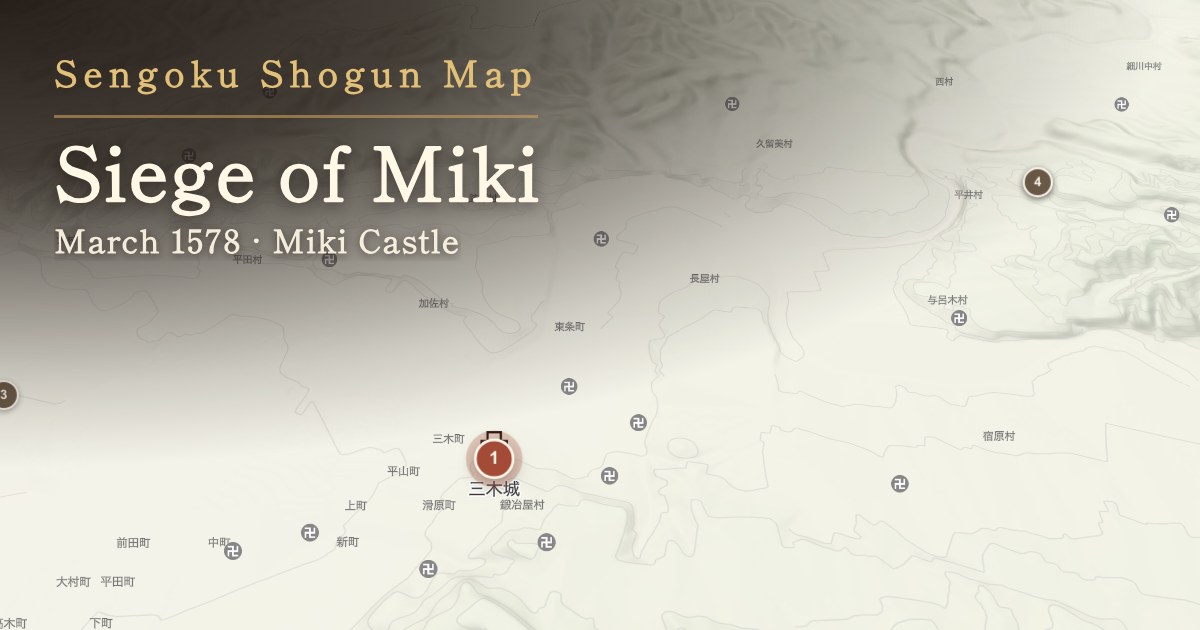
Bessho Nagaharu of Miki Castle broke with the Oda and aligned with the Mōri, prompting Hashiba Hideyoshi to begin the siege of Miki.
Background
In 1577, Bessho Nagaharu of Miki Castle, initially aligned with Oda, switched to the Mōri in 1578 just as Hashiba Hideyoshi, having arrived in Harima under Nobunaga's orders, was advancing westward. With the castle left unchecked, Hideyoshi's supply lines would be cut off and his advance blocked, so he constructed a ring of siege fortifications with auxiliary forts and earthworks.
Outcome
Hideyoshi's forces cut off access and supplies to the castle using auxiliary forts, with the blockade lasting about twenty-two months. Takenaka Shigetsugu died of illness in the field in 1579. In January 1580, Bessho Nagaharu took his own life and Miki Castle surrendered.
Course of the battle
1 March 1578
Siege of Miki Begins
Bessho Nagaharu of Miki Castle broke with the Oda and aligned with the Mōri, prompting Hashiba Hideyoshi to begin the siege of Miki.
Sources123·Certainty: Medium
2 July 1578
Oda Nobutada builds the fort on Hiraiyama
Oda Nobutada built the fort on Hiraiyama that became Hideyoshi’s headquarters, along with several others. The forts ringed Miki castle over some six kilometres east to west and five north to south, and are thought to have numbered about forty including probable sites.
Sources1245·Certainty: Medium
3 9–10 September 1579
The clash at Hirata and Omura
A force trying to carry provisions into Miki castle met Hideyoshi’s troops at Hirata and Omura. The supplies did not get through, and hunger inside the castle grew worse.
Sources1234·Certainty: Medium
4 17 October 1579
Hideyoshi tightens the ring with more forts
Hideyoshi raised further forts and closed the ring around Miki castle. Rather than storm it he cut its supply lines, and the siege ran for about a year and ten months. It came to be called the starving-out of Miki.
Sources1245·Certainty: Medium
5 17 January 1580
Bessho Nagaharu takes his life and Miki falls
Bessho Nagaharu and others took their own lives and Miki castle fell. The Bessho of Miki, the greatest power in eastern Harima, were finished, and Hideyoshi’s western campaign moved on.
Sources1234·Certainty: Medium
Historical significance
This is considered the first use of Hideyoshi's characteristic siege strategy of a long-term blockade with auxiliary forts and earthworks—a method he would later employ at Tottori and Takamatsu castles. The surrounding population endured widespread impacts, providing provisions, labor, and bearing casualties across a regional conflict.
Advertisement
Key figures
羽柴氏
4

General-in-Chief
Campaigned in Harima, besieged Miki Castle for an extended period, and forced Bessho Nagaharu to surrender.
Sources12·Certainty: High

Officer of Hashiba Hideyoshi
According to Miki, died of illness in the Hirayama encampment in June 1579.
Sources26·Certainty: High

Local daimyo of Harima supporting Hashiba
Conducted regional operations in Harima and supported Hashiba's siege of Miki.
Sources1·Certainty: Medium

Officer in charge of auxiliary fortifications
Constructed multiple auxiliary fortifications including Hirayama-no-kami, which served as Hashiba's headquarters.
Sources14·Certainty: High
別所氏
1

Lord of Miki Castle
Rebelled against the Oda, sided with the Mōri, and after about 21 months of siege committed suicide and surrendered the castle.
Sources12·Certainty: High
Other events of 1578
Sources consulted
- 三木市「三木合戦とは【豊臣兄弟と三木】」
- 三木市「三木城跡及び付城跡・土塁(国指定史跡)」
- 三木市「三木合戦の史跡・スポット」
- 三木市「平井山ノ上付城跡(国指定史跡)」
- 三木市「付城跡群」
- 三木市「竹中半兵衛の墓」
The numbers in the text refer to the list above. Certainty indicates how far a statement is supported by the cited sources; it does not refer to the precision of the coordinates or the dating.
Advertisement