1573 territory map and events: The Fall of the Muromachi Shogunate and the Collapse of the First Anti-Nobunaga Coalition
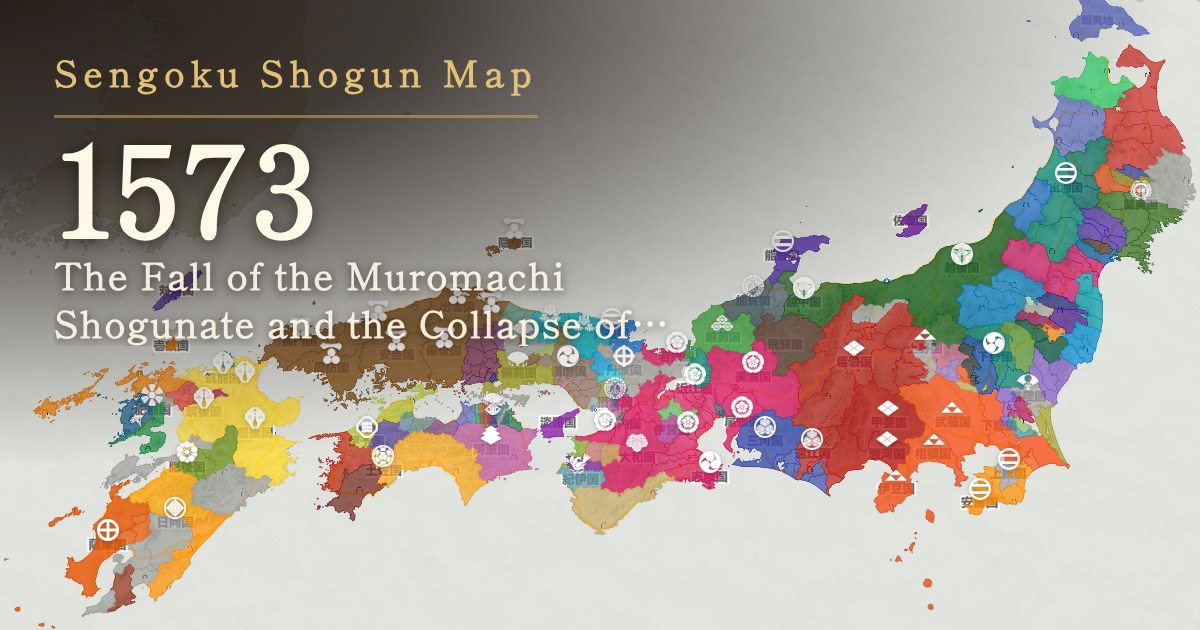
1573 was Tenshō 1 (mizunoto-tori).
As the anti-Nobunaga forces lost cohesion following the death of Takeda Shingen, Oda Nobunaga intensified his offensives in Kinai and Ōmi. By attacking Makishima Castle, he drove Ashikaga Yoshiaki from power, effectively bringing the Muromachi shogunate to an end. He then destroyed Azai Nagamasa and Asakura Yoshikage, causing the first anti-Nobunaga coalition to largely collapse. Regional realignments also advanced elsewhere, making this year a turning point in which leadership in the late Sengoku period shifted decisively toward the Oda side.
1573 territory map: major daimyo and their provinces
Each province is counted under its main power. The map shows the finer division by district.
- 山城国 (Murai Sadakatsu), 大和国 (Matsunaga Hisahide), 河内国 (Sakuma Nobumori, Miyoshi Yasunaga and others), 和泉国 (Oda Nobunaga, Lords of Izumi and others), 伊勢国 (Kitabatake Tomofusa and others), 志摩国 (Kuki Yoshitaka), 尾張国 (Oda Nobunaga), 美濃国 (Oda Nobunaga), 若狭国 (Oda Nobunaga and others)
Oda clan9 provinces
- 伯耆国 (Mōri Terumoto), 出雲国 (Mōri Terumoto), 石見国 (Mōri Terumoto), 隠岐国 (Mōri Terumoto), 備後国 (Mōri Terumoto), 安芸国 (Mōri Terumoto), 周防国 (Mōri Terumoto), 長門国 (Mōri Terumoto)
Mōri clan8 provinces
- 伊豆国 (Hōjō Ujimasa), 相模国 (Hōjō Ujimasa), 武蔵国 (Hōjō Ujimasa), 下総国 (Chiba Tanetomi)
Later Hōjō clan4 provinces
- 筑前国 (Ōtomo Sōrin), 筑後国 (Ōtomo Sōrin), 豊前国 (Ōtomo Sōrin), 豊後国 (Ōtomo Sōrin)
Ōtomo clan4 provinces
- 駿河国 (Takeda Katsuyori), 甲斐国 (Takeda Katsuyori), 信濃国 (Takeda Katsuyori)
Takeda clan3 provinces
- 但馬国 (Yamana Suketomi), 因幡国 (Yamana Toyokuni)
Yamana clan2 provinces
- 越中国 (Uesugi Kenshin), 越後国 (Uesugi Kenshin)
Uesugi clan2 provinces
- 安房国 (Satomi Yoshihiro), 上総国 (Satomi Yoshihiro)
Satomi clan2 provinces
- 淡路国 (Atagi Nobuyasu)
Atagi clan (Awaji)1 province
- 蝦夷地 (Kakizaki Suehiro)
Andō clan1 province
- 伊賀国
Iga Sokoku Ikki1 province
- 丹後国 (Isshiki Yoshimichi)
Isshiki clan1 province
- 備前国 (Uragami Munekage, Ukita Naoie)
Uragami clan1 province
- 阿波国 (Miyoshi Nagaharu)
Miyoshi clan1 province
- 備中国 (Mimura Motochika)
Mimura clan1 province
- 飛驒国 (Miki Yoritsuna)
Miki clan (Hida)1 province
- 対馬国
Sō clan1 province
- 壱岐国 (Matsuura Takanobu)
Matsuura clan1 province
- 越前国 (Asakura Yoshikage)
Asakura clan1 province
- 薩摩国 (Shimazu Yoshihisa)
Shimazu clan1 province
- 三河国 (Tokugawa Ieyasu)
Tokugawa clan1 province
- 能登国 (畠山義慶 and others)
Hatakeyama clan (Noto)1 province
- 佐渡国 (Honma clan)
Honma clan (Sado)1 province
- 加賀国 (Ikkō-ikki)
Honganji and Ikkō-ikki1 province
Provinces divided among several powers19 provinces
摂津国 (Araki Murashige and others), 遠江国 (Tokugawa Ieyasu and others), 常陸国 (Satake Yoshishige and others), 近江国 (Oda Nobunaga and others), 上野国 (Hōjō Ujikuni and others), 下野国 (Utsunomiya Hirotsuna and others), 陸奥国 (Date Terumune and others), 出羽国 (Mogami Yoshimori and others), 丹波国 (Hatano Hideharu and others), 播磨国 (Bessho Nagaharu and others), 美作国 (Uragami Munekage and others), 紀伊国 (Saika Ikki (Saika Magoichi) and others), 讃岐国 (Sogō Masayasu and others), 伊予国 (Kōno Michinao and others), 土佐国 (Chōsokabe Motochika and others), 肥前国 (Ryūzōji Takanobu and others), 肥後国 (Sagara Yoshihisa and others), 日向国 (Itō Yoshisuke and others), 大隅国 (Shimazu Yoshihisa and others)
Events this year
Spring
In Hokuriku, Uesugi Kenshin continued his involvement in Etchū and Noto, and tensions persisted with Oda-aligned forces and the Ikko-ikki.
1/25
Takeda forces clashed with the Tokugawa-Oda allied army at Mikatagahara in Totomi, and Ieyasu suffered a devastating defeat. Takeda Shingen's military prestige was displayed to the whole country and gave the anti-Nobunaga side a major psychological boost.
See this battle in detail →Sources 浜松市「犀ヶ崖古戦場」(静岡県指定史跡)
Month 3
When Ashikaga Yoshiaki rose against Nobunaga, Asakura Yoshikage marched as far as Tsuruga in the third month but could not advance against the strong defenses on the western shore of the lake, and the Esshū Gunki says he returned to Ichijōdani on the tenth of the fifth month.
Sources 福井県立図書館『福井県史』通史編2
Month 4
Takeda Shingen, who had been advancing on his western campaign, died of illness. With the loss of a figure capable of anchoring the anti-Nobunaga coalition, anti-Oda forces across the country lost much of their ability to coordinate.
Oda Nobunaga set fire to Kamigyō in Kyoto, and 6,000 to 7,000 houses are said to have burned. In the same month Nobunaga and Ashikaga Yoshiaki made a temporary peace by imperial order.
Summer
Mōri Terumoto remained wary of Oda expansion westward while maintaining defensive lines in the Chūgoku region. Although there was still room for coordination with Yoshiaki, the rapid change in Kinai politics led the Mōri to adopt a more cautious stance.
Month 7
While Shogun Ashikaga Yoshiaki continued calling on various daimyō to rise against Nobunaga, Oda Nobunaga attacked Makishima Castle near Kyoto. Yoshiaki was defeated, surrendered, and was expelled from Kyoto.
With the expulsion of Ashikaga Yoshiaki, the Ashikaga shogunate's system of control over Kyoto collapsed. This year is generally regarded as the year in which the Muromachi shogunate came to an end.
Autumn
Having advanced the unification of Tosa, the Chōsokabe clan sought to expand its influence into Awa and Iyo. The balance of power in Shikoku gradually began to break down.
7/28
As a saii kaigen (era change to ward off calamity), the imperial court (Emperor Ōgimachi) changed the era name from Genki to Tenshō. In the same month Ashikaga Yoshiaki was driven out of Kyoto.
Month 8
With the Oda army's invasion of Echizen, Asakura Yoshikage abandoned Ichijōdani and fled. Compounded by defections of his retainers, he took his own life at Kenshōji in Ōno District, and the sengoku-daimyo Asakura clan was destroyed.
Sources 福井県立一乗谷朝倉氏遺跡博物館「朝倉氏の歴史」
Saitō Tatsuoki, who had been driven from Inabayama Castle and taken refuge with Asakura Yoshikage, is said to have been killed in battle in Echizen when Oda Nobunaga destroyed the Asakura clan.
After the fall of the Asakura clan, Oda Nobunaga appointed Maenami Yoshitsugu (later Katsurada Nagatoshi), who had been the first to defect, as shugodai of Echizen, and confirmed the home lands of the former Asakura senior retainers who submitted.
Sources 福井県立図書館『福井県史』通史編2
8/2
Iwanari Tomomichi, one of the Miyoshi Triumvirate, was attacked by the Oda army at Yodo Castle, where he had holed up in opposition to Oda, and died in defeat. The Triumvirate lost its last major stronghold in the Kinai.
8/8
Atsuji Sadayuki, lord of the Azai-side Yamamotoyama Castle, surrendered to the Oda side, and on the 12th Asami Tsushima-no-kami also surrendered, after which the Oda army began attacking the Ōdake bailey of Odani Castle.
Sources 長浜市教育委員会「史跡小谷城跡保存管理計画書」
8/13
On the night of the 13th of the eighth month (lunar), the Oda army pursued the Asakura army as it retreated toward Echizen at Tonezaka and won a great victory. It decisively broke the Asakura clan's military base.
Month 9
Odani Castle in northern Ōmi fell to Oda forces, and Azai Nagamasa committed suicide. The Azai clan was destroyed, and northern Ōmi came under Oda control.
Sources 滋賀県教育委員会「近江戦国探訪ガイドブック2 信長の城と戦国近江」
Winter
In Kyushu, Shimazu Yoshihisa consolidated his base in southern Kyushu, and the rivalry with Ōtomo Sōrin continued. A tense balance remained in place on the eve of full-scale conflict.
10/17
The Shinchō-kō Ki records that Azai Nagamasa's heir Manpukumaru (aged 10) was crucified at Sekigahara. This was about a month and a half after Nagamasa took his own life.
Sources 長浜市教育委員会「史跡小谷城跡保存管理計画書」
11/16
Miyoshi Yoshitsugu, who had sided with Ashikaga Yoshiaki and turned against Nobunaga, was attacked by Sakuma Nobumori and others and took his own life at Wakae Castle. As the last head of the main Miyoshi line, his death meant the Miyoshi clan in the Kinai was virtually destroyed.
12/26
Hisamichi, son of Matsunaga Hisahide, handed Tamon Castle over to Sakuma Nobumori, a commander of Oda Nobunaga, and withdrew to Shigisan Castle. The Matsunaga clan's rule of Nara ended.
Oda Nobunaga sent Date Terumune a red-seal letter bearing the seal 「天下布武」. The year is said to be around 1573, and the document is preserved as an important cultural property in 伊達家文書.
Takayama Ukon became lord of Takatsuki Castle together with his father Hidakami. He undertook the expansion of the castle and development of the castle town, establishing it as a center of Christianity through the construction of over twenty churches.
Yamanaka Yukimori and others invaded Inaba from Tajima and welcomed Amago Katsuhisa, who had taken refuge in Oki. In September of the same year they captured Tottori Castle in Inaba.
Sources 島根歴史講座資料(島根県古代文化センター)
Takeda Shingen besieged Noda Castle in Mikawa Province, and Suganuma Sadamitsu held out for more than a month before surrendering. The attackers are said to have drained the castle's well.
Sources 新城市「武田信玄最期の城攻め『野田城』」「野田城跡」
After Shingen's death, the kokujin of 三河作手, 奥平貞能 and his son Okudaira Sadamasa, switched from the Takeda side to Tokugawa Ieyasu's side. Later, Okudaira Sadamasa held Nagashino Castle.
Sources 新城市「長篠城址史跡保存館展示解説」「奥平信昌」(座標は作手の亀山城)
Following the death of Takeda Shingen, Takeda Katsuyori succeeded to the headship. Shingen's death is said to have been kept secret for a time, and his formal funeral was held in 1576.
Sources コトバンク「武田勝頼」/甲州市「歴史的風致維持向上計画 第2章」。信玄の死を伏せた期間や家督の継ぎ方の論点には触れない
The senior retainers of the Ichijō family, who were in contact with Chōsokabe Motochika, pressed Kanesada to retire and installed his heir Uchimasa. Ichijō Uchimoto, who had come down from Kyoto, held Uchimasa's coming-of-age ceremony.