1569 territory map and events: The Honkokuji Incident
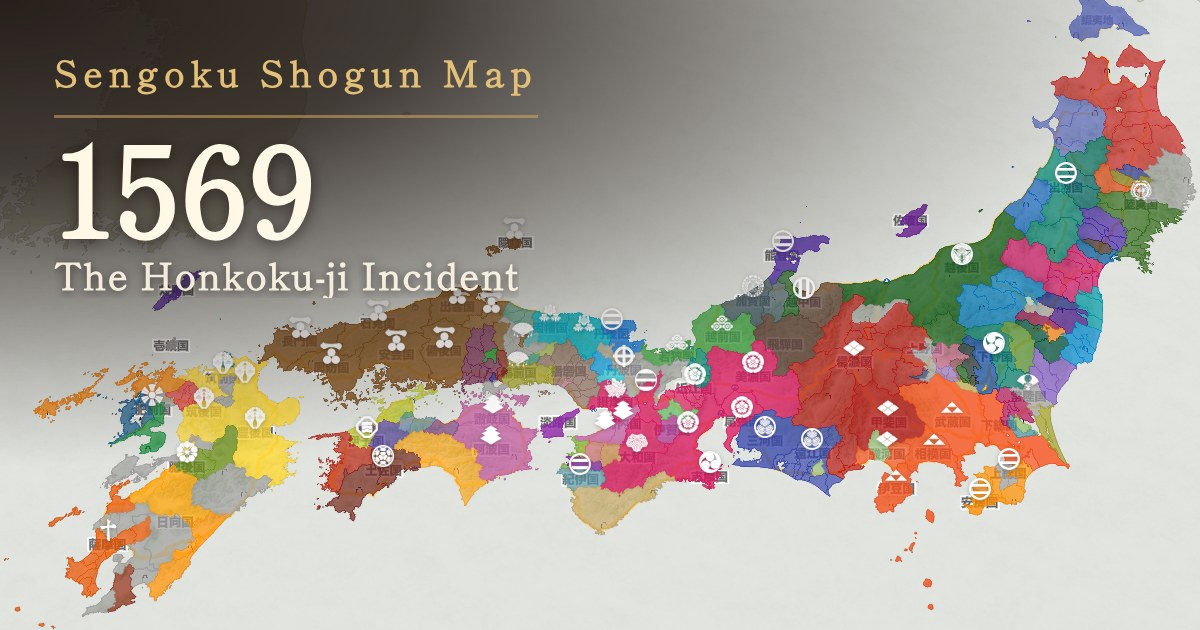
1569 was Eiroku 12 (tsuchinoto-mi).
In the 1st month, the Miyoshi Triumvirate attacked Honkokuji, the residence of Shogun Ashikaga Yoshiaki, but the attack was repelled. Oda Nobunaga began constructing a new palace for Yoshiaki. In the 10th month, Ōuchi Teruhiro attacked Yamaguchi in Suō but was defeated by Mōri forces.
1569 territory map: major daimyo and their provinces
Each province is counted under its main power. The map shows the finer division by district.
- 山城国 (Ashikaga Yoshiaki), 大和国 (Matsunaga Hisahide), 摂津国 (Ikeda Katsumasa, Itami Chikaoki, Wada Koremasa), 伊勢国 (Oda Nobunaga and others), 志摩国 (Kuki Yoshitaka), 尾張国 (Oda Nobunaga), 美濃国 (Oda Nobunaga)
Oda clan7 provinces
- 伯耆国 (Mōri Motonari), 出雲国 (Mōri Motonari), 石見国 (Mōri Motonari), 備後国 (Mōri Terumoto), 安芸国 (Mōri Terumoto), 周防国 (Mōri Terumoto), 長門国 (Mōri Terumoto)
Mōri clan7 provinces
- 伊豆国 (Hōjō Ujimasa), 相模国 (Hōjō Ujimasa), 武蔵国 (Hōjō Ujimasa), 下総国 (Chiba Tanetomi)
Later Hōjō clan4 provinces
- 河内国 (Miyoshi Yoshitsugu), 和泉国 (Miyoshi Yoshitsugu), 阿波国 (Miyoshi Nagaharu), 讃岐国
Miyoshi clan4 provinces
- 筑後国 (Ōtomo Sōrin), 豊前国 (Ōtomo Sōrin), 豊後国 (Ōtomo Sōrin)
Ōtomo clan3 provinces
- 但馬国 (Yamana Suketomi), 因幡国
Yamana clan2 provinces
- 越中国 (Jinbō Nagamoto), 越後国 (Uesugi Kenshin)
Uesugi clan2 provinces
- 若狭国 (Asakura Yoshikage and others), 越前国 (Asakura Yoshikage)
Asakura clan2 provinces
- 甲斐国 (Takeda Shingen), 信濃国 (Takeda Shingen)
Takeda clan2 provinces
- 淡路国 (Atagi Nobuyasu)
Atagi clan (Awaji)1 province
- 蝦夷地 (Kakizaki Suehiro)
Andō clan1 province
- 伊賀国
Iga Sokoku Ikki1 province
- 丹後国 (Isshiki Yoshimichi)
Isshiki clan1 province
- 備中国 (Mimura Motochika)
Mimura clan1 province
- 飛驒国 (Miki Yoshiyori)
Miki clan (Hida)1 province
- 対馬国
Sō clan1 province
- 三河国 (Tokugawa Ieyasu)
Tokugawa clan1 province
- 隠岐国 (Amago Katsuhisa, 山中幸盛, Oki clan)
Amago clan1 province
- 能登国 (畠山義慶 and others)
Hatakeyama clan (Noto)1 province
- 佐渡国 (Honma clan)
Honma clan (Sado)1 province
- 加賀国 (Honganji, Ikkō-ikki)
Honganji and Ikkō-ikki1 province
- 安房国 (Satomi Yoshihiro)
Satomi clan1 province
Provinces divided among several powers23 provinces
遠江国 (Tokugawa Ieyasu and others), 駿河国 (Takeda Shingen and others), 上総国 (Satomi Yoshihiro and others), 常陸国 (Satake Yoshishige and others), 近江国 (Oda Nobunaga, Azai Nagamasa), 上野国 (Asari Nobutane and others), 下野国 (Utsunomiya Hirotsuna and others), 陸奥国 (Date Terumune and others), 出羽国 (Mogami Yoshimori and others), 丹波国 (Hatano Hideharu and others), 播磨国 (Akamatsu Yoshisuke), 美作国 (Uragami Munekage and others), 備前国 (Uragami Munekage and others), 紀伊国 (Hatakeyama Takamasa and others), 伊予国 (Kōno Michinao and others), 土佐国 (Chōsokabe Motochika and others), 筑前国 (Ōtomo Sōrin and others), 肥前国 (Ryūzōji Takanobu and others), 肥後国 (Sagara Yoshihisa and others), 日向国 (Itō Yoshisuke and others), 大隅国 (Shimazu Takahisa and others), 薩摩国 (Shimazu Takahisa and others), 壱岐国 (Hata clan, Hidaka clan)
Events this year
Month 1
While Nobunaga had returned to Gifu, the Miyoshi Triumvirate and others attacked Honkokuji, Ashikaga Yoshiaki's residence, but were beaten back by the defenders and reinforcements. Nobunaga hurried to Kyoto.
1/14
Oda Nobunaga drew up the Denchū Okite, rules for order in the shogun's palace, and Ashikaga Yoshiaki approved them and added his seal. They are said to have forbidden the shogun from meeting daimyo's retainers in private and the like.
Sources 国立国会図書館レファレンス協同データベース
1/17
Tokugawa Ieyasu personally took position on Tennōzan, about 900 m east of Kakegawa Castle, and began the attack on the castle where Ujizane was holed up. The attack and defense then continued until the fifth month. The date is in the lunar calendar.
Sources 掛川市「徳川家康と掛川城のかかわり~掛川城の戦いを中心に~」
1/24
The Mōri clan killed at the shrine front the brothers of Wachi Masaharu, who had run into the grounds of Itsukushima Shrine in the twelfth month of the previous year.
Sources 広島県文書館「広島県史年表(中世2)」(房顕覚書)
Month 4
The Asakura clan and the leadership of Honganji and Kaga concluded a peace, ending the enmity that had lasted since Eishō 3 (1506). The ban on the Ikkō sect in Echizen, which had lasted about 60 years, was also lifted.
Sources 福井県立図書館『福井県史』通史編2
5/17
Tokugawa Ieyasu besieged Imagawa Ujizane in Kakegawa Castle for more than five months. On the 17th of the fifth month Ujizane surrendered the castle and withdrew to Izu, coming under the protection of the Hōjō clan, and the sengoku-daimyo Imagawa clan came to an end.
Sources 掛川市「掛川城の歴史」
Leap 5/3
The Mōri army took Tachibana Castle in Chikuzen in the intercalary fifth month and faced the Ōtomo across the Tatara River, but withdrew from Chikuzen around October, leaving troops behind.
Sources 広島県文書館『広島県史年表(中世2)』/文化庁・九州国立博物館「小早川隆景書状」/北九州市「門司の歴史」9.戦国時代
8/7
Fujii Kōgen rose in revolt against Sugihara Morishige, lord of Kannabe Castle. In October of the same year, Narasaki Toyokage seized Kannabe Castle and sent Kōgen's head to Mōri Motonari's camp.
Sources 広島県史年表(中世2)
8/11
Chōsokabe Motochika took Kanaoka Castle, fought at Yanagare and closed in on Aki Castle, and Kunitora took his own life on condition that his men be spared. The Aki clan was destroyed and eastern Tosa fell into Motochika's hands.
8/26
Oda Nobunaga attacked Kitabatake Tomonori, provincial governor of Ise, at Ōkōchi Castle. After surrounding it with multiple palisades and besieging it for roughly fifty days, a settlement was reached whereby Nobunaga's third son became the adopted heir of Kitabatake Tomonori, effectively bringing the Kitabatake clan under Nobunaga's control.
Sources 三重県「大河内城の戦いと信長の伊勢進攻」
Month 10
Takeda Shingen led a large army to besiege Odawara Castle in Sagami. While withdrawing from the siege to return to Kai, his forces clashed with the Hōjō, resulting in the Battle of Mimase Pass.
Sources 小田原市「新・北条五代記 四代氏政の時代」
As the Takeda army retreated toward Kai after lifting the siege of Odawara Castle, the Hōjō pursued them, resulting in a battle at Mimasaka Pass. According to Aikawa Town's account, the Hōjō initially had the upper hand, but when Yamamoto Kagesuke's unit launched a surprise attack from higher ground, the situation changed in favor of the Takeda, who ultimately won. Casualty figures of 3,269 for the Hōjō and 900 for the Takeda are presented, but these are traditional estimates provided by the town and not confirmed figures.
See this battle in detail →Sources 愛川町「三増合戦史跡」
Ōuchi Teruhiro, backed by the Ōtomo, invaded Yamaguchi and attacked Takamine Castle, but was pursued by Kikkawa Motoharu's forces and killed himself at Tonomi in Suō.
Sources 広島県文書館『広島県史年表(中世2)』/島根県「島根歴史講座 尼子家の『御一家再興』戦争と山中幸盛」
Shingen entered Musashi from western Kōzuke and attacked Hōjō Ujikuni at Hachigata Castle. In the tenth month of that year he fought the Hōjō forces at Mimase Pass.
Sources https://www.city.takasaki.gunma.jp/uploaded/attachment/40400.pdf
When Takeda Shingen invaded Hōjō territory, Takiyama Castle was also attacked. Hōjō Ujiteru is said to have defended it and held out.
Sources https://www.city.hachioji.tokyo.jp/kankobunka/003/003/001/001/p005254.html
Month 11
The Takeda army laid siege to Fukasawa Castle, a strategic strongpoint connecting Suruga, Sagami, and Kai, which surrendered in the first month of Genki 1 the following year.
Sources 静岡県「しずおか文化財ナビ 深沢城跡」
On the orders of Shogun Ashikaga Yoshiaki, the Mōri sought peace with the Ōtomo from around August, and in November Ōtomo Sōrin agreed to it.
Sources 広島県文書館『広島県史年表(中世2)』
12/6
On the sixth day of the twelfth month of Eiroku 12 (1569, lunar calendar), Takeda Shingen again invaded Suruga and captured 蒲原城 at the mouth of the 富士川. Yamagata Masakage entered the castle.
Oda Nobunaga expanded the former Buei encampment and built a fortified Nijō palace for Ashikaga Yoshiaki, who had become shogun the previous year.
Following Takeda Shingen's invasion of Suruga, Hōjō Ujiyasu and Ujimasa pursued peace with their longtime enemy Uesugi Kenshin. The two houses formed the Etsusō Alliance to oppose the Takeda.
Sources おだわらデジタルミュージアム「北条氏康書状(永禄12年3月13日)」
Yamanaka Yukimori and other former Amago retainers, backing Amago Katsuhisa, invaded Izumo and, holding Niiyama Castle among others, fought Amano Takashige at Tomita Castle. The Amago restoration war began.
Sources 島根県「島根歴史講座 尼子家の『御一家再興』戦争と山中幸盛」/広島県文書館『広島県史年表(中世2)』/文化庁・九州国立博物館「小早川隆景書状」
The Mōri clan of the Chūgoku region built a castle at Kokura, where the present Kokura Castle stands. Hosokawa Tadaoki later laid the foundations of the present castle.
Sources 小倉城と小倉藩 - 北九州市
Kinoshita Tōkichirō (later Toyotomi Hideyoshi) attacked Tajima, and within about ten days 18 castles from Ikuno to Konokosumiyama fell. The Yamana clan's headquarters also fell.
Sources 朝来市「竹田城の歴史」/豊岡市「国指定史跡 有子山城跡」
Satake Yoshishige defeated Oda Ujiharu in the battle at Tebasaka, and Ujiharu lost Oda Castle. Afterward Oda Castle became one of the Satake's branch castles.
Sources コトバンク「小田城」(日本の城がわかる事典)
The Hishikari clan submitted to the Shimazu clan, and Niiro Tadamoto entered Ōkuchi Castle as its first jitō. In the same year Irikiin Shigetsugu also gave up his domain and became a Shimazu retainer.
Sources 伊佐市広報/文化遺産オンライン「清色城跡」