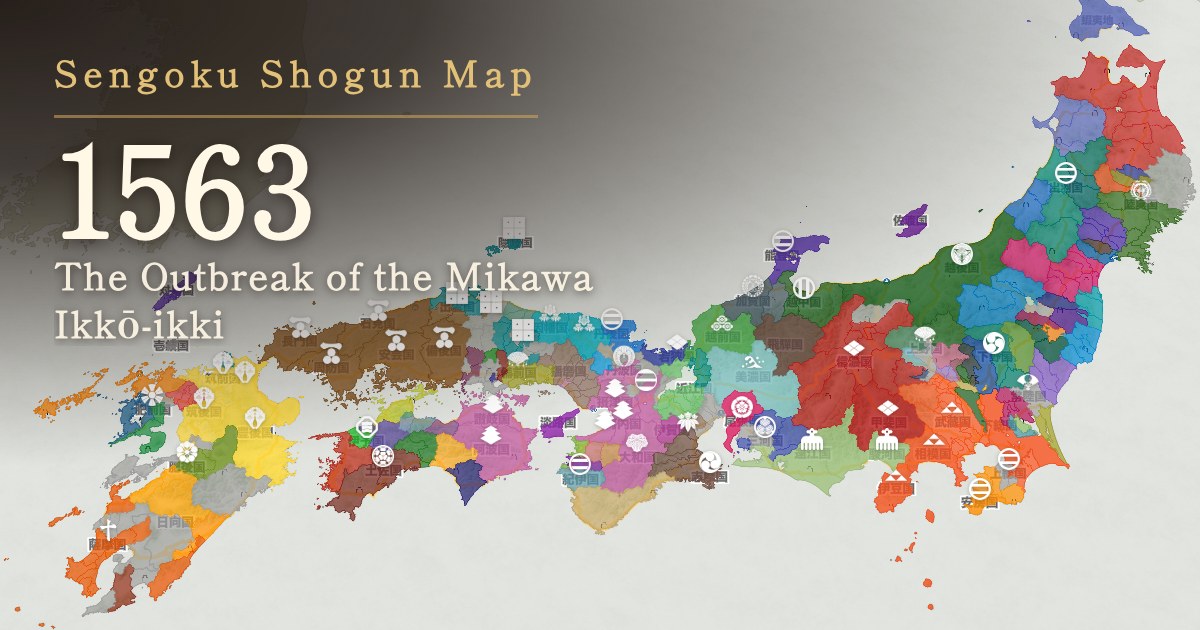
1563 territory map and events: The Outbreak of the Mikawa Ikkō-ikki
1563 was Eiroku 6 (mizunoto-i).
Kūshō, the head priest of Honshō-ji in Mikawa, rallied followers, and an Ikkō-ikki uprising against Matsudaira Ieyasu (the future Tokugawa Ieyasu) erupted across western Mikawa. Some of Ieyasu's own hereditary retainers, including Honda Masanobu, joined the rebels, splitting his vassal band. The six-month revolt was later counted by Ieyasu himself among the three greatest crises of his life.
1563 territory map: major daimyo and their provinces
Each province is counted under its main power. The map shows the finer division by district.
- 山城国 (Ashikaga Yoshiteru), 大和国 (Matsunaga Hisahide), 河内国 (Miyoshi Nagayoshi), 和泉国 (Miyoshi Nagayoshi), 摂津国 (Miyoshi Nagayoshi), 阿波国 (Miyoshi Nagayoshi), 讃岐国
Miyoshi clan7 provinces
- 石見国 (Mōri Motonari), 備後国 (Mōri Terumoto), 安芸国 (Mōri Terumoto), 周防国 (Mōri Terumoto), 長門国 (Mōri Terumoto)
Mōri clan5 provinces
- 伊豆国 (Hōjō Ujimasa), 相模国 (Hōjō Ujimasa), 武蔵国 (Hōjō Ujimasa), 下総国 (Chiba Tanetomi)
Later Hōjō clan4 provinces
- 筑前国 (Ōtomo Sōrin), 筑後国 (Ōtomo Sōrin), 豊前国 (Ōtomo Sōrin), 豊後国 (Ōtomo Sōrin)
Ōtomo clan4 provinces
- 遠江国 (Imagawa Ujizane), 駿河国 (Imagawa Ujizane)
Imagawa clan2 provinces
- 但馬国 (Yamana Suketomi), 因幡国
Yamana clan2 provinces
- 越中国 (Jinbō Nagamoto), 越後国 (Uesugi Kenshin)
Uesugi clan2 provinces
- 甲斐国 (Takeda Shingen), 信濃国 (Takeda Shingen)
Takeda clan2 provinces
- 淡路国 (Atagi Haruoki)
Atagi clan (Awaji)1 province
- 蝦夷地 (Kakizaki Suehiro)
Andō clan1 province
- 伊賀国
Iga Sokoku Ikki1 province
- 丹後国 (Isshiki Yoshimichi)
Isshiki clan1 province
- 志摩国 (Kuki Yoshitaka)
Kuki clan1 province
- 美濃国 (Saitō Tatsuoki)
Saitō clan1 province
- 飛驒国 (Miki Yoshiyori)
Miki clan (Hida)1 province
- 若狭国 (Takeda Yoshimune and others)
Wakasa-Takeda clan1 province
- 対馬国
Sō clan1 province
- 尾張国 (Oda Nobunaga)
Oda clan1 province
- 越前国 (Asakura Yoshikage)
Asakura clan1 province
- 隠岐国 (Amago Yoshihisa)
Amago clan1 province
- 能登国 (Hatakeyama Yoshitsuna)
Hatakeyama clan (Noto)1 province
- 佐渡国 (Honma clan)
Honma clan (Sado)1 province
- 加賀国 (Honganji, Ikkō-ikki)
Honganji and Ikkō-ikki1 province
- 安房国 (Satomi Yoshihiro)
Satomi clan1 province
Provinces divided among several powers25 provinces
伊勢国 (Kitabatake Tomonori and others), 三河国 (Matsudaira Ieyasu and others), 上総国 (Satomi Yoshihiro and others), 常陸国 (Satake Yoshishige and others), 近江国 (Rokkaku clan, Azai clan), 上野国 (Nagano Narimori and others), 下野国 (Utsunomiya Hirotsuna and others), 陸奥国 (Date Harumune and others), 出羽国 (Mogami Yoshimori and others), 丹波国 (Naito Munekatsu and others), 伯耆国 (Amago Yoshihisa and others), 出雲国 (Amago Yoshihisa and others), 播磨国 (Akamatsu Yoshisuke), 美作国 (Amago Yoshihisa and others), 備前国 (Uragami Munekage and others), 備中国 (Mimura Iechika and others), 紀伊国 (Hatakeyama Takamasa and others), 伊予国 (Kōno Michinao and others), 土佐国 (Chōsokabe Motochika and others), 肥前国 (Ryūzōji Takanobu and others), 肥後国 (Sagara Yoshihisa and others), 日向国 (Itō Yoshisuke and others), 大隅国 (Shimazu Takahisa and others), 薩摩国 (Shimazu Takahisa and others), 壱岐国 (Hata and others)
Events this year
Month 1
Motoyama Shigetoki, defeated in the struggle with Chōsokabe Motochika, burned Asakura Castle (in Tosa) and withdrew to his base at Motoyama. The western side of the Kōchi plain came under the Chōsokabe clan's influence.
1/27
Amano Takashige, a castle commander on the Mōri side, repelled the Ōtomo army that attacked Matsuyama Castle in Buzen. This was a time when the Mōri and Ōtomo were contesting Buzen.
Sources 広島県史年表(中世2)
3/1
Hosokawa Harumoto, once lord of the Miyoshi clan, spent his last years at Fumonji in Tonda under the watch of Miyoshi Yoshioki, and died there. His grave is at the same temple.
8/4
On the march to the Izumo campaign, Mōri Takamoto died suddenly at Sasabe in Aki. His son Terumoto became head while still a child, with his grandfather Motonari as guardian.
Sources 広島県文書館「広島県史年表(中世2)」/山口県文書館「毛利輝元没後400年」
8/26
Miyoshi Yoshioki, Nagayoshi's heir and lord of Akutagawayama Castle, died there. His grave is at Reishō-ji in Tenjin-chō, Takatsuki.
Sources 高槻市「続日本100名城 芥川山城跡」/高槻市「BOTTOたかつき 芥川山城跡」
Month 10
The Mōri drove an Amago commander to Oki and occupied Shiraga Castle. Amago Yoshihisa lost his link between Tomita Castle and the Shimane Peninsula.
Sources 島根県古代文化センター「島根歴史講座 尼子家の『御一家再興』戦争と山中幸盛」資料/広島県文書館『広島県史年表(中世2)』
Month 12
The Mōri occupied Shirakaya Castle in Izumo and drove Matsuda Masayasu to Oki; around December of the same year they took control of Oki. Amago Yoshihisa was cut off from contact with the Shimane Peninsula.
Sources 島根歴史講座「尼子家の『御一家再興』戦争と山中幸盛」資料(島根県古代文化センター)
Oda Nobunaga built Komakiyama Castle as a base for his campaign into Mino, moved there from Kiyosu, and developed a planned castle town below the mountain.
Tokugawa Ieyasu's forces clashed with followers of the Honganji school centered on Mikawa's three major temples, and his retainers split between the two sides. The conflict continued until a settlement and suppression in spring 1564.
See this battle in detail →Sources 岡崎市「歴史文化の特徴」/安城市図書情報館「新編安城市史5 細目次」/岡崎市「市指定:史跡 上宮寺境内地」/愛知県総合教育センター「三河一向一揆と本證寺」
Kūsei, abbot of Honshōji, and forces including Hatoya Hannosuke, based at Shōmanji, barricaded themselves in a fortified temple town and confronted Tokugawa Ieyasu's forces.
Sources 安城市「本證寺境内」/岡崎市「市指定:史跡 勝鬘寺境内地」
Ōmura Sumitada was baptized at the church in Yokoseura and became Japan's first Christian daimyo. The same year the port was burned in an attack by anti-Sumitada forces.
Sources 西海市「県指定文化財(史跡 横瀬浦)」/観光庁多言語解説文データベース「長崎を中心とするキリシタン関連年表」
Mōri Motonari and Takamoto presented the Ōmori silver mine in Iwami to the imperial court and the shogunate, apparently to gain legitimacy for their control of the mine.
Sources 島根県「令和2年度 島根の世界遺産講座」資料/広島県文書館『広島県史年表(中世2)』
In the year of the Mikawa Ikkō uprising, Matsudaira Motoyasu changed his name to Ieyasu. The National Archives chronology dates this to between June and October.
Sources 国立公文書館「徳川家康 関係年表」
Uesugi Terutora (Kenshin) captured Gion Castle, and Oyama Hidetsuna surrendered and sent hostages to Kasugayama Castle in Echigo.
Sources 小山市の年表(付録) - 小山市
Chōsokabe Motochika married a daughter of the Ishiya clan, a family of Muromachi shogunate bugyōnin. This tie would later connect Motochika with the Oda side.
Uragami Munekage, based at Tenjinyama Castle in eastern Bizen, made peace with his estranged elder brother Uragami Masamune, bringing the fighting in eastern Bizen to a temporary end.
Sources 岡山県「備前・備中・美作の戦国」