1601 territory map and events: The Aftermath of Sekigahara—A Sweeping Reshuffle of the Daimyo
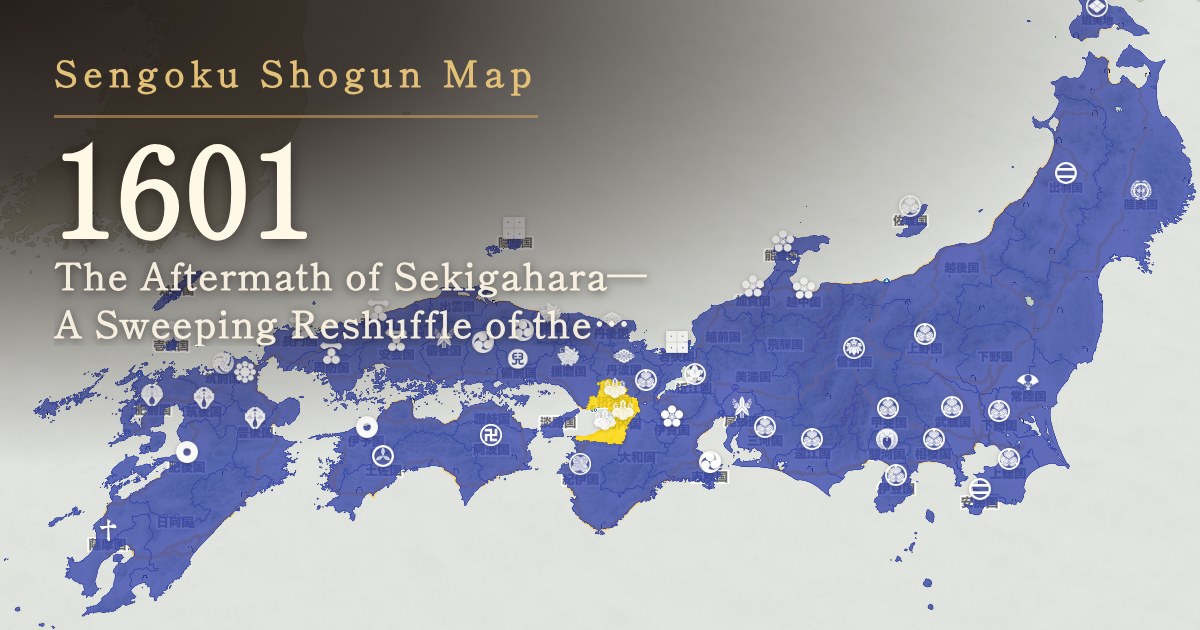
1601 was Keichō 6 (kanoto-ushi).
Soon after his victory at Sekigahara, Tokugawa Ieyasu carried out a reward and punishment campaign, stripping fiefs from daimyo who had sided with the Western Army while granting increased holdings to those who had backed him. Many daimyo who owed their positions to the Toyotomi were relocated to distant regions such as Chūgoku, Shikoku, and Kyūshū, while the strategic Kinai and Tōkaidō regions were filled with Tokugawa relatives and hereditary vassals, establishing the pattern of daimyo placement that would define the Edo period.
1601 territory map: major daimyo and their provinces
Each province is counted under its main power. The map shows the finer division by district.
- 山城国 (Tokugawa Ieyasu, Itakura Katsushige), 大和国 (Lords of Yamato, Tokugawa intendants and others), 伊賀国 (Tsutsui Sadatsugu), 伊勢国 (Tomita Nobutaka, Honda Tadakatsu and others), 志摩国 (Kuki Moritaka), 尾張国 (Matsudaira Tadayoshi), 三河国 (Tokugawa Ieyasu(直轄) and others), 遠江国 (Matsudaira Sadakatsu and others), 駿河国 (Naitō Nobunari), 甲斐国 (Tokugawa Ieyasu), 伊豆国 (Tokugawa Ieyasu), 相模国 (Ōkubo Tadachika and others), 武蔵国 (Tokugawa Ieyasu), 安房国 (Satomi Yoshiyasu), 上総国 (Honda Tadatomo and others), 下総国 (Tokugawa Ieyasu), 常陸国 (Satake Yoshinobu), 近江国 (Ii Naomasa, Toda Kazuaki, Tokugawa intendants and others), 美濃国 (Okudaira Nobumasa, Ishikawa Yasumichi and others), 飛驒国 (Kanamori Nagachika, Kanamori Arishige), 信濃国 (Ishikawa Yasunaga and others), 上野国 (Sakai Shigetada and others), 下野国 (Okudaira Iemasa and others), 陸奥国 (Date Masamune and others), 出羽国 (Mogami Yoshiaki and others), 若狭国 (Kyōgoku Takatsugu, Kyōgoku Tadataka), 越前国 (Yūki Hideyasu), 加賀国 (Maeda Toshinaga), 能登国 (Maeda Toshinaga), 越中国 (Maeda Toshinaga), 越後国 (Hori Hideharu and others), 佐渡国 (Tokugawa intendants and others), 丹波国 (Maeda Gen'i, Arima Toyouji and others), 丹後国 (Kyōgoku Takatomo), 但馬国 (Sugihara Nagafusa and others), 因幡国 (Ikeda Nagayoshi, Kamei Korenori, Yamazaki Iemori and others), 伯耆国 (Nakamura Kazutada), 出雲国 (Horio Yoshiharu, Horio Tadauji), 石見国 (Tokugawa intendants, Ōkubo Nagayasu and others), 隠岐国 (Horio Yoshiharu, Horio Tadauji), 播磨国 (Ikeda Terumasa), 美作国 (Kobayakawa Hideaki and others), 備前国 (Kobayakawa Hideaki), 備中国 (Tokugawa intendants, Kinoshita Iesada and others), 備後国 (Fukushima Masanori), 安芸国 (Fukushima Masanori), 周防国 (Mōri Terumoto), 長門国 (Mōri Terumoto), 紀伊国 (Asano Yoshinaga), 淡路国 (Wakisaka Yasuharu), 阿波国 (Hachisuka Yoshishige), 讃岐国 (Ikoma Kazumasa), 伊予国 (Katō Yoshiaki, Tōdō Takatora and others), 土佐国 (Yamauchi Kazutoyo), 筑前国 (Kuroda Nagamasa), 筑後国 (Tanaka Yoshimasa), 豊前国 (Hosokawa Tadaoki), 豊後国 (Nakagawa Hidenari, Inaba Sadamichi, Hosokawa Tadaoki, Kinoshita Nobutoshi, Takenaka Shigetoshi and others), 肥前国 (Nabeshima Katsushige, Terasawa Hirotaka, Matsuura clan, Ōmura Yoshiaki and others), 肥後国 (Katō Kiyomasa, Sagara Yorifusa and others), 日向国 (Lords of Hyūga and others), 大隅国 (Shimazu Yoshihisa), 薩摩国 (Shimazu Yoshihisa), 壱岐国 (Matsuura clan), 対馬国 (Sō clan), 蝦夷地 (Matsumae Yoshihiro)
Tokugawa regime66 provinces
- 河内国 (Toyotomi Hideyori, Hōjō Ujimori and others), 和泉国 (Toyotomi Hideyori), 摂津国 (Toyotomi Hideyori, Shinjō Naoyori, Arima Noriyori and others)
Toyotomi clan3 provinces
Events this year
Month 1
Ieyasu issued official documents stamped with his vermillion seal (the 'Tenpma Shuin-jō') and regulations (the 'Gotenpma-no-sadame') specifying the number of horses to be kept at relay stations along the Tōkaidō, establishing the early modern Tōkaidō relay station system.
Sources 国土交通省関東地方整備局横浜国道事務所「伝馬朱印状とはどういうものですか?」
1/8
After being granted Tosa Province following Sekigahara, Yamauchi Kazutoyo traveled overland from Kannoura and entered Urado Castle.
Month 5
To standardize the quality of silver throughout the realm, Ieyasu established the Fushimi Silver Guild. Administrative offices and residences for officials were built across four districts, creating a central mechanism for minting and managing Keichō-era gold and silver.
Sources 京都市「伏見銀座跡(フィールドミュージアム京都)」
The Shiryō Sōran is said to record that, after Sekigahara, the troops of Itō Sukenori of Obi and the Shimazu-side troops of Sadowara fought at Mukasa. The course and outcome have not been confirmed.
Sources 四本健光「島津氏と関ケ原合戦」の注(『史料綜覧』の引用)
After Sekigahara, Sanada Masayuki and Nobushige surrendered Ueda Castle to the Tokugawa side, and the castle was dismantled.
After surrendering Ueda Castle, Sanada Masayuki and Nobushige were exiled to Kudoyama below Mount Kōya in Kii Province.
After Sekigahara, Uesugi Kagekatsu was reduced from 1.2 million koku in Aizu to 300,000 koku at Yonezawa and shifted the center of his domain there.
Sources 米沢市「米沢の歴史」/米沢市教育委員会文化財年報
Tokugawa Ieyasu ordered western daimyō to build Nijō Castle as a guard for the Kyoto Imperial Palace and a residence for shogunal visits.
Sources 京都市「元離宮二条城 年表」
Transferred from Ōtaki to Kuwana in Ise Province with 100,000 koku, Tadakatsu became the first daimyo of Kuwana. He oversaw development of the castle town through Keichō-era urban planning and established Kuwana's foundation.
Sources 桑名市「桑名の歴史をたずねて」
Uwajima Castle, which Takatori directed, was completed in 1601. It became his first modern-era castle as a daimyo.
Sources 宇和島市「国指定 宇和島城」
Masamune, who had decided to relocate to Sendai and laid out the plans in 1600, began the full-scale construction of Sendai Castle in 1601.
Sources 仙台市「仙台城の紹介-仙台城の歴史-」
Following the discovery of gold and silver mines at Aikawa, Sado Island was placed under direct shogunate control. Bugyō Okubo Nagayasu administered Sado, which soon became a crucial pillar of shogunate finances.
Sources 新潟県佐渡市「国指定 記念物:佐渡金銀山遺跡」
Kuroda Nagamasa, who entered Chikuzen after Sekigahara, began construction of Fukuoka Castle and a castle town at Fukusaki in Kego Village, naming the new castle town Fukuoka.
Sources 福岡市「福岡城跡」/福岡市博物館「黒田長政の筑前入国」
Kuwayama Kazuharu, who had left Kii, entered Shinjō as lord of the Yamato Shinjō domain and built a jin'ya and a jin'ya town as the base of domain administration.
Sources 葛城市「第12回特別展『桑山一族の興隆』」
The Western Army's Tachibana Muneshige was dispossessed after Sekigahara, and the Eastern Army's Tanaka Yoshimasa is said to have received all of Chikugo and entered Yanagawa Castle in his place.
Sources 立花宗茂と吉政 - 柳川市
After Sekigahara the Hosokawa moved to Buzen, and Kyōgoku Takatomo of Iida in Shinano was granted Tango and entered the province. He is said to have gone to Tanabe Castle rather than the burned Miyazu Castle.
Sources 舞鶴市文化財調査報告書第51集
Kyōgoku Takatsugu, who received all of Wakasa for his service at Sekigahara, abandoned the castle on Mt. Nochise and began building Obama Castle at Kumohama, at the mouths of the Kitagawa and Minamigawa rivers.
Sources 史跡後瀬山城跡整備基本計画 - 小浜市教育委員会
As a reward for his merit at Sekigahara, Mogami Yoshiaki was granted additional territory: the three districts of Shōnai. This ended Uesugi Kagekatsu's rule over Shōnai.
Sources 鶴岡市「庄内歴史ハンドブック」(座標は鶴ヶ岡城)
In the transfer to Suō and Nagato after Sekigahara, Kikkawa Hiroie left Tonda in Izumo, landed at Yuu in Suō and entered Iwakuni to become its lord. His stipend was 30,000 koku.
Sources コトバンク「吉川広家」「萩藩」
Hidenari, head of the Mōri family, was kept in Edo as a hostage and is said to have been permitted to return home in 1611.
Sources コトバンク「毛利秀就」
After Sekigahara, Ieyasu's second son Yūki Hideyasu, who had been given Echizen, entered Kitanoshō Castle and became the first lord of Fukui domain. He greatly rebuilt Kitanoshō Castle and laid the foundations of Fukui Castle.
Sources 福井県「徳川家康・結城秀康ゆかりのスポット」/新修名古屋市史 第2巻