1598 territory map and events: The Death of Hideyoshi and the Withdrawal from Korea
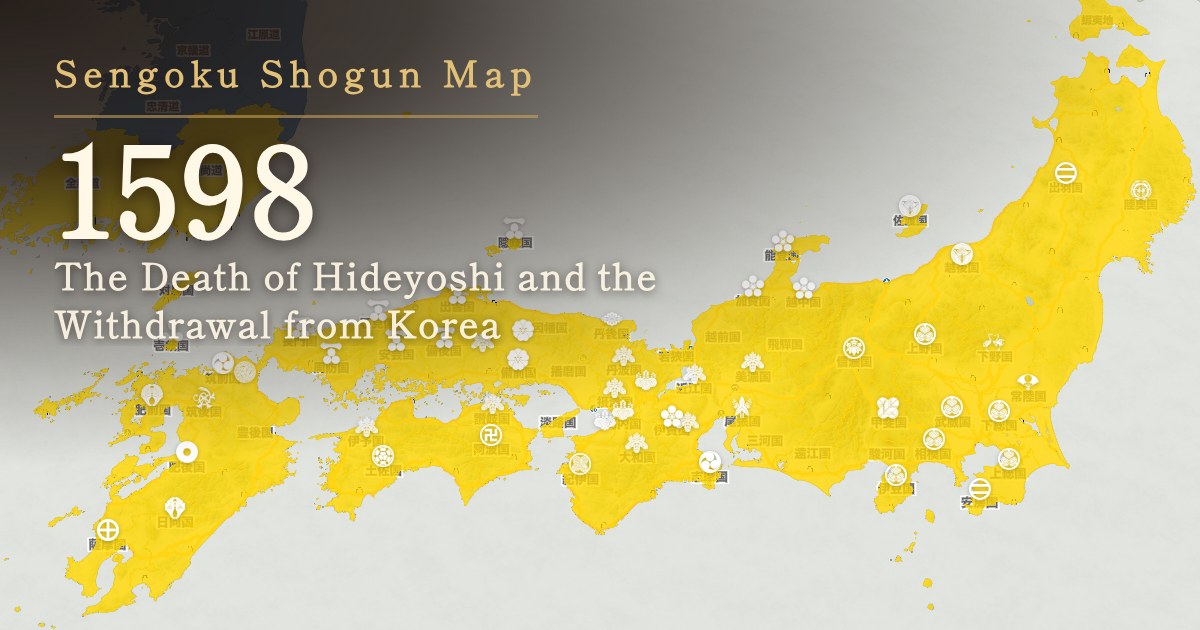
1598 was Keichō 3 (tsuchinoe-inu).
In August, Hideyoshi died of illness at Fushimi Castle. Shortly before his death, he instructed the Five Elders to withdraw all forces from Korea, and the Japanese army began its retreat accordingly. At the Battle of Noryang in November, Japanese forces fought fiercely against the combined Ming-Korean fleet and killed the renowned admiral Yi Sun-sin, but following this final engagement the Japanese completed their full withdrawal from the Korean peninsula, bringing the seven-year campaign to a close.
1598 territory map: major daimyo and their provinces
Each province is counted under its main power. The map shows the finer division by district.
- 山城国 (Toyotomi Hideyori), 大和国 (Toyotomi Hideyori, Mashita Nagamori, Lords of Yamato), 河内国 (Toyotomi Hideyori), 和泉国 (Toyotomi Hideyori), 摂津国 (Toyotomi Hideyori and others), 伊賀国 (Tsutsui Sadatsugu), 伊勢国 (Toyotomi Hideyori, Lords of Ise), 志摩国 (Kuki Yoshitaka), 尾張国 (Fukushima Masanori), 三河国 (Tanaka Yoshimasa, Ikeda Terumasa and others), 遠江国 (Horio Yoshiharu), 駿河国 (Nakamura Kazuuji), 甲斐国 (Asano Nagamasa, Asano Yoshinaga), 伊豆国 (Tokugawa Ieyasu), 相模国 (Tokugawa Ieyasu), 武蔵国 (Tokugawa Ieyasu), 安房国 (Satomi Yoshiyasu), 上総国 (Tokugawa Ieyasu, Honda Tadakatsu and others), 下総国 (Tokugawa Ieyasu), 常陸国 (Satake Yoshinobu), 近江国 (Toyotomi Hideyori and others), 美濃国 (Toyotomi Hideyori, Oda Hidenobu and others), 飛驒国 (Kanamori Nagachika), 信濃国 (Ishikawa Kazumasa and others), 上野国 (Tokugawa Ieyasu and others), 下野国 (Gamō Hideyuki and others), 陸奥国 (Date Masamune and others), 出羽国 (Mogami Yoshiaki and others), 若狭国 (Kinoshita Katsutoshi and others), 越前国 (Kobayakawa Hideaki), 加賀国 (Maeda Toshiie), 能登国 (Maeda Toshimasa), 越中国 (Maeda Toshinaga), 越後国 (Hori Hideharu), 佐渡国 (Uesugi Kagekatsu), 丹波国 (Toyotomi Hideyori, Maeda Gen'i and others), 丹後国 (Hosokawa Tadaoki), 但馬国 (Koide Yoshimasa and others), 因幡国 (Mori Tadamasa), 伯耆国 (Nanjō Mototada, Kikkawa Hiroie), 出雲国 (Kikkawa Hiroie), 石見国 (Mōri Terumoto), 隠岐国 (Mōri Terumoto), 播磨国 (Kinoshita Iesada and others), 美作国 (Ukita Hideie), 備前国 (Ukita Hideie), 備中国 (Mōri Terumoto, Ukita Hideie and others), 備後国 (Mōri Terumoto), 安芸国 (Mōri Terumoto), 周防国 (Mōri Terumoto), 長門国 (Mōri Terumoto), 紀伊国 (Kuwayama Kazuharu and others), 淡路国 (Wakisaka Yasuharu), 阿波国 (Hachisuka Iemasa), 讃岐国 (Toyotomi Hideyori, Ikoma Chikamasa), 伊予国 (Toyotomi Hideyori and others), 土佐国 (Chōsokabe Motochika), 筑前国 (豊臣直轄), 筑後国 (Tachibana Muneshige, 毛利秀包, 筑紫広門 and others), 豊前国 (Kuroda Yoshitaka, 毛利勝信), 豊後国 (Hayakawa Nagamasa and others), 肥前国 (龍造寺高房, Nabeshima Naoshige), 肥後国 (Katō Kiyomasa and others), 日向国 (Shimazu Yoshihiro, Itō Suketake, Takahashi Mototane, Akizuki Tanenaga, 島津豊久 and others), 大隅国 (Shimazu Yoshihiro and others), 薩摩国 (Shimazu Yoshihisa), 壱岐国 (Matsura Shigenobu), 対馬国 (Sō clan), 蝦夷地 (Kakizaki Yoshihiro)
Toyotomi clan69 provinces
Events this year
Month 1
By Hideyoshi's order, Hideharu was transferred from Kitanoshō to Echigo. He took over the former domain of Uesugi Kagekatsu, conducting a land survey to reorganize his territorial control.
Sources 十日町市博物館「太子堂村検地帳」
3/15
Toyotomi Hideyoshi held a grand cherry-blossom viewing at Daigoji with Hideyori, Kita-no-Mandokoro, Yodo-dono, and a large entourage.
3/18
Toyotomi Hideyoshi issued a vermillion-sealed order commanding the Shikoku daimyō to provide rotational relief forces for Busan Castle in Korea.
5/3
The four commissioners (Maeda Gen'i, Asano Nagamasa, Masuda Nagamori, and Nagatsuka Masaie) issued a jointly signed edict increasing Katō Yoshiaki's holdings to 100,000 koku in recognition of his military service in Korea.
Month 9
Toyotomi Hideyoshi died at Fushimi Castle. A new system of governance was established with the five regents (Go-Tairō) and five commissioners (Go-Bugyō) supporting the young Hideyori. The withdrawal of forces from Korea commenced.
Sources 早稲田大学図書館「豊臣秀吉遺言覚書案」
9/3
Following Toyotomi Hideyoshi's death, the five elders and five commissioners issued a sworn oath pledging collective deliberation to support the young Hideyori.
Month 12
Shimazu Yoshihiro's fleet, trying to rescue Konishi Yukinaga as he withdrew from Suncheon, fought the combined fleet of Yi Sun-sin and Chen Lin, and Yi Sun-sin was killed in the battle.
Sources 国史編纂委員会 우리역사넷/コトバンク「文禄・慶長の役」
Kobayakawa Hideaki was ordered to transfer from Chikuzen and Chikugo to Echizen, but in February of the following year both provinces were restored to him under Hideyoshi's dying instructions.
Sources 広島県史年表(中世2)
After Toyotomi Hideyoshi's death, the daimyō armies withdrew from Korea, ending the invasions launched from Nagoya in Hizen.
For naval service in destroying enemy ships off Geoje Island together with Wakisaka Yasuharu, Takatori received a 10,000-koku increase at Iyo Ōzu, bringing his total to 80,000 koku.
Sources 愛媛県総合教育センター「データベース『えひめの記憶』」
Honda Masatake, a retainer of Toyotomi Hidenaga, is said to have entered Katsumoto Castle and been stationed there for seven years, until Keichō 3. The castle was dismantled after the campaign ended.
Sources 勝本城跡 - 長崎県の文化財
In place of Gamō Hideyuki, who had been moved to Utsunomiya, Uesugi Kagekatsu moved from Echigo to Aizu. The domain is said to have totaled about 1.2 million koku, including Aizu, Shōnai and Sado.
Sources コトバンク「上杉景勝」(山川日本史小辞典)/鶴ヶ城(座標は若松城)
Ukita Hideie was counted as one of the Five Elders, alongside Tokugawa Ieyasu, Maeda Toshiie, Mōri Terumoto and Uesugi Kagekatsu. The time is given as 1598.
Sources コトバンク「宇喜多秀家」