1567 territory map and events: Oda Nobunaga Captures Inabayama Castle and Renames It Gifu
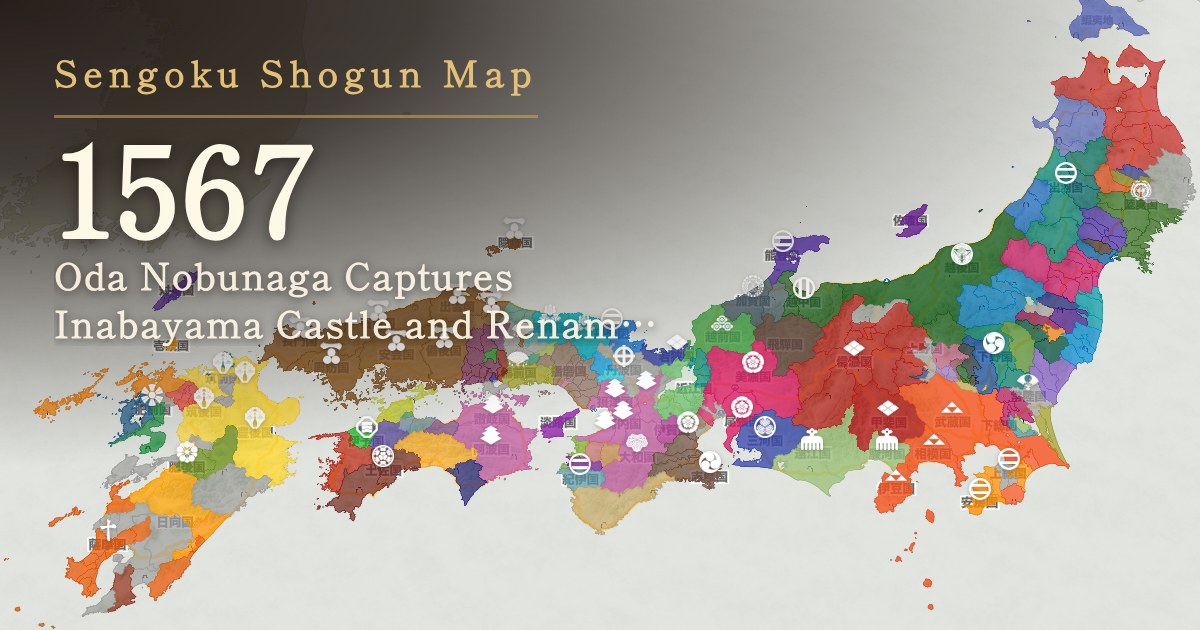
1567 was Eiroku 10 (hinoto-u).
With the defection of the Mino Triumvirate secured, Oda Nobunaga burned the town below Inabayama Castle, stripping it of its defenses, and its lord Saitō Tatsuoki fled. Having conquered Mino, Nobunaga renamed the region Gifu and proclaimed the motto Tenka Fubu (rule the realm by force), marking a major stepping stone in his campaign to unify Japan.
1567 territory map: major daimyo and their provinces
Each province is counted under its main power. The map shows the finer division by district.
- 山城国 (Miyoshi Triumvirate), 大和国 (Matsunaga Hisahide), 河内国 (Miyoshi Yoshitsugu), 和泉国 (Miyoshi Yoshitsugu), 摂津国 (Miyoshi Yoshitsugu), 阿波国 (Miyoshi Nagaharu), 讃岐国
Miyoshi clan7 provinces
- 伯耆国 (Mōri Motonari), 出雲国 (Mōri Motonari), 石見国 (Mōri Motonari), 備後国 (Mōri Terumoto), 安芸国 (Mōri Terumoto), 周防国 (Mōri Terumoto), 長門国 (Mōri Terumoto)
Mōri clan7 provinces
- 伊豆国 (Hōjō Ujimasa), 相模国 (Hōjō Ujimasa), 武蔵国 (Hōjō Ujimasa), 下総国 (Chiba Tanetomi)
Later Hōjō clan4 provinces
- 筑後国 (Ōtomo Sōrin), 豊前国 (Ōtomo Sōrin), 豊後国 (Ōtomo Sōrin)
Ōtomo clan3 provinces
- 遠江国 (Imagawa Ujizane), 駿河国 (Imagawa Ujizane)
Imagawa clan2 provinces
- 但馬国 (Yamana Suketomi), 因幡国
Yamana clan2 provinces
- 越中国 (Jinbō Nagamoto), 越後国 (Uesugi Kenshin)
Uesugi clan2 provinces
- 尾張国 (Oda Nobunaga), 美濃国 (Oda Nobunaga)
Oda clan2 provinces
- 甲斐国 (Takeda Shingen), 信濃国 (Takeda Shingen)
Takeda clan2 provinces
- 淡路国 (Atagi Nobuyasu)
Atagi clan (Awaji)1 province
- 蝦夷地 (Kakizaki Suehiro)
Andō clan1 province
- 伊賀国
Iga Sokoku Ikki1 province
- 丹後国 (Isshiki Yoshimichi)
Isshiki clan1 province
- 志摩国 (Kuki Yoshitaka)
Kuki clan1 province
- 備中国 (Mimura Motochika)
Mimura clan1 province
- 飛驒国 (Miki Yoshiyori)
Miki clan (Hida)1 province
- 若狭国 (Takeda Yoshimune and others)
Wakasa-Takeda clan1 province
- 対馬国
Sō clan1 province
- 越前国 (Asakura Yoshikage)
Asakura clan1 province
- 三河国 (Tokugawa Ieyasu)
Tokugawa clan1 province
- 隠岐国 (Amago Katsuhisa, 山中幸盛, Oki clan)
Amago clan1 province
- 壱岐国
Hata clan1 province
- 能登国 (畠山義慶 and others)
Hatakeyama clan (Noto)1 province
- 佐渡国 (Honma clan)
Honma clan (Sado)1 province
- 加賀国 (Honganji, Ikkō-ikki)
Honganji and Ikkō-ikki1 province
- 安房国 (Satomi Yoshihiro)
Satomi clan1 province
Provinces divided among several powers21 provinces
伊勢国 (Oda Nobunaga and others), 上総国 (Satomi Yoshihiro and others), 常陸国 (Satake Yoshishige and others), 近江国 (Rokkaku clan, Azai clan), 上野国 (Asari Nobutane and others), 下野国 (Utsunomiya Hirotsuna and others), 陸奥国 (Date Terumune and others), 出羽国 (Mogami Yoshimori and others), 丹波国 (Hatano Hideharu and others), 播磨国 (Akamatsu Yoshisuke), 美作国 (Uragami Munekage and others), 備前国 (Uragami Munekage and others), 紀伊国 (Hatakeyama Takamasa and others), 伊予国 (Kōno Michinao and others), 土佐国 (Chōsokabe Motochika and others), 筑前国 (Ōtomo Sōrin and others), 肥前国 (Ryūzōji Takanobu and others), 肥後国 (Sagara Yoshihisa and others), 日向国 (Itō Yoshisuke and others), 大隅国 (Shimazu Takahisa and others), 薩摩国 (Shimazu Takahisa and others)
Events this year
Month 2
Miyoshi Yoshitsugu, dissatisfied with the conduct of the Miyoshi Triumvirate and Shinohara Nagafusa, left Takaya Castle for Sakai, joined hands with Matsunaga Hisahide and broke away from the Triumvirate.
Month 3
Horie Kagetada, a powerful kokujin of Sakai District, turned against the Asakura clan and allied with the Kaga Ikkō-ikki. The ikki forces advanced as far as Kanazu Ueno, but the Asakura side met them and routed them.
Sources 福井県立図書館『福井県史』通史編2
Month 8
Oda Nobunaga captured Saitō Tatsuoki's Inabayama Castle, took control of Mino, renamed the castle town Gifu, and moved his residence there.
See this battle in detail →Sources 岐阜市「史跡岐阜城跡整備基本計画」
Hōjō Ujimasa's army, aiming at western Kazusa, fought the Satomi and was heavily defeated; Ōta Ujisuke, lord of Iwatsuki Castle, and others fell. Iwatsuki later came under direct Later-Hōjō rule.
Sources 君津市「三舟山陣跡」/さいたま市立博物館「展示web解説(中世その1)」
Takeda Shingen had over two hundred retainers from Kai, Shinano and western Kōzuke submit written oaths pledging, among other things, not to rebel, and deposited them at Ikushima Tarushima Shrine.
Sources 文化庁「国指定文化財等データベース」生島足島神社文書/上田市マルチメディア情報センター「武田信玄武将の起請文(生島足島神社文書)」
8/3
Date Masamune, whose childhood name was 梵天丸, was born at Yonezawa Castle as the eldest son of Date Terumune, some years after Terumune succeeded as head of the clan.
9/15
Right after Nobunaga took Inabayama Castle, Azai Nagamasa issued a document asking Ichihashi Nagatoshi to intercede for him with Oda Nobunaga (Komonjo-san).
Sources 長浜市教育委員会「史跡小谷城跡保存管理計画書」
Month 10
Soon after entering Gifu, Oda Nobunaga issued a regulation notice (seisatsu) to the Kanō rakuichi market, setting tax and debt privileges and peace within the market. The notice survives at Entoku-ji.
Sources 岐阜市歴史博物館「参考資料集[17]楽市場制札・岐阜城下町学習セット」/岐阜県「楽市楽座制札 附織田信長百姓帰住制札」
Takeda Yoshinobu, Shingen's eldest son, who had been placed in the care of 東光寺 since 1565, died. Shingen returned Yoshinobu's wife to Imagawa and dissolved the alliance with Imagawa.
Sources コトバンク「武田義信」/甲府市「東光寺仏殿」
Winter
Nobunaga's younger sister Oichi is said to have married Nagamasa, and the Oda and Azai allied. Nagahama City gives the end of Eiroku 10 or the start of the next year, but accounts of the year of the marriage differ.
Sources 長浜市教育委員会「史跡小谷城跡保存管理計画書」
Month 11
Oda Nobunaga used a vermilion seal reading "Tenka Fubu" on documents. A vermilion-seal letter dated the eleventh month of Eiroku 10 is held at Keio University.
Sources 慶應義塾大学メディアセンター デジタルコレクション「織田信長朱印状」/京都府立京都学・歴彩館「東寺百合文書の『織田信長禁制』」
Ashikaga Yoshiaki (then writing his name 義秋), a wanderer, entered Ichijōdani and mediated, and the Asakura clan and the Kaga Ikkō-ikki withdrew their troops in the eleventh month. It was only a temporary settlement, however, and fighting flared up again the following March.
Sources 福井県立図書館『福井県史』通史編2
Nobunaga's eldest son Oda Nobutada (aged 11) and Takeda Shingen's daughter Matsuhime (aged 7) were betrothed. In 1572 the two houses became enemies and the betrothal is said to have been dissolved.
11/21
After the Kaga–Echizen peace, Ashikaga Yoshiaki moved to Ichijōdani, where Asakura Yoshikage received him at the residence (goshō) at Anyō-ji and sheltered him.
Sources 福井県立一乗谷朝倉氏遺跡博物館「朝倉氏の歴史」
After Minowa Castle fell, the Takeda controlled western Kōzuke. In the east, Kitajō Takahiro of Umayabashi Castle defected to the Later Hōjō while the Uesugi retained Numata Castle, leaving the province divided among three powers.
Sources 高崎市・笹本正治「箕輪城と武田氏」/沼田市「沼田城跡」
Warfare between Miyoshi and Matsunaga brought fire into the Tōdai-ji compound, destroying much of the temple complex. The Great Buddha was also damaged, and its subsequent restoration proved extremely difficult.
Sources 東大寺公式サイト「東大寺の歴史」
Takahashi Akitane, a senior Ōtomo retainer holding Hōman Castle in Chikuzen, turned against Ōtomo Sōrin, and Akizuki Tanezane rose in support. Sōrin attacked with a force of over 20,000.
Sources 朝倉市「ふるさと人物誌1 戦国時代を翔けた『秋月種実』」/太宰府市「城郭研究から見た天正11年米ノ山合戦」
Mimura Motochika invaded Bizen to avenge his murdered father but suffered a heavy defeat at the hands of the Ukita. It is also called the "Battle of Myōzen-ji."
Sources 毛利氏・三村氏・宇喜多氏と備中兵乱(おかやまの中世争乱史「天下統一への道」)
The Shimazu side stormed Umagoe Castle of the Hishikari clan in northern Satsuma, and the Hishikari campaign began. The fighting continued until 1569.
Sources 姶良市「島津義弘公没後400年」年譜
Oda Nobunaga, using Takigawa Kazumasu and others, entered northern Ise and brought the kokujin of the Hokusei region, such as the Kanbe and Seki clans, under his command. The year is given as 1567 or the year after, and sources differ.
To cement the Oda–Tokugawa alliance, Matsudaira Nobuyasu, aged nine, married Tokuhime (Gotoku), daughter of Oda Nobunaga.
Sources コトバンク「松平信康」