1607 territory map and events: The Completion of Kumamoto Castle and the First Korean Embassy
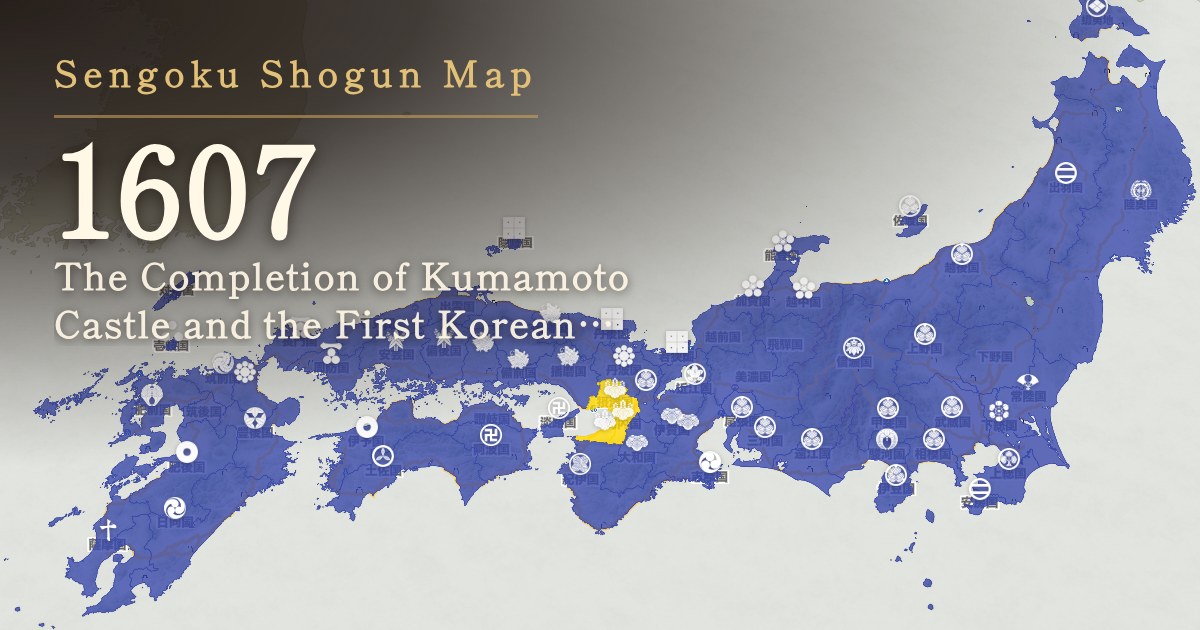
1607 was Keichō 12 (hinoto-hitsuji).
Kumamoto Castle, into which Katō Kiyomasa had poured immense effort, was completed this year. Around the same time, mediation by the Sō clan of Tsushima bore fruit as negotiations to restore diplomatic relations between Japan and Korea succeeded, and the first Korean embassy since the Bunroku-Keichō invasions arrived in Japan, marking a step toward normalized relations between the two countries.
1607 territory map: major daimyo and their provinces
Each province is counted under its main power. The map shows the finer division by district.
- 山城国 (Tokugawa Ieyasu, Itakura Katsushige), 大和国 (Honda Toshitomo, Fukushima Takaharu, Katagiri Sadataka, Tokugawa intendants and others), 伊賀国 (Tsutsui Sadatsugu), 伊勢国 (Tomita Nobutaka, Honda Tadakatsu and others), 志摩国 (Kuki Moritaka), 尾張国 (Tokugawa Yoshinao), 三河国 (Tokugawa Ieyasu), 遠江国 (Matsudaira Sadakatsu and others), 駿河国 (Tokugawa Ieyasu), 甲斐国 (Tokugawa Ieyasu), 伊豆国 (Tokugawa Ieyasu), 相模国 (Ōkubo Tadachika and others), 武蔵国 (Tokugawa Ieyasu), 安房国 (Satomi Tadayoshi), 上総国 (Honda Tadatomo and others), 下総国 (Doi Toshikatsu), 常陸国 (Tokugawa Yorinobu and others), 近江国 (Ii Naotsugu and others), 美濃国 (Okudaira Nobumasa and others), 飛驒国 (Kanamori Arishige), 信濃国 (Ishikawa Yasunaga and others), 上野国 (Sakai Shigetada and others), 下野国 (Okudaira Iemasa and others), 陸奥国 (Date Masamune and others), 出羽国 (Mogami Yoshiaki and others), 若狭国 (Kyōgoku Takatsugu, Kyōgoku Tadataka), 越前国 (Matsudaira Tadanao), 加賀国 (Maeda Toshitsune), 能登国 (Maeda Toshitsune), 越中国 (Maeda Toshinaga and others), 越後国 (Hori Tadatoshi and others), 佐渡国 (Tokugawa intendants), 丹波国 (Maeda Shigekatsu, Arima Toyouji and others), 丹後国 (Kyōgoku Takatomo), 但馬国 (Koide Yoshihide, Sugihara Nagafusa and others), 因幡国 (Ikeda Nagayoshi, Kamei Korenori, Yamazaki Iemori and others), 伯耆国 (Nakamura Kazutada), 出雲国 (Horio Yoshiharu, Horio Tadaharu), 石見国 (Tokugawa intendants, Ōkubo Nagayasu, Sakazaki Naomori and others), 隠岐国 (Horio Yoshiharu, Horio Tadaharu), 播磨国 (Ikeda Terumasa), 美作国 (Mori Tadamasa), 備前国 (Ikeda Tadatsugu), 備中国 (Tokugawa intendants, Kobori Masatsugu, Kinoshita Iesada, Togawa Michiyasu and others), 備後国 (Fukushima Masanori), 安芸国 (Fukushima Masanori), 周防国 (Mōri Terumoto), 長門国 (Mōri Terumoto), 紀伊国 (Asano Yoshinaga), 淡路国 (Wakisaka Yasuharu), 阿波国 (Hachisuka Yoshishige), 讃岐国 (Ikoma Kazumasa), 伊予国 (Katō Yoshiaki, Tōdō Takatora and others), 土佐国 (Yamauchi Tadayoshi), 筑前国 (Kuroda Nagamasa), 筑後国 (Tanaka Yoshimasa), 豊前国 (Hosokawa Tadaoki), 豊後国 (Nakagawa Hidenari, Inaba Sadamichi, Hosokawa Tadaoki, Kinoshita Nobutoshi, Takenaka Shigetoshi and others), 肥前国 (Nabeshima Katsushige, Terasawa Hirotaka, Matsuura clan, Ōmura Yoshiaki and others), 肥後国 (Katō Kiyomasa, Sagara Yorifusa and others), 日向国 (Takahashi Mototane, Itō Sukenori, Akizuki Tanenaga, Shimazu Yukihisa, Shimazu Tadatsune and others), 大隅国 (Shimazu Tadatsune), 薩摩国 (Shimazu Tadatsune), 壱岐国 (Matsuura clan), 対馬国 (Sō clan), 蝦夷地 (Matsumae Yoshihiro)
Tokugawa regime66 provinces
- 河内国 (Toyotomi Hideyori, Hōjō Ujimori and others), 和泉国 (Toyotomi Hideyori), 摂津国 (Toyotomi Hideyori, Shinjō Naoyori, Arima Toyouji and others)
Toyotomi clan3 provinces
Events this year
Month 3
After the incident in which Ryūzōji Takafusa took his own life, Nabeshima Naoshige's heir Katsushige was formally recognized by the shogunate as head of the domain, and the Nabeshima Saga domain was established.
5/23
A major reconstruction of Sunpu Castle began with daimyo mobilized from across Japan to create the base of Tokugawa Ieyasu's retired-shogun government.
Sources 静岡市「駿府城跡・駿府城跡天守台発掘調査」
Month 7
Tokugawa Ieyasu, now Ōgosho, moved from Edo to the newly built Sunpu Castle and made it his political base. Shizuoka City's chronology gives the third of the seventh month (lunar), but the castle burned at the end of the same year.
Sources 静岡市「駿府城公園の整備」
Month 8
The main shrine buildings of 大崎八幡宮, which Date Masamune built in the northwest of Sendai's castle town, were completed. It is a gongen-zukuri shrine in which the main hall and worship hall are joined by a stone chamber, and it is a National Treasure.
Kumamoto Castle, built by Katō Kiyomasa, was completed as the center of his rule in Higo together with improvements to the castle town and Shirakawa River.
Sources 【公式】熊本城「歴史」
A Korean Response and Prisoner-Repatriation Embassy (chief envoy Yeo U-gil), sent to restore relations severed by the invasions of Korea under the Toyotomi regime, visited Japan and exchanged state letters with the Tokugawa government in Edo.
Sources 九州国立博物館「対馬と宗家 - 対馬宗家文書」/京都市歴史資料館「文化史17 朝鮮通信使」/東京大学史料編纂所「日本―朝鮮・西欧・台湾鄭氏往復外交文書表」/静岡市立図書館『図書館だより』2024年11月号
At Ieyasu's command, Kyoto merchant Sumizuoka Ryōi undertook dredging and engineering work on the Fuji River, opening a waterway linking the Kōshin region with Suruga and Edo. This secured transportation routes for tax rice, salt, and other goods.
Sources 富士市「富士川を行き交う~渡船と舟運」
Yūki Hideyasu, Tokugawa Ieyasu's second son and lord of Echizen Kitanoshō, died of illness at Fukui Castle, and his heir Matsudaira Tadanao succeeded him at the age of thirteen.
Sources 福井県交流文化部文化課「徳川家康・結城秀康ゆかりの地」/福井県立歴史博物館『館報』第69号
After the death of Matsudaira Tadayoshi, lord of Owari, Tokugawa Ieyasu installed his ninth son Yoshinao there. As Yoshinao was a child, Ieyasu took charge of building up the domain himself.
Sources 名古屋市中区「中区のなりたち」/静岡市「徳川家康―大御所と駿府城下町」
Toyotomi Hideyori built (restored) the main hall of Kitano Tenmangū. The present hall, a Momoyama structure that served as the prototype of the gongen style, is a National Treasure.
Sources 北野天満宮「北野天満宮について」/京都市上京区「翔鸞」まち歩きパンフレット
Horio Yoshiharu began building Matsue Castle and its castle town as a new seat to replace Gassan-Toda Castle. Work is said to have started around 1607.
Sources 松江市「調査コラム」第39回「松江城・史料調査課だより」/松江市「史跡松江城」計画書 第3章