1604 territory map and events: The Establishment of the Itowappu Trade System
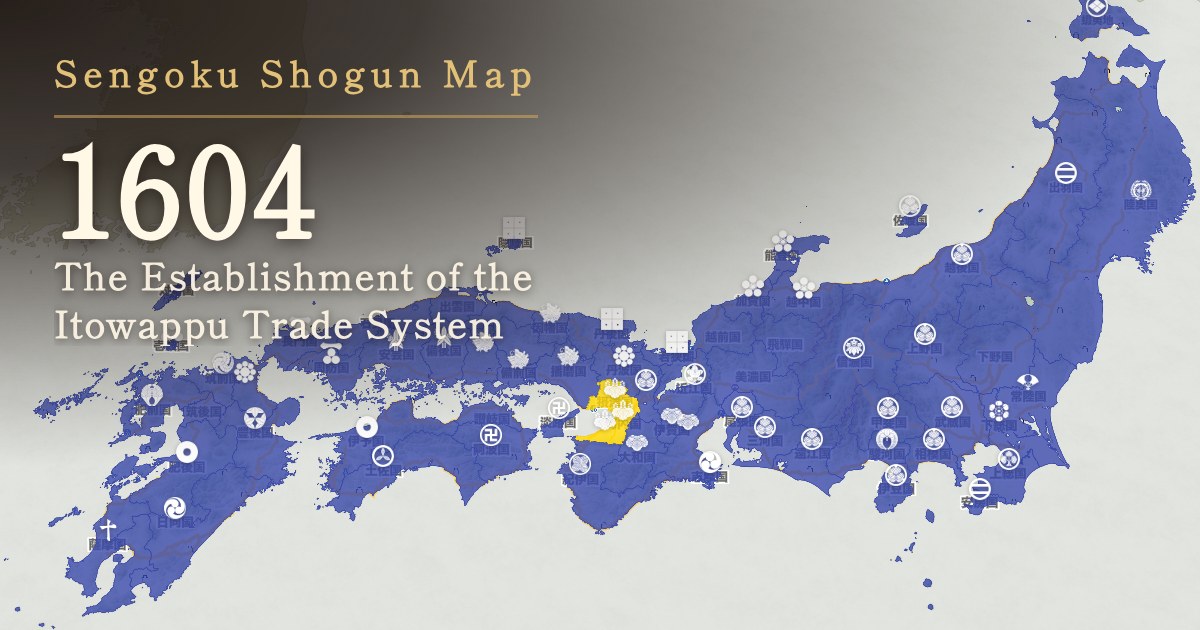
1604 was Keichō 9 (kinoe-tatsu).
To curb Portuguese merchants' monopoly on profits from the raw silk trade, Tokugawa Ieyasu established the itowappu system, under which designated merchant guilds in Kyoto, Sakai, and Nagasaki collectively purchased imported silk and distributed it domestically. This regulatory measure shifted control over silk pricing to the Japanese side and helped curb the outflow of precious metals overseas.
1604 territory map: major daimyo and their provinces
Each province is counted under its main power. The map shows the finer division by district.
- 山城国 (Tokugawa Ieyasu, Itakura Katsushige), 大和国 (Honda Toshitomo, Fukushima Takaharu, Katagiri Sadataka, Tokugawa intendants and others), 伊賀国 (Tsutsui Sadatsugu), 伊勢国 (Tomita Nobutaka, Honda Tadakatsu and others), 志摩国 (Kuki Moritaka), 尾張国 (Matsudaira Tadayoshi), 三河国 (Tokugawa Ieyasu), 遠江国 (Matsudaira Sadakatsu and others), 駿河国 (Naitō Nobunari), 甲斐国 (Tokugawa Yoshinao), 伊豆国 (Tokugawa Ieyasu), 相模国 (Ōkubo Tadachika and others), 武蔵国 (Tokugawa Ieyasu), 安房国 (Satomi Tadayoshi), 上総国 (Honda Tadatomo and others), 下総国 (Doi Toshikatsu), 常陸国 (Tokugawa Yorinobu and others), 近江国 (Ii Naotsugu and others), 美濃国 (Okudaira Nobumasa and others), 飛驒国 (Kanamori Nagachika, Kanamori Arishige), 信濃国 (Ishikawa Yasunaga and others), 上野国 (Sakai Shigetada and others), 下野国 (Okudaira Iemasa and others), 陸奥国 (Date Masamune and others), 出羽国 (Mogami Yoshiaki and others), 若狭国 (Kyōgoku Takatsugu, Kyōgoku Tadataka), 越前国 (Yūki Hideyasu), 加賀国 (Maeda Toshinaga), 能登国 (Maeda Toshinaga), 越中国 (Maeda Toshinaga), 越後国 (Hori Hideharu and others), 佐渡国 (Tokugawa intendants), 丹波国 (Maeda Shigekatsu, Arima Toyouji and others), 丹後国 (Kyōgoku Takatomo), 但馬国 (Koide Yoshihide, Sugihara Nagafusa and others), 因幡国 (Ikeda Nagayoshi, Kamei Korenori, Yamazaki Iemori and others), 伯耆国 (Nakamura Kazutada), 出雲国 (Horio Yoshiharu, Horio Tadaharu), 石見国 (Tokugawa intendants, Ōkubo Nagayasu, Sakazaki Naomori and others), 隠岐国 (Horio Yoshiharu, Horio Tadaharu), 播磨国 (Ikeda Terumasa), 美作国 (Mori Tadamasa), 備前国 (Ikeda Tadatsugu), 備中国 (Tokugawa intendants, Kobori Masatsugu, Kinoshita Iesada, Togawa Michiyasu and others), 備後国 (Fukushima Masanori), 安芸国 (Fukushima Masanori), 周防国 (Mōri Terumoto), 長門国 (Mōri Terumoto), 紀伊国 (Asano Yoshinaga), 淡路国 (Wakisaka Yasuharu), 阿波国 (Hachisuka Yoshishige), 讃岐国 (Ikoma Kazumasa), 伊予国 (Katō Yoshiaki, Tōdō Takatora and others), 土佐国 (Yamauchi Kazutoyo), 筑前国 (Kuroda Nagamasa), 筑後国 (Tanaka Yoshimasa), 豊前国 (Hosokawa Tadaoki), 豊後国 (Nakagawa Hidenari, Inaba Sadamichi, Hosokawa Tadaoki, Kinoshita Nobutoshi, Takenaka Shigetoshi and others), 肥前国 (Nabeshima Katsushige, Terasawa Hirotaka, Matsuura clan, Ōmura Yoshiaki and others), 肥後国 (Katō Kiyomasa, Sagara Yorifusa and others), 日向国 (Takahashi Mototane, Itō Sukenori, Akizuki Tanenaga, Shimazu Yukihisa, Shimazu Tadatsune and others), 大隅国 (Shimazu Tadatsune), 薩摩国 (Shimazu Tadatsune), 壱岐国 (Matsuura clan), 対馬国 (Sō clan), 蝦夷地 (Matsumae Yoshihiro)
Tokugawa regime66 provinces
- 河内国 (Toyotomi Hideyori, Hōjō Ujimori and others), 和泉国 (Toyotomi Hideyori), 摂津国 (Toyotomi Hideyori, Shinjō Naoyori, Arima Toyouji and others)
Toyotomi clan3 provinces
Events this year
1/20
Tokugawa Ieyasu granted Matsumae Yoshihiro a black-seal charter forbidding trade with the Ainu that bypassed the Matsumae. This is regarded as the founding of the Matsumae domain.
Sources 苫小牧市「苫小牧市史 上巻 第四編 幕藩時代 第一章 松前藩と勇払」/北海道博物館「北海道120万年物語 3 蝦夷地のころ」
Month 8
Satake Yoshinobu moved into the Kubota Castle then under construction. Minato Castle, the seat of the former lord, the Akita clan, was abandoned.
Sources 秋田市「久保田城について」
Leap month 8
Ryūzōji Takafusa, the nominal lord of Saga domain, was granted Junior Fifth Rank, Lower Grade and the title Suruga-no-kami, and was attached to Hidetada and posted in Edo.
12/16
On the 16th day of the 12th month of Keichō 9 (3 February 1605 in the Gregorian calendar), a tsunami struck the Pacific coast from Bōsō to Kyushu. Damage from the shaking itself is said to have been small.
Sources 気象庁徳島地方気象台「南海地震の県内被害記録」/気象庁高知地方気象台「過去に高知県に被害を及ぼした地震」/東北大学災害科学国際研究所「熊本地震IRIDeS調査報告会」資料
The shogunate designated Nihonbashi as the starting point for national distances and developed a transport system centered on the five highways.
Maeda Toshinaga created an organizational system combining approximately 10 villages in Noto, establishing the foundation of the tomura system, a unique peasant control mechanism that would characterize the Kaga domain.
For Chinese raw silk brought by Portuguese ships to Nagasaki, the shogunate granted the 'Itozaifumi Guild'—merchants from Sakai, Kyoto, and Nagasaki—exclusive rights to set prices and make bulk purchases, thereby controlling trade and protecting merchant interests.
Sources 長崎市出島復元整備室「出島の歴史(長崎年表)」
Starting from Edo's Nihonbashi, mounds were built on both sides of main roads at one-ri (approximately 4 km) intervals, with shade trees like Japanese hackberries (enoki) planted. These served as distance markers for travelers and as reference points for calculating palanquin and horse rental fees.
Sources 東京都板橋区「時代を紡ぐ 志村一里塚は動かなかった!」
Under Ōkubo Nagayasu, the Sado magistrate, the excavation of mine galleries (mabu) in the gold and silver mines proceeded under direct government administration. The Sado Gold and Silver Mine ruins are designated as national historic sites.
Sources 新潟県佐渡市「国指定 記念物:佐渡金銀山遺跡」
Kuroda Yoshitaka (Josui) died in Fushimi, Kyoto. After Sekigahara, he had been involved with his son Nagamasa in the construction of Fukuoka Castle and the formation of their domain in Chikuzen.
Sources 中津市立図書館「郷土の歴史(黒田官兵衛)」
From Fushimi Castle, Tokugawa Ieyasu ordered the daimyo to submit provincial maps and registers of assessed yields (gōchō). The order is said to have covered mainly western Japan.
Sources 高山市教育委員会「幕府が収納した国絵図」/国立国会図書館 リサーチ・ナビ「国絵図・郷帳・村絵図」/松江市史講座 第92講 上杉和央「地図から読み解く近世の松江市域」
Mori Tadamasa chose Tsuruyama, overlooking the confluence of the Yoshii and Miya rivers, as his castle site, renamed it Tsuyama and began construction. It was completed twelve years later.
Sources 津山の歴史的風致(津山市歴史的風致維持向上計画)
Mōri Terumoto began building Hagi Castle, an early modern castle, on Mt. Shizuki northwest of Hagi. It was completed in Keichō 13 (1608).
Sources 萩城跡(文化遺産オンライン)