1603 territory map and events: Establishment of the Edo Shogunate
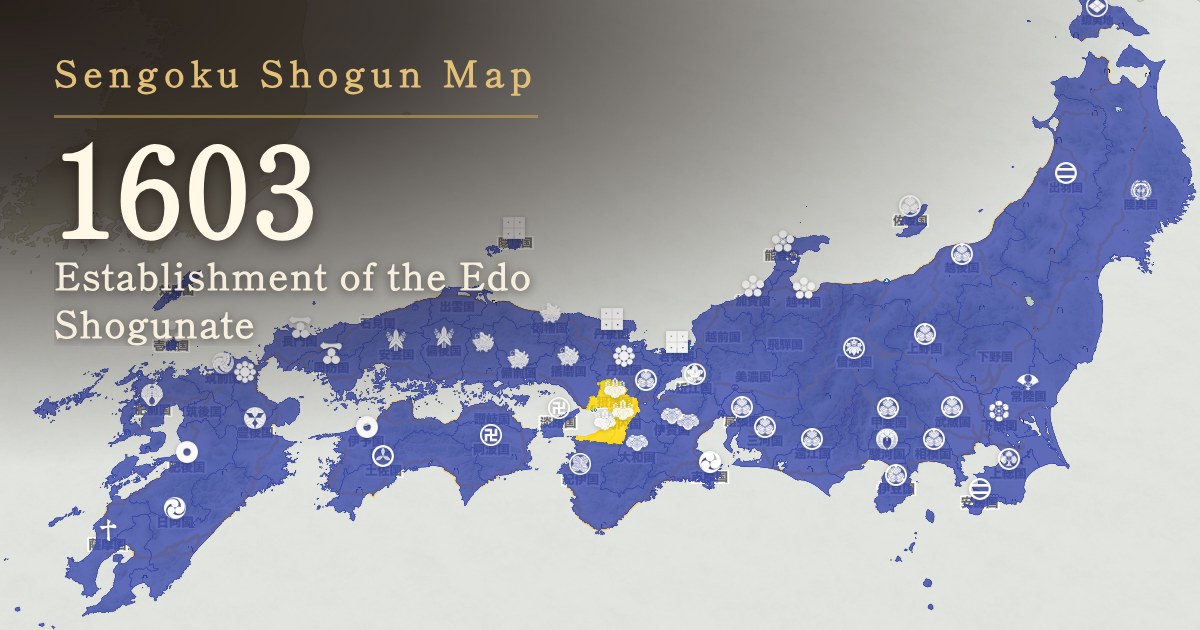
1603 was Keichō 8 (mizunoto-u).
Following the reorganization after Sekigahara, Ieyasu was appointed shogun and founded the Edo Shogunate. Construction of Edo Castle, development of the castle town, and reorganization of highway networks began. While the Toyotomi family remained in Osaka, the center of power shifted firmly to the Tokugawa.
1603 territory map: major daimyo and their provinces
Each province is counted under its main power. The map shows the finer division by district.
- 山城国 (Tokugawa Ieyasu, Itakura Katsushige), 大和国 (Lords of Yamato, Tokugawa intendants and others), 伊賀国 (Tsutsui Sadatsugu), 伊勢国 (Tomita Nobutaka, Honda Tadakatsu and others), 志摩国 (Kuki Moritaka), 尾張国 (Matsudaira Tadayoshi), 三河国 (Tokugawa Ieyasu), 遠江国 (Matsudaira Sadakatsu and others), 駿河国 (Naitō Nobunari), 甲斐国 (Tokugawa Yoshinao), 伊豆国 (Tokugawa Ieyasu), 相模国 (Ōkubo Tadachika and others), 武蔵国 (Tokugawa Ieyasu), 安房国 (Satomi Tadayoshi), 上総国 (Honda Tadatomo and others), 下総国 (Lords of Shimōsa and others), 常陸国 (Takeda Nobuyoshi, Tokugawa Yorinobu), 近江国 (Ii Naotsugu and others), 美濃国 (Okudaira Nobumasa, Ishikawa Yasumichi and others), 飛驒国 (Kanamori Nagachika, Kanamori Arishige), 信濃国 (Ishikawa Yasunaga and others), 上野国 (Sakai Shigetada and others), 下野国 (Okudaira Iemasa and others), 陸奥国 (Date Masamune and others), 出羽国 (Mogami Yoshiaki and others), 若狭国 (Kyōgoku Takatsugu, Kyōgoku Tadataka), 越前国 (Yūki Hideyasu), 加賀国 (Maeda Toshinaga), 能登国 (Maeda Toshinaga), 越中国 (Maeda Toshinaga), 越後国 (Hori Hideharu and others), 佐渡国 (Tokugawa intendants, Ōkubo Nagayasu), 丹波国 (Maeda Shigekatsu, Arima Toyouji and others), 丹後国 (Kyōgoku Takatomo), 但馬国 (Koide Yoshimasa, Sugihara Nagafusa and others), 因幡国 (Ikeda Nagayoshi, Kamei Korenori, Yamazaki Iemori and others), 伯耆国 (Nakamura Kazutada), 出雲国 (Horio Yoshiharu, Horio Tadauji), 石見国 (Sakazaki Naomori, Tokugawa intendants and others), 隠岐国 (Horio Yoshiharu, Horio Tadauji), 播磨国 (Ikeda Terumasa), 美作国 (Mori Tadamasa), 備前国 (Ikeda Tadatsugu), 備中国 (Tokugawa intendants, Kobori Masatsugu and others), 備後国 (Fukushima Masanori), 安芸国 (Fukushima Masanori), 周防国 (Mōri Terumoto), 長門国 (Mōri Terumoto), 紀伊国 (Asano Yoshinaga), 淡路国 (Wakisaka Yasuharu), 阿波国 (Hachisuka Yoshishige), 讃岐国 (Ikoma Kazumasa), 伊予国 (Katō Yoshiaki, Tōdō Takatora and others), 土佐国 (Yamauchi Kazutoyo), 筑前国 (Kuroda Nagamasa), 筑後国 (Tanaka Yoshimasa), 豊前国 (Hosokawa Tadaoki), 豊後国 (Nakagawa Hidenari, Inaba Sadamichi, Hosokawa Tadaoki, Kinoshita Nobutoshi, Takenaka Shigetoshi and others), 肥前国 (Nabeshima Katsushige, Terasawa Hirotaka, Matsuura clan, Ōmura Yoshiaki and others), 肥後国 (Katō Kiyomasa, Sagara Yorifusa and others), 日向国 (Takahashi Mototane, Itō Sukenori, Akizuki Tanenaga, Shimazu Yukihisa, Shimazu Tadatsune and others), 大隅国 (Shimazu Tadatsune), 薩摩国 (Shimazu Tadatsune), 壱岐国 (Matsuura clan), 対馬国 (Sō clan), 蝦夷地 (Matsumae Yoshihiro)
Tokugawa regime66 provinces
- 河内国 (Toyotomi Hideyori, Hōjō Ujimori and others), 和泉国 (Toyotomi Hideyori), 摂津国 (Toyotomi Hideyori, Shinjō Naoyori, Arima Toyouji and others)
Toyotomi clan3 provinces
Events this year
2/6
After the Okayama domain ended with the death of Kobayakawa Hideaki, Mori Tadamasa was granted 186,500 koku in Mimasaka and entered the Kamae castle at Innoshō.
Sources 津山の歴史的風致(津山市歴史的風致維持向上計画)
2/12
Tokugawa Ieyasu received appointment as seii taishōgun at Fushimi Castle, marking the establishment of the Edo shogunate.
Sources 国立公文書館「歴史と物語 年表」
Month 3
The principal buildings of Nijō Castle were completed, and Tokugawa Ieyasu entered the castle during his visit to Kyoto for his appointment as shogun.
Sources 京都市「元離宮二条城 年表」
Month 5
Satake Yoshinobu, newly transferred, began building a new seat on Shinmeizan in Kubota, Dewa (now Senshū Park in Akita).
Sources 秋田市「久保田城について」
Month 7
Senhime (age 7), daughter of Tokugawa Hidetada, married Toyotomi Hideyori (age 11 by East Asian reckoning) at Osaka Castle, tying the Toyotomi and Tokugawa houses by marriage.
Sources コトバンク「千姫」「豊臣秀頼」
11/14
Nakamura Kazutada had his senior retainer Yokota Muraaki killed. Yokota's retainers resisted but were put down with help from Horio Yoshiharu, lord of Tonda Castle in Izumo.
Sources 米子城跡リーフレット(米子城関係年表) - 米子市
Izumo no Okuni performed kabuki dance at Kitano Shrine in Kyoto, helping spread the form of entertainment that developed into kabuki.
As part of Edo's urban development after the opening of the shogunate, the Nihonbashi and Kyōbashi bridges were built for the first time. The first Nihonbashi was a wooden bridge.
Sources 中央区「中央区の沿革・ダイジェスト」/中央区「日本橋地域」
The Jesuits in Nagasaki published the Nippo Jisho (Vocabulario da Lingoa de Iapam), a dictionary explaining Japanese in Portuguese, with about 32,800 headwords.
Sources 長崎市「ナガジン! 長崎発!辞書のススメ」
The year after the Kobayakawa house came to an end, Ikeda Terumasa's fifth son Tadatsugu was enfeoffed in Bizen as lord of Okayama Castle, laying the foundation for the Ikeda's rule of the Okayama domain.
Sources 岡山城跡(文化遺産オンライン)
Ōkubo Nagayasu, who had served at places such as the Iwami silver mine, was appointed magistrate of Sado, which became shogunate land after Sekigahara. The following year an administrative office was built at Aikawa.
Sources 佐渡金銀山遺跡 世界遺産関係資料「第Ⅱ章」 - 佐渡市
Ukita Hideie, defeated at Sekigahara, took refuge with the Shimazu clan in Satsuma and is said to have escaped the death penalty through petitions for clemency by the Shimazu and Maeda clans, and to have been sent to Suruga.
Sources コトバンク「宇喜多秀家」、岡山県「宇喜多秀家」
Tokugawa Ieyasu gave Sadowara in Hyūga, the Shimazu clan's former territory, to Shimazu Yukihisa, who became the first lord of Sadowara domain with a little over 30,000 koku.
Sources コトバンク「島津以久」