1575 territory map and events: The Battle of Nagashino and the Decline of the Takeda
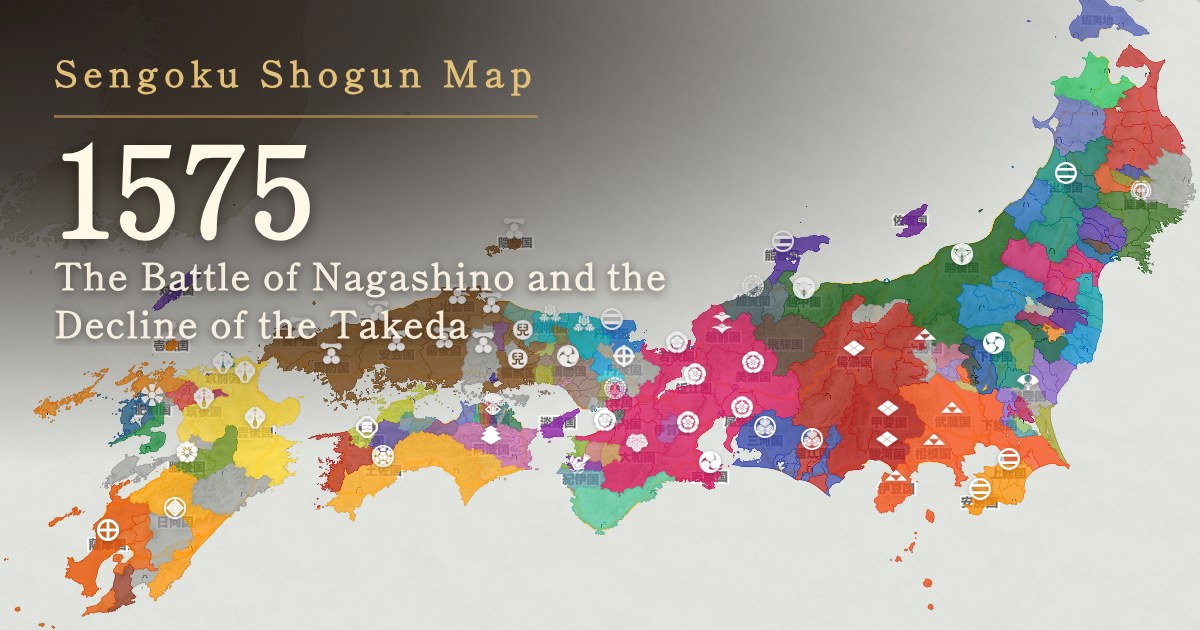
1575 was Tenshō 3 (kinoto-i).
Around Nagashino Castle in Mikawa, the allied Oda-Tokugawa army of 38,000 clashed with Takeda Katsuyori's 15,000 troops at Shitaragahara. Using anti-cavalry palisades and massed arquebusiers, Nobunaga repelled the Takeda's famed cavalry charges, killing many senior retainers including Yamagata Masakage and Baba Nobuharu. The defeat gutted the Takeda's core forces, and although the clan endured, it never fully recovered its former offensive strength.
1575 territory map: major daimyo and their provinces
Each province is counted under its main power. The map shows the finer division by district.
- 山城国 (Murai Sadakatsu), 大和国 (Matsunaga Hisahide), 河内国 (Sakuma Nobumori, Miyoshi Yasunaga and others), 和泉国 (Oda Nobunaga, Lords of Izumi and others), 伊勢国 (Kitabatake Tomofusa and others), 志摩国 (Kuki Yoshitaka), 尾張国 (Oda Nobunaga), 近江国 (Oda Nobunaga), 美濃国 (Oda Nobunaga), 若狭国 (Oda Nobunaga and others), 越前国 (Shibata Katsuie)
Oda clan11 provinces
- 伯耆国 (Mōri Terumoto), 出雲国 (Mōri Terumoto), 石見国 (Mōri Terumoto), 隠岐国 (Mōri Terumoto), 美作国 (Ukita Naoie, Mōri clan), 備前国 (Ukita Naoie), 備後国 (Mōri Terumoto), 安芸国 (Mōri Terumoto), 周防国 (Mōri Terumoto), 長門国 (Mōri Terumoto)
Mōri clan10 provinces
- 伊豆国 (Hōjō Ujimasa), 相模国 (Hōjō Ujimasa), 武蔵国 (Hōjō Ujimasa), 下総国 (Chiba Tanetomi)
Later Hōjō clan4 provinces
- 筑前国 (Ōtomo Sōrin), 筑後国 (Ōtomo Sōrin), 豊前国 (Ōtomo Sōrin), 豊後国 (Ōtomo Sōrin)
Ōtomo clan4 provinces
- 駿河国 (Takeda Katsuyori), 甲斐国 (Takeda Katsuyori), 信濃国 (Takeda Katsuyori)
Takeda clan3 provinces
- 但馬国 (Yamana Suketomi), 因幡国 (Yamana Toyokuni)
Yamana clan2 provinces
- 越中国 (Uesugi Kenshin), 越後国 (Uesugi Kenshin)
Uesugi clan2 provinces
- 大隅国 (Shimazu Yoshihisa), 薩摩国 (Shimazu Yoshihisa)
Shimazu clan2 provinces
- 安房国 (Satomi Yoshihiro), 上総国 (Satomi Yoshihiro)
Satomi clan2 provinces
- 淡路国 (Atagi Nobuyasu)
Atagi clan (Awaji)1 province
- 蝦夷地 (Kakizaki Suehiro)
Andō clan1 province
- 伊賀国
Iga Sokoku Ikki1 province
- 丹後国 (Isshiki Yoshimichi)
Isshiki clan1 province
- 飛驒国 (Miki Yoritsuna)
Miki clan (Hida)1 province
- 対馬国
Sō clan1 province
- 壱岐国 (Matsuura Takanobu)
Matsuura clan1 province
- 土佐国 (Chōsokabe Motochika)
Chōsokabe clan1 province
- 三河国 (Tokugawa Ieyasu)
Tokugawa clan1 province
- 能登国 (畠山義慶 and others)
Hatakeyama clan (Noto)1 province
- 佐渡国 (Honma clan)
Honma clan (Sado)1 province
- 加賀国 (Ikkō-ikki)
Honganji and Ikkō-ikki1 province
Provinces divided among several powers17 provinces
摂津国 (Araki Murashige and others), 遠江国 (Tokugawa Ieyasu and others), 常陸国 (Satake Yoshishige and others), 上野国 (Hōjō Ujikuni and others), 下野国 (Utsunomiya Hirotsuna and others), 陸奥国 (Date Terumune and others), 出羽国 (Mogami Yoshimori and others), 丹波国 (Hatano Hideharu and others), 播磨国 (Bessho Nagaharu and others), 備中国 (Mōri Terumoto and others), 紀伊国 (Saika Ikki (Saika Magoichi) and others), 阿波国 (Miyoshi Nagaharu and others), 讃岐国 (Sogō Masayasu and others), 伊予国 (Kōno Michinao and others), 肥前国 (Ryūzōji Takanobu and others), 肥後国 (Sagara Yoshihisa and others), 日向国 (Itō Yoshisuke and others)
Events this year
Month 2
Shimazu Iehisa, with the permission of his elder brother Yoshihisa, left Kushikino and went up to Kyoto by land and sea. He left an account of what he saw along the way in the Chūsho Iehisa-kō Go-jōkyō Nikki.
Sources 鹿児島大学附属図書館「家久君上京日記」書誌/和樂web
Month 4
Miyoshi Yasunaga of Takaya Castle in Kawachi submitted to Oda Nobunaga and later won his trust. The Miyoshi clan's power was confined to Awa and Sanuki, and Takaya Castle was burned and abandoned in the same year.
Month 6
On the 14th day of the fifth month of Tenshō 3 (old calendar), Torii Suneemon, on the orders of Okudaira Sadamasa, slipped out of Nagashino Castle, which was surrounded by Takeda forces, ran to Okazaki, and obtained a promise of reinforcements.
Sources 新城市「鳥居強右衛門」「長篠城址史跡保存館展示解説」「長篠・設楽原の戦い」(旧暦5月14〜16日。長篠の既存行に合わせ月は西暦月)
6/29
The allied forces of Oda Nobunaga and Tokugawa Ieyasu, marching to relieve Nagashino Castle, defeated Takeda Katsuyori at Shitaragahara, where the Takeda lost many senior commanders.
See this battle in detail →Sources 新城市「長篠・設楽原の戦い」
At the Battle of Nagashino, Sanada Yukitaka's eldest son Nobutsuna and second son 真田昌輝 were killed in battle. Sanada Masayuki, the third son, who had been serving Shingen as an attendant under the surname Mutō, succeeded to the Sanada house.
Sources コトバンク「真田昌幸」「真田信綱」/群馬県「真田信之・真田信繁」
8/15
Nobunaga launched a two-pronged assault on the ikki through Kinome Pass and Sugitsu, subduing Echizen in short order. The mop-up was thorough — 1,500 were killed in Fuchū town alone — and the ikki's rule of the province, which had held it since the fall of the Asakura, came to an end.
See this battle in detail →Sources 福井県立図書館・文書館『福井県史』通史編3 近世一「信長の越前侵攻と一揆の壊滅」
Month 9
After the suppression of the Echizen Ikkō uprising, Oda Nobunaga entrusted Shibata Katsuie with eight districts of Echizen and the northern campaign. Katsuie began developing Kitanoshō Castle and its town.
9/2
After subduing the Echizen Ikkō-ikki, Nobunaga granted two districts around Fuchū to Maeda Toshiie, Sassa Narimasa, and Fuwa Mitsuharu, who governed Echizen as adjutants and overseers under Shibata Katsuie.
10/14
Nanjō Munekatsu, a kokujin lord of eastern Hōki and lord of Hanedō Castle, died, and his son Mototsugu asked the Kikkawa for a stipend (fuchi).
Sources 広島県史年表(中世2)
Month 11
After the Takeda defeat at Nagashino, Oda Nobutada besieged Iwamura Castle, and it fell after a six-month siege. Akiyama Torashige and the others who surrendered were crucified on the bank of the Nagara River in Gifu.
11/4
Oda Nobunaga was admitted to the imperial court and appointed Gon-dainagon on the fourth of the eleventh month, and three days later, on the seventh, was additionally given the post of Ukonoe-taishō. This was a promotion in the year of the Battle of Nagashino.
11/21
Oda Nobunaga sent a letter to Satake Yoshishige to open friendly relations, calling on him to attack Takeda Katsuyori in a pincer movement.
Sources 水戸市史 上巻 第八章 第三節
11/28
Oda Nobunaga handed the headship to Nobutada and passed Owari and Mino to him. A reference work writes that famous swords and other items were attached and that he also gave Gifu Castle to Nobutada.
12/24
Tokugawa Ieyasu set up his headquarters at Toba-yama Castle and besieged Futamata Castle, and Yoda Nobushige, the Takeda-side castle commander, surrendered it. The castle was entrusted to Ōkubo Tadayo. The date is in the lunar calendar.
Sources コトバンク「二俣城」(『日本の城がわかる事典』)/浜松市文化財情報 vol.94
Under Oda Nobunaga's orders, Akechi Mitsuhide began the conquest of Tamba. He surrounded Kuroi Castle but was forced to retreat after Hatano Hideharu defected and his army was attacked from both sides.
Urakami Munekage is said to have been driven from his domain when his retainer Ukita Naoie took his seat, Tenjinyama Castle. The third year of Tenshō (1575) is the leading view for the year.
Sources 毛利氏・三村氏・宇喜多氏と備中兵乱(おかやまの中世争乱史)
Bitchū Matsuyama Castle fell to an attack by Mōri Terumoto's side, and Mimura Motochika killed himself at Shōren-ji. Jōzan Castle fell around the same time, and the Mimura clan was destroyed.
Sources 備中松山城略史 - 高梁市
Ichijō Kanesada, who had returned from Bungo and tried to recover Hata District, was defeated by Chōsokabe Motochika at the Watari River. The Ichijō clan's rule of Nakamura ended, and Motochika unified Tosa.
Following the fall of Bitchū-Matsuyama Castle, Kobayakawa Takakage attacked Tsuneyama Castle on Kojima in Bizen. The Mimura-side castle fell, and in the Bitchū disturbance the Mimura clan's power vanished.
Sources 岡山県観光連盟「常山」
After the Battle of Nagashino, Tokugawa Ieyasu stormed the Takeda-side Suwahara Castle and renamed it Makino Castle. It became a foothold for attacking eastern Tōtōmi.
Sources しずおか文化財ナビ「諏訪原城跡」/島田市広報「築城450年を迎える諏訪原城の成り立ち」