1570 territory map and events: Full-scale Formation of the First Anti-Nobunaga Coalition
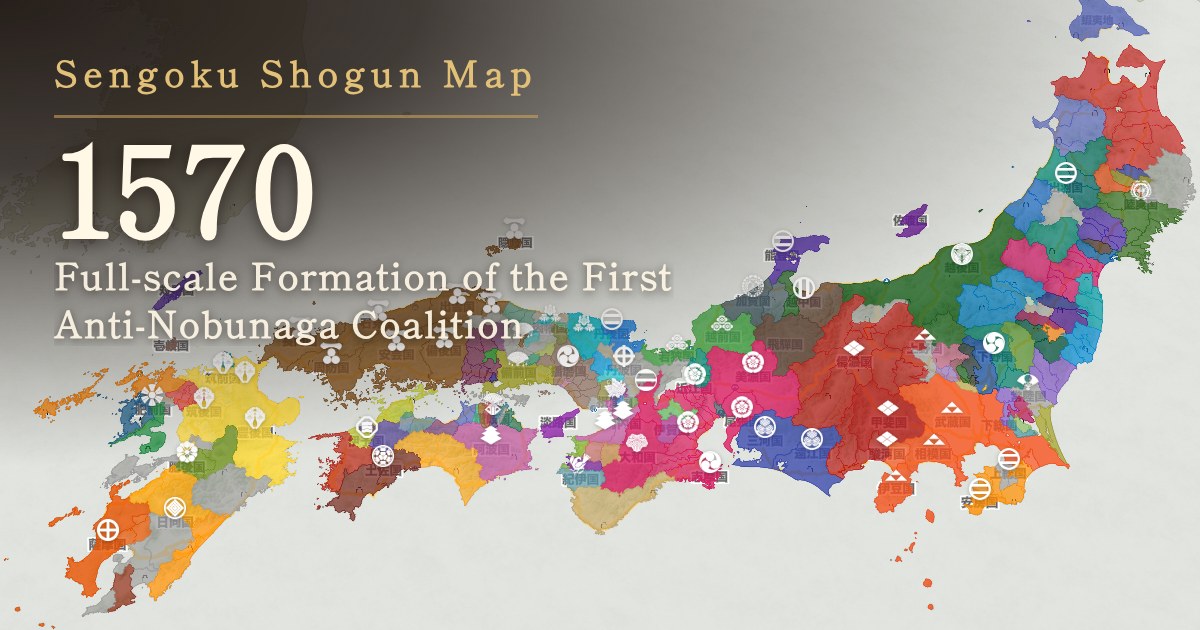
1570 was Genki 1 (kanoe-uma).
The defection of Azai Nagamasa became evident with the retreat at Kanegasaki. Although the Oda–Tokugawa alliance won the subsequent Battle of Anegawa, the Ishiyama War began, expanding the front. The Siege of Shiga underscored the tense situation in the Kinai region, heightening pressures that would culminate in the burning of Mount Hiei the following year.
1570 territory map: major daimyo and their provinces
Each province is counted under its main power. The map shows the finer division by district.
- 山城国 (Ashikaga Yoshiaki), 大和国 (Matsunaga Hisahide), 伊勢国 (Kitabatake Tomofusa and others), 志摩国 (Kuki Yoshitaka), 尾張国 (Oda Nobunaga), 美濃国 (Oda Nobunaga)
Oda clan6 provinces
- 出雲国 (Mōri Terumoto), 石見国 (Mōri Terumoto), 備後国 (Mōri Terumoto), 安芸国 (Mōri Terumoto), 周防国 (Mōri Terumoto), 長門国 (Mōri Terumoto)
Mōri clan6 provinces
- 伊豆国 (Hōjō Ujimasa), 相模国 (Hōjō Ujimasa), 武蔵国 (Hōjō Ujimasa), 下総国 (Chiba Tanetomi)
Later Hōjō clan4 provinces
- 筑前国 (Ōtomo Sōrin), 筑後国 (Ōtomo Sōrin), 豊前国 (Ōtomo Sōrin), 豊後国 (Ōtomo Sōrin)
Ōtomo clan4 provinces
- 河内国 (Miyoshi Yoshitsugu), 和泉国 (Miyoshi Yoshitsugu), 阿波国 (Miyoshi Nagaharu)
Miyoshi clan3 provinces
- 駿河国 (Takeda Shingen), 甲斐国 (Takeda Shingen), 信濃国 (Takeda Shingen)
Takeda clan3 provinces
- 越中国 (Jinbō Nagamoto), 越後国 (Uesugi Kenshin)
Uesugi clan2 provinces
- 若狭国 (Asakura Yoshikage and others), 越前国 (Asakura Yoshikage)
Asakura clan2 provinces
- 三河国 (Tokugawa Ieyasu), 遠江国 (Tokugawa Ieyasu)
Tokugawa clan2 provinces
- 安房国 (Satomi Yoshihiro), 上総国 (Satomi Yoshihiro)
Satomi clan2 provinces
- 淡路国 (Atagi Nobuyasu)
Atagi clan (Awaji)1 province
- 蝦夷地 (Kakizaki Suehiro)
Andō clan1 province
- 伊賀国
Iga Sokoku Ikki1 province
- 丹後国 (Isshiki Yoshimichi)
Isshiki clan1 province
- 備前国 (Uragami Munekage, Ukita Naoie)
Uragami clan1 province
- 備中国 (Mimura Motochika)
Mimura clan1 province
- 飛驒国 (Miki Yoshiyori)
Miki clan (Hida)1 province
- 但馬国 (Yamana Suketomi)
Yamana clan1 province
- 対馬国
Sō clan1 province
- 薩摩国 (Shimazu Yoshihisa)
Shimazu clan1 province
- 隠岐国 (Amago Katsuhisa, 山中幸盛, Oki clan)
Amago clan1 province
- 壱岐国
Hidaka clan1 province
- 能登国 (畠山義慶 and others)
Hatakeyama clan (Noto)1 province
- 佐渡国 (Honma clan)
Honma clan (Sado)1 province
- 加賀国 (Ikkō-ikki)
Honganji and Ikkō-ikki1 province
Provinces divided among several powers20 provinces
摂津国 (Ikeda Katsumasa and others), 常陸国 (Satake Yoshishige and others), 近江国 (Oda Nobunaga, Azai Nagamasa), 上野国 (Hōjō Ujikuni and others), 下野国 (Utsunomiya Hirotsuna and others), 陸奥国 (Date Terumune and others), 出羽国 (Mogami Yoshimori and others), 丹波国 (Hatano Hideharu and others), 因幡国 (Yamana Toyokazu and others), 伯耆国 (Mōri clan and others), 播磨国 (Bessho Nagaharu and others), 美作国 (Uragami Munekage and others), 紀伊国 (Saika Ikki (Saika Magoichi) and others), 讃岐国 (Sogō Masayasu and others), 伊予国 (Kōno Michinao and others), 土佐国 (Chōsokabe Motochika and others), 肥前国 (Ryūzōji Takanobu and others), 肥後国 (Sagara Yoshihisa and others), 日向国 (Itō Yoshisuke and others), 大隅国 (Shimazu Yoshihisa and others)
Events this year
Spring
Mōri Terumoto fortifies Gassan-Toda Castle to block Amago remnants and Oda advances.
1/23
Oda Nobunaga presented the shogun Ashikaga Yoshiaki with a five-article document and had him approve it. It is explained as having restricted the shogun's authority, for example by requiring Nobunaga's accompanying letter on the shogun's letters to the daimyo.
2/14
At Nunobe in Izumo, the Mōri army under its commander-in-chief Mōri Terumoto and others defeated the Amago restoration force of Amago Katsuhisa and Yamanaka Yukimori. Yukimori and his men fled, and the Mōri side gained the upper hand.
Sources 広島県文書館「広島県史年表(中世2)」/山根正明「尼子家復興戦における佐陀江と満願寺城」(島根大学)
Month 4
Date Terumune repelled a rebellion led by his senior retainer 中野宗時 and 中野宗時's son 牧野久仲. Munetoki and the others fled to Sōma territory, and Terumune went on to unify his retainers.
During the Echizen campaign, Azai Nagamasa suddenly defects. Oda Nobunaga faces encirclement by Asakura Yoshikage but retreats successfully thanks to rearguard actions.
Oda Nobunaga made a sudden attack on Tsuruga from Wakasa and stormed Tenzutsuyama, Kanegasaki, Hikida and other castles. Asakura Kagetsune of Kanegasaki Castle withdrew from Tsuruga District.
Sources 福井県立図書館『福井県史』通史編2
4/23
To cut off misfortune brought by war, the imperial court (Emperor Ōgimachi) changed the era name from Eiroku to Genki. It was the shogun Ashikaga Yoshiaki who petitioned for it, and Nobunaga is said to have opposed it.
Month 5
Nobunaga, returning from Kanegasaki through Kyoto to Gifu, was shot at by the marksman Sugitani Zenjūbō at the Chigusa Pass but was unharmed. Zenjūbō is said to have been asked to do so by Rokkaku Yoshikata.
6/4
The force of Rokkaku Jōtei and the Ikkō-ikki, which had risen in alliance with Azai Nagamasa, was defeated on the riverbed of the Yasu River by Oda forces including Shibata Katsuie. Jōtei is said to have later submitted to Nobunaga.
Month 7
Capitalizing on victory at Anegawa, Ieyasu strengthens control in Mikawa and Tōtōmi, subduing rivals and building new castles.
Autumn
Having subdued the Motoyama and Aki clans, Chosokabe Motochika controlled central and eastern Tosa. The remaining rivalry with the Ichijo clan of western Tosa (Hata district) would be the final stage of his unification of the province.
Sources 高知県公式「長宗我部元親と土佐の戦国時代」
7/30
In Ōmi, Oda–Tokugawa allied forces defeat the Azai–Asakura alliance, expanding their influence by securing northern Ōmi castles.
See this battle in detail →Sources 長浜市広報「きゃんせ長浜」2007年10月号(姉川の合戦史跡を巡るハイキング)
Month 8
Kennyo of the Ishiyama Hongan-ji in Settsu rises against Nobunaga, starting a prolonged war involving Ikkō sect followers.
See this battle in detail →Sources 大阪市「石山(大坂)本願寺推定地」/大阪市「大阪市の歴史-タイムトリップ20,000年」
Month 9
In Settsu, Oda forces attack strongholds of the Miyoshi Triumvirs and Hongan-ji, but retreat when Azai–Asakura advance south.
See this battle in detail →Sources 大阪市「7.野田城(のだじょう)跡」(福島区玉川四丁目11)/大阪市福島区「名所・旧跡」
During the Shiga Campaign, Azai Nagamasa issued prohibitions forbidding violence by soldiers to Kamigyō in Kyoto and to Kiyomizudera, Daitokuji, Chion-in, Myōshinji and Ōyamazaki.
Sources 長浜市教育委員会「史跡小谷城跡保存管理計画書」
9/20
Murakami Takeyoshi, head of the Noshima Murakami, pledged loyalty to Mōri Motonari and Terumoto. The naval force that controlled sea traffic in the Seto Inland Sea came to belong to the Mōri side.
Sources 広島県文書館「広島県史年表(中世2)」/コトバンク「村上武吉」
Mori Yoshinari of Usayama Castle fought the Azai and Asakura army at the Sakamoto approach and was killed with Nobunaga's younger brother Oda Nobuharu. The castle did not fall, which led into the Shiga Campaign.
Month 10
In Ōmi, Oda clashes with Azai, Asakura, and Hongan-ji forces near Sakamoto–Ōtsu. Mediated by Enryaku-ji, the stalemate continues into the following year.
Sources 公益社団法人びわ湖大津観光協会「比叡山/織田信長の比叡山焼き討ち」
Winter
Nanbu clan eases conflict with Andō in Tsugaru, maintaining control over northern trade routes.
Month 11
The Nagashima Ikkō-ikki, responding to the uprising of Ishiyama Honganji, attacked Okoshi Castle in Owari, and Nobunaga's younger brother Oda Nobuoki, who was in the castle, died. It is regarded as the beginning of the Nagashima Ikkō-ikki.
11/26
During the Shiga Campaign, Sakai Masahisa of the Oda side was attacked by the Azai and Asakura army at Katata on the western shore of Lake Biwa and was killed.
12/13
Uesugi Terutora deposited at the 看経所 of Kasugayama Castle a prayer for the pacification of Etchū, and from this time took the religious name Kenshin.
Sources 上越市(謙信公祭協賛会)「略年譜」
A truce ordered by the shogun Ashikaga Yoshiaki and the kampaku Nijō Haruyoshi was concluded, ending the Shiga Campaign, in which Oda Nobunaga faced Azai Nagamasa and Asakura Yoshikage. Yoshikage withdrew his troops to Echizen on the 15th.
Sources 長浜市教育委員会「史跡小谷城跡保存管理計画書」
Ukita Naoie, lord of Numa Castle, brought down Konkō Munetaka, who held the castle at Ishiyama in Okayama, and posted a castle guard. He later moved to Ishiyama and built a castle there by the first year of Tenshō (1573).
Sources 天下統一と近世城郭の誕生(おかやまの中世争乱史)
Oda Nobunaga left Kyoto to subdue the Asakura and camped at the residence of Matsumiya Genba at Kumagawa in Wakasa before advancing into Echizen. Many of Wakasa's kokujin are said to have followed him.
Sources 史跡後瀬山城跡整備基本計画 - 小浜市教育委員会
Kinoshita Tōkichirō (later Hashiba Hideyoshi) entered Yokoyama Castle, which Oda Nobunaga had captured in the Battle of Anegawa, and is said to have guarded the front line against Azai territory.
Sources 滋賀県文化財保護協会「新近江名所図会 第99回」/長浜市「史跡小谷城跡保存管理計画書」
As a token of the Echigo–Sagami alliance, Ujiyasu's son Saburō was sent to Echigo, where he is said to have been adopted by Uesugi Kenshin and given the name Kagetora.
Sources https://www.city.joetsu.niigata.jp/site/cultural-property/cultural-property-city184.html/https://kotobank.jp/word/上杉景虎
Mogami Yoshiaki succeeded to the headship from his father Yoshimori and became lord of Yamagata Castle. The time is given as 1570 or 1571, and he is said to have been in conflict with his younger brother.
Forces on Ōtomo Sōrin's side closed in on Saga, and Ryūzōji Takanobu's side defeated the army of Ōtomo Hachirō (said to be Ōtomo Chikasada) at Imayama.
Tokugawa Ieyasu moved his base from Okazaki Castle in Mikawa to Hikuma Castle in Tōtōmi, enlarged it and renamed it Hamamatsu Castle. It remained his base until he moved to Sunpu in 1586.
Sources 浜松市「家康公の略年表」/浜松市「浜松城の変遷」