1568 territory map and events: Oda Nobunaga's March on Kyoto and the Installation of Ashikaga Yoshiaki as Shogun
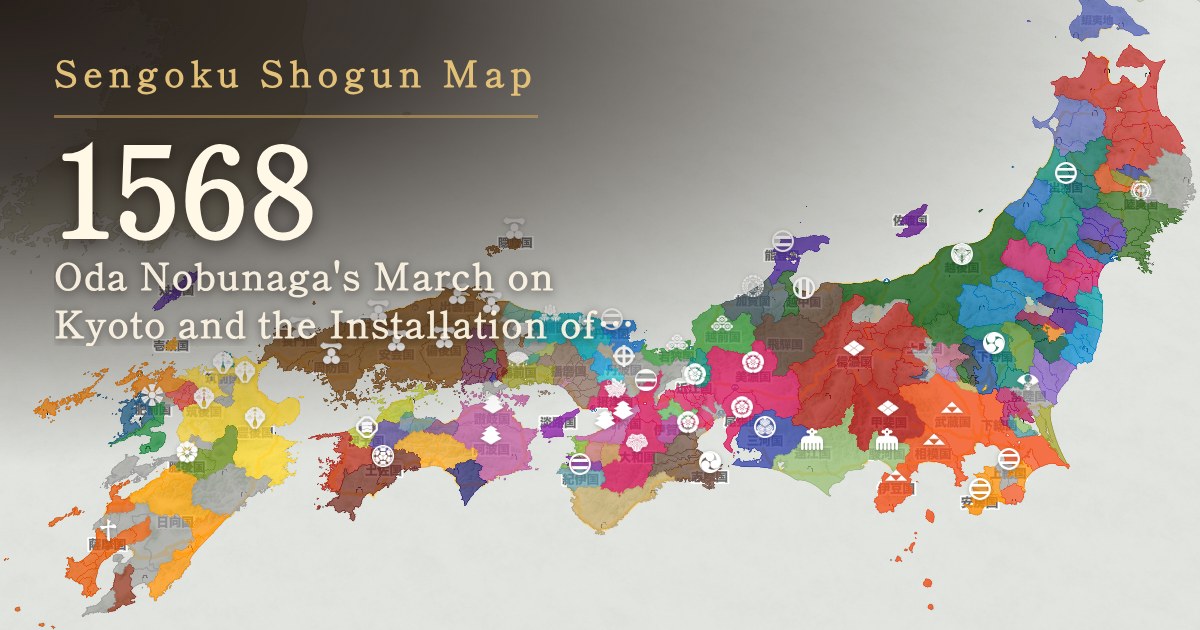
1568 was Eiroku 11 (tsuchinoe-tatsu).
Responding to Ashikaga Yoshiaki's request, Oda Nobunaga marched on Kyoto with a large army, brushing aside Miyoshi resistance and seizing control of the capital. In October, Yoshiaki was appointed the 15th shogun, and shogunal government was rebuilt under the protection of Nobunaga's military might, an arrangement that simultaneously gave Nobunaga himself an opening to dominate central politics.
1568 territory map: major daimyo and their provinces
Each province is counted under its main power. The map shows the finer division by district.
- 伯耆国 (Mōri Motonari), 出雲国 (Mōri Motonari), 石見国 (Mōri Motonari), 備後国 (Mōri Terumoto), 安芸国 (Mōri Terumoto), 周防国 (Mōri Terumoto), 長門国 (Mōri Terumoto)
Mōri clan7 provinces
- 山城国 (Ashikaga Yoshiaki), 大和国 (Matsunaga Hisahide), 摂津国 (Ikeda Katsumasa, Itami Chikaoki, Wada Koremasa), 尾張国 (Oda Nobunaga), 美濃国 (Oda Nobunaga)
Oda clan5 provinces
- 伊豆国 (Hōjō Ujimasa), 相模国 (Hōjō Ujimasa), 武蔵国 (Hōjō Ujimasa), 下総国 (Chiba Tanetomi)
Later Hōjō clan4 provinces
- 河内国 (Miyoshi Yoshitsugu), 和泉国 (Miyoshi Yoshitsugu), 阿波国 (Miyoshi Nagaharu), 讃岐国
Miyoshi clan4 provinces
- 筑後国 (Ōtomo Sōrin), 豊前国 (Ōtomo Sōrin), 豊後国 (Ōtomo Sōrin)
Ōtomo clan3 provinces
- 遠江国 (Imagawa Ujizane), 駿河国 (Imagawa Ujizane)
Imagawa clan2 provinces
- 但馬国 (Yamana Suketomi), 因幡国
Yamana clan2 provinces
- 越中国 (Jinbō Nagamoto), 越後国 (Uesugi Kenshin)
Uesugi clan2 provinces
- 若狭国 (Asakura Yoshikage and others), 越前国 (Asakura Yoshikage)
Asakura clan2 provinces
- 甲斐国 (Takeda Shingen), 信濃国 (Takeda Shingen)
Takeda clan2 provinces
- 淡路国 (Atagi Nobuyasu)
Atagi clan (Awaji)1 province
- 蝦夷地 (Kakizaki Suehiro)
Andō clan1 province
- 伊賀国
Iga Sokoku Ikki1 province
- 丹後国 (Isshiki Yoshimichi)
Isshiki clan1 province
- 志摩国 (Kuki Yoshitaka)
Kuki clan1 province
- 備中国 (Mimura Motochika)
Mimura clan1 province
- 飛驒国 (Miki Yoshiyori)
Miki clan (Hida)1 province
- 対馬国
Sō clan1 province
- 三河国 (Tokugawa Ieyasu)
Tokugawa clan1 province
- 隠岐国 (Amago Katsuhisa, 山中幸盛, Oki clan)
Amago clan1 province
- 壱岐国
Hata clan1 province
- 能登国 (畠山義慶 and others)
Hatakeyama clan (Noto)1 province
- 佐渡国 (Honma clan)
Honma clan (Sado)1 province
- 加賀国 (Honganji, Ikkō-ikki)
Honganji and Ikkō-ikki1 province
- 安房国 (Satomi Yoshihiro)
Satomi clan1 province
Provinces divided among several powers21 provinces
伊勢国 (Oda Nobunaga and others), 上総国 (Satomi Yoshihiro and others), 常陸国 (Satake Yoshishige and others), 近江国 (Oda Nobunaga, Azai Nagamasa), 上野国 (Asari Nobutane and others), 下野国 (Utsunomiya Hirotsuna and others), 陸奥国 (Date Terumune and others), 出羽国 (Mogami Yoshimori and others), 丹波国 (Hatano Hideharu and others), 播磨国 (Akamatsu Yoshisuke), 美作国 (Uragami Munekage and others), 備前国 (Uragami Munekage and others), 紀伊国 (Hatakeyama Takamasa and others), 伊予国 (Kōno Michinao and others), 土佐国 (Chōsokabe Motochika and others), 筑前国 (Ōtomo Sōrin and others), 肥前国 (Ryūzōji Takanobu and others), 肥後国 (Sagara Yoshihisa and others), 日向国 (Itō Yoshisuke and others), 大隅国 (Shimazu Takahisa and others), 薩摩国 (Shimazu Takahisa and others)
Events this year
Month 3
The Agakita lord Honjō Shigenaga answered Takeda Shingen's overtures, turned against Uesugi Terutora, and was surrounded. He surrendered in the second month of the following year and sent his heir as a hostage.
Sources 上越市「略年譜」(座標は村上城。本庄城は近く)
Jukei-ni, wife of Ujichika and mother of Ujiteru and Yoshimoto, died. She took over government during Ujiteru's childhood and was called the "female sengoku daimyo," and she supported Yoshimoto in the Hanakura Rebellion.
Sources 日本人名大辞典「寿桂尼」
At the request of the Kōno clan, Kobayakawa Takakage crossed the sea to Iyo, repelled the Ichijō advance and seized castles of the Utsunomiya clan at Ōzu and elsewhere. Kikkawa Motoharu is also said to have gone.
Sources 川岡勉「永禄期の南伊予の戦乱をめぐる一考察」(愛媛大学)/広島県文書館「広島県史年表(中世2)」
Month 4
Under Asakura Yoshikage's guardianship, Ashikaga Yoshiaki performed his coming-of-age ceremony at Ichijōdani and changed his name from Yoshiaki to Yoshiaki.
Sources 福井県立一乗谷朝倉氏遺跡博物館「朝倉氏の歴史」
5/7
Emperor Ōgimachi asked Mōri Motonari to contribute toward rebuilding Tōdai-ji's Great Buddha Hall, burned the previous year. It is not confirmed whether Motonari complied.
Sources 広島県文書館『広島県史年表(中世2)』
Month 6
Asakura Yoshikage's young heir died at the age of seven. Coming after the death of his favored concubine in Eiroku 4, it was a further misfortune, and Yoshikage is said to have been overcome with grief.
Sources 福井県立図書館『福井県史』通史編2
7/13
Ashikaga Yoshiaki gave up on the situation in the northern provinces, accepted Oda Nobunaga's invitation, left Ichijōdani and headed for Mino. His stay lasted about nine months, and Asakura Kagetsune escorted him to the Ōmi border.
Sources 福井県立図書館『福井県史』通史編2
7/16
Ashikaga Yoshiaki (then writing his name 義秋), who had been with Asakura Yoshikage in Echizen, entered Azai Nagamasa's Odani Castle on his way to Mino.
Sources 長浜市教育委員会「史跡小谷城跡保存管理計画書」
Month 8
Oda Nobunaga, who was marching on Kyoto with Yoshiaki, sent an envoy from Sawayama in Ōmi asking Asakura Yoshikage to join him, but Yoshikage did not comply.
Sources 河村昭一論文(若越郷土研究65巻2号)
The Asakura clan advanced troops to Onyū District in Wakasa and brought the young Takeda Motoaki, who had succeeded to the headship after the death of Takeda Yoshimune, to Echizen. The rule of the Wakasa-Takeda clan effectively came to an end.
Sources 福井県立図書館『福井県史』通史編2
Month 9
Ashikaga Yoshiaki and Oda Nobunaga took Akutagawayama Castle, held by Miyoshi Nagayasu, and entered it. Yoshiaki was later appointed shogun in Kyoto.
Sources 高槻市「11.足利義昭の上洛と高槻」
Month 10
After entering Kyoto, Oda Nobunaga accepted Matsunaga Hisahide's surrender and ordered him, as deputy in Nara, to pacify Yamato. Nobunaga issued a seisatsu (notice board) in Nara and demanded gift money.
10/18
With support from Oda Nobunaga's march on Kyoto, Ashikaga Yoshiaki entered the capital and was appointed shogun on October 18. The Muromachi shogunate's shogunal office was restored.
Sources 高槻市「11.足利義昭の上洛と高槻」
Month 12
Tokugawa Ieyasu agreed with Takeda Shingen to divide Suruga and Tōtōmi, and invaded Tōtōmi with the guidance of the Iinoya Three. On the 18th of the twelfth month he entered Hikuma Castle (later Hamamatsu Castle). He did not move his seat there until 1570.
Sources 浜松市「徳川家康公顕彰四百年記念事業特別展 家康と遠江の国衆」
12/12
Azai Hisamasa and his son Nagamasa sent a written oath to Kutsuki Mototsuna, recognizing new lands of 1,000 koku and arranging the handing over of hostages and other matters, and so drew the Kutsuki clan to their side.
Sources 長浜市教育委員会「史跡小谷城跡保存管理計画書」
12/13
On the thirteenth day of the twelfth month of Eiroku 11 (1568, lunar calendar), Takeda Shingen's army entered Sunpu. Imagawa Ujizane fled to Kakegawa Castle with only about 50 mounted retainers.
Shimazu Tadayoshi (Jisshinsai), who had supported Takahisa's succession to the main family, died at the age of 77. He was later regarded as the author of the "Iroha-uta," a code of conduct for the retainer band. His place of death is thought to be Kaseda.
Sources コトバンク「島津忠良」
12/27
Tokugawa Ieyasu advanced his camp close to Kakegawa and closed in on Kakegawa Castle, where Imagawa Ujizane was holed up, and set fire to the town below. He did not mount a full assault but built siege forts around it and withdrew. The date is in the lunar calendar.
Sources 掛川市「徳川家康と掛川城のかかわり~掛川城の戦いを中心に~」
Advancing toward Kyoto with Ashikaga Yoshiaki, Oda Nobunaga attacked Kannonji Castle, drove out Rokkaku Yoshikata and his allies, and secured the route to the capital.
See this battle in detail →Sources 滋賀県「史跡観音寺城跡の調査と整備」
Takeda Shingen agreed with Tokugawa Ieyasu to divide the Imagawa domain, invaded Suruga and occupied Sunpu. Imagawa Ujizane withdrew to Kakegawa, and the Kai–Sagami–Suruga three-way alliance collapsed.
Sources 静岡市歴史博物館「今川義元」/おだわらデジタルミュージアム「北条氏康書状(永禄12年3月13日)」/浜松市「家康公を学ぶ 家康公の略年表」/静岡市「中世~鎌倉・南北朝・室町・戦国~」
Shortly after entering Kyoto, Nobunaga demanded 20,000 kan of arrow tax—military funds—from the autonomous merchant city of Sakai. Records indicate Sakai's residents deepened their moats for defense.
Sources 堺市「堺環濠都市遺跡」
Fuji Nobutada resisted Takeda attacks at Ōmiya Castle. While there were apparently multiple attacks, public records confirm only the period of Eiroku 11-12, with individual dates remaining unknown.
Sources 富士宮市「大宮城の発掘」
Ukita Naoie attacked the Matsuda clan of Kanagawa Castle, with whom he had marriage ties, and the castle fell; the Matsuda clan was destroyed. Naoie became the leading power in western Bizen.
Sources 岡山県「備前・備中・美作の戦国」
Oda Nobunaga is said to have entered Ōmi with Ashikaga Yoshiaki and made camp at the Azai-side Sawayama. The date of the seventh of the eighth month in Nagahama City's chronology is not certain as to month and day.
Sources 長浜市教育委員会「史跡小谷城跡保存管理計画書」
In 1568, as the Takeda and Tokugawa invasion drew near, Imagawa Ujizane tried, through his senior retainer Sekiguchi Ujitsune, to have Ii Naotora and others carry out the Iinoya tokusei that had been stalled.
Sources 日本歴史地名大系「井伊谷村」
The Kanbe clan of northern Ise is said to have made peace with Nobunaga on condition that it take in Nobunaga's third son (later Oda Nobutaka) as an adopted heir. The Seki clan also submitted to the Oda side.