1562 territory map and events: The Formation of the Kiyosu Alliance
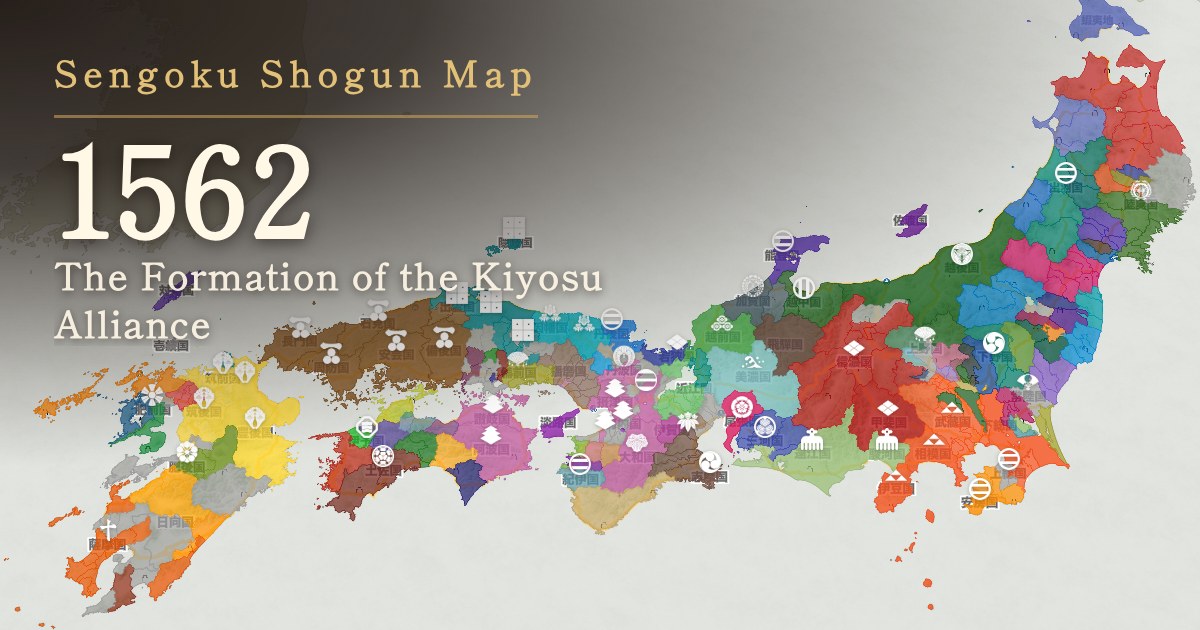
1562 was Eiroku 5 (mizunoe-inu).
Having slain Imagawa Yoshimoto at Okehazama, Oda Nobunaga met with Matsudaira Motoyasu (the future Tokugawa Ieyasu), who was breaking away from Imagawa control, at Kiyosu Castle, and the two concluded a mutual defense pact. The Kiyosu Alliance would hold firm for roughly twenty years until Nobunaga's death at Honnō-ji, a remarkably stable partnership by the standards of the Sengoku period.
1562 territory map: major daimyo and their provinces
Each province is counted under its main power. The map shows the finer division by district.
- 山城国 (Ashikaga Yoshiteru), 大和国 (Matsunaga Hisahide), 摂津国 (Miyoshi Nagayoshi), 阿波国 (Miyoshi Nagayoshi), 讃岐国
Miyoshi clan5 provinces
- 石見国 (Mōri Motonari), 備後国 (Mōri Motonari), 安芸国 (Mōri Motonari), 周防国 (Mōri Motonari), 長門国 (Mōri Motonari)
Mōri clan5 provinces
- 伊豆国 (Hōjō Ujimasa), 相模国 (Hōjō Ujimasa), 武蔵国 (Hōjō Ujimasa), 下総国 (Chiba Tanetomi)
Later Hōjō clan4 provinces
- 筑前国 (Ōtomo Sōrin), 筑後国 (Ōtomo Sōrin), 豊前国 (Ōtomo Sōrin), 豊後国 (Ōtomo Sōrin)
Ōtomo clan4 provinces
- 伯耆国 (Amago Yoshihisa), 出雲国 (Amago Yoshihisa), 隠岐国 (Amago Yoshihisa)
Amago clan3 provinces
- 遠江国 (Imagawa Ujizane), 駿河国 (Imagawa Ujizane)
Imagawa clan2 provinces
- 但馬国 (Yamana Suketomi), 因幡国
Yamana clan2 provinces
- 越中国 (Jinbō Nagamoto), 越後国 (Uesugi Kenshin)
Uesugi clan2 provinces
- 甲斐国 (Takeda Shingen), 信濃国 (Takeda Shingen)
Takeda clan2 provinces
- 淡路国 (Atagi Haruoki)
Atagi clan (Awaji)1 province
- 蝦夷地 (Kakizaki Suehiro)
Andō clan1 province
- 伊賀国
Iga Sokoku Ikki1 province
- 丹後国 (Isshiki Yoshimichi)
Isshiki clan1 province
- 志摩国 (Kuki Yoshitaka)
Kuki clan1 province
- 美濃国 (Saitō Tatsuoki)
Saitō clan1 province
- 飛驒国 (Miki Yoshiyori)
Miki clan (Hida)1 province
- 若狭国 (Takeda Yoshimune and others)
Wakasa-Takeda clan1 province
- 対馬国
Sō clan1 province
- 尾張国 (Oda Nobunaga)
Oda clan1 province
- 越前国 (Asakura Yoshikage)
Asakura clan1 province
- 能登国 (Hatakeyama Yoshitsuna)
Hatakeyama clan (Noto)1 province
- 佐渡国 (Honma clan)
Honma clan (Sado)1 province
- 加賀国 (Honganji, Ikkō-ikki)
Honganji and Ikkō-ikki1 province
- 安房国 (Satomi Yoshihiro)
Satomi clan1 province
Provinces divided among several powers25 provinces
河内国 (Miyoshi Nagayoshi and others), 和泉国 (Miyoshi Nagayoshi and others), 伊勢国 (Kitabatake Tomonori and others), 三河国 (Matsudaira Motoyasu and others), 上総国 (Satomi Yoshihiro and others), 常陸国 (Satake Yoshishige and others), 近江国 (Rokkaku clan, Azai clan), 上野国 (Nagano Narimori and others), 下野国 (Utsunomiya Hirotsuna and others), 陸奥国 (Date Harumune and others), 出羽国 (Mogami Yoshimori and others), 丹波国 (Naito Munekatsu and others), 播磨国 (Akamatsu Yoshisuke), 美作国 (Amago Yoshihisa and others), 備前国 (Uragami Munekage and others), 備中国 (Mimura Iechika and others), 紀伊国 (Hatakeyama Takamasa and others), 伊予国 (Kōno Michinao and others), 土佐国 (Chōsokabe Motochika and others), 肥前国 (Ryūzōji Takanobu and others), 肥後国 (Sagara Yoshihisa and others), 日向国 (Itō Yoshisuke and others), 大隅国 (Shimazu Takahisa and others), 薩摩国 (Shimazu Takahisa and others), 壱岐国 (Hata and others)
Events this year
Month 1
Hōjō forces under Ōta Yasusuke surrounded Kasai Castle. After holding out for roughly two months, it fell in late April. A senior officer of the Awa-Satomi fell during this siege.
Sources さいたま市「岩槻城跡を探る(中編・下)」
3/5
Miyoshi Jikkyū was killed in battle near Kumedadera in the fighting against the Hatakeyama side. His date of death is given as the fifth day of the third month (Nihon Jinmei Daijiten, Takatsuki Shishi).
Sources 岸和田市「三好実休の碑」
Month 5
The Miyoshi side and Hatakeyama Takamasa's side fought in Kawachi (the battle of Kyōkōji and Habikino), and between the middle and end of the fifth month Takamasa is said to have been defeated and fled to Kii.
Month 6
By June 1562 the Mōri had driven Amago-aligned forces out of Iwami. Honjō Tsunemitsu, who had held Yamabuki Castle, also surrendered, and the Iwami Silver Mine returned to Mōri hands.
Sources 島根県「令和2年度 島根の世界遺産講座」資料/島根県古代文化センター「島根歴史講座 尼子家の『御一家再興』戦争と山中幸盛」資料
Month 7
The Mōri declared the Izumo–Aki peace void and invaded Izumo. In July most Izumo local lords submitted, and Motonari and Motoharu entered Akana to direct the campaign.
Sources 島根県古代文化センター「島根歴史講座 尼子家の『御一家再興』戦争と山中幸盛」資料/松江市「戦国時代の松江地域」
Month 8
Shogun Ashikaga Yoshiteru appointed Mōri Takamoto shugo of Bitchū and Bingo in August and of Nagato in September. This was a move to confirm Mōri rule over western Japan through shogunal office.
Sources 広島県文書館『広島県史年表(中世2)』
8/21
Asakura Yoshikage welcomed Daikakuji Gishun, who had come down from Kyoto, and held a gokusui no en (poetry banquet by a winding stream) at Ichijōdani, attended by men of culture from Kyoto and by Yoshikage's kin and retainers.
Sources 福井県立図書館『福井県史』通史編2
9/18
In a letter to Utsunomiya Hirotsuna, Takeda Shingen reported that he had smashed the villages of Minowa, Sōja and Kuragano. At this point neither Minowa nor Kuragano had fallen.
Sources 高崎市・笹本正治「箕輪城と武田氏」
Month 11
Hōjō Ujiyasu, with Takeda Shingen's support, besieged Matsuyama Castle. After roughly three months of siege, it fell in February 1563.
Sources さいたま市「岩槻城跡を探る(中編・下)」
Mōri Motonari killed the surrendered Honjō Tsunemitsu at his camp in Shinji. Kumano and other lords on the Mōri side returned to the Amago, and Motonari set up camp on the north shore of Lake Shinji.
Sources 島根県古代文化センター「島根歴史講座 尼子家の『御一家再興』戦争と山中幸盛」資料/島根県「令和2年度 島根の世界遺産講座」資料
Matsudaira Motoyasu and Oda Nobunaga met at Kiyosu Castle and formed an alliance, allowing Motoyasu to focus on Mikawa and Nobunaga on Mino.
The Later Hōjō issued regulations for the market before Iizumi Kannon, prohibiting levies, forced purchases, violence, and quarrels in order to regulate trade and public order.
Sources おだわらデジタルミュージアム「郷土読本 小田原」
At age sixteen, Satake Yoshishige succeeded to the chieftaincy from his father Yoshiaki. He assumed leadership while receiving guardianship from Yoshiaki and support from his clan and administrative officials. He would later become known as the 'Demon Yoshishige.'
Sources 茨城県立歴史館「佐竹義重」
Ōmura Sumitada opened Yokoseura in Hizen as a port for Namban trade. Merchants arriving on Portuguese ships were exempted from duties for ten years, and a church was built; the port is said to have prospered.
Sources 西海市「県指定文化財(史跡 横瀬浦)」/観光庁多言語解説文データベース「長崎を中心とするキリシタン関連年表」
Ōtomo Yoshishige of Bungo took Buddhist vows and adopted the name Sōrin. While protecting the spread of Christianity, he is said to have himself shaved his head and devoted himself to Zen Buddhism.
Sources 大分市「宗麟と天下人」/大分市「大友宗麟とその時代」
Ii Naochika, lord of Iinoya Castle in Tōtōmi Province, was killed at Kakegawa, on his way to explain away rumors of rebellion, by Asahina Yasutomo, a senior retainer of Imagawa Ujizane.
Sources 日本人名大辞典「井伊直親」
Matsudaira Motoyasu stormed the Imagawa-side Kaminogō Castle, and its lord Udono Nagateru, whose mother was a sister of Imagawa Yoshimoto, was killed in battle. After the fall of the castle the Hisamatsu clan was placed in it.
Sources 蒲郡市「広報がまごおり 2009年9月号 上ノ郷城跡発掘調査中間報告」
Motoyasu's wife Tsukiyama-dono and his son Nobuyasu, who had been left with the Imagawa clan at Sunpu, are said to have moved to Okazaki and rejoined Motoyasu.
Sources コトバンク「築山殿」