1554 territory map and events: The Formation of the Kai-Sagami-Suruga Triple Alliance
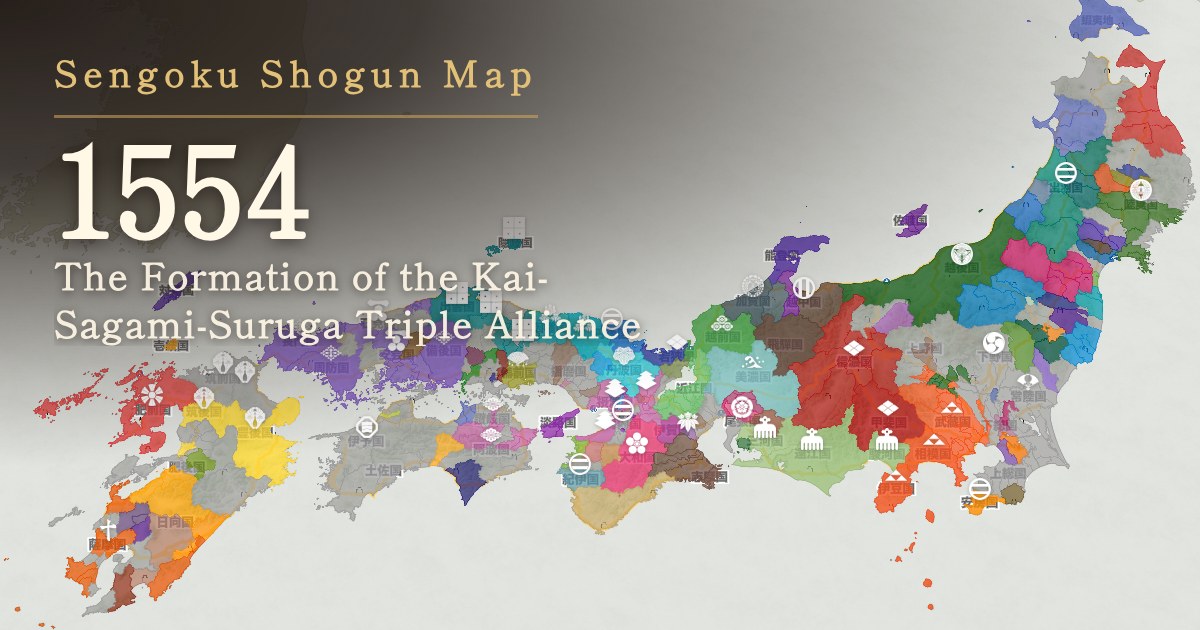
1554 was Tenbun 23 (kinoe-tora).
Takeda Harunobu, Hōjō Ujiyasu, and Imagawa Yoshimoto formed the Kai-Sagami-Suruga Triple Alliance, sealed through a series of marriages between their children. With this pact among three eastern daimyo who had long fought one another, each lord was freed from worrying about his rear, allowing them to concentrate their strength on northern Shinano, the Kantō, and Owari respectively.
1554 territory map: major daimyo and their provinces
Each province is counted under its main power. The map shows the finer division by district.
- 伊豆国 (Hōjō Ujiyasu), 相模国 (Hōjō Ujiyasu), 武蔵国 (Hōjō Ujiyasu and others)
Later Hōjō clan3 provinces
- 三河国 (Imagawa castle wardens), 遠江国 (Imagawa Yoshimoto), 駿河国 (Imagawa Yoshimoto)
Imagawa clan3 provinces
- 山城国 (Miyoshi Nagayoshi and others), 和泉国 (Miyoshi Nagayoshi, Local lords of Izumi and others), 摂津国 (Miyoshi Nagayoshi, Ikeda clan and others)
Miyoshi clan3 provinces
- 備後国 (Ōuchi Yoshinaga and others), 周防国 (Ōuchi Yoshinaga, Sue Harukata), 長門国 (Ōuchi Yoshinaga, Sue Harukata)
Ōuchi clan3 provinces
- 筑後国 (Ōtomo Yoshishige and others), 豊後国 (Ōtomo Yoshishige)
Ōtomo clan2 provinces
- 出雲国 (Amago Haruhisa), 隠岐国 (Amago Haruhisa and others)
Amago clan2 provinces
- 蝦夷地 (Kakizaki Suehiro)
Andō clan1 province
- 伊賀国
Iga Sokoku Ikki1 province
- 丹後国 (Isshiki clan, Local lords of Tango and others)
Isshiki clan1 province
- 志摩国 (Shima lords and others)
Kuki clan1 province
- 美濃国 (Saitō Dōsan and others)
Saitō clan1 province
- 飛驒国 (Anekōji clan and others)
Miki clan (Hida)1 province
- 但馬国 (Yamana clan and others)
Yamana clan1 province
- 若狭国 (Takeda Nobutoyo, Local lords of Wakasa and others)
Wakasa-Takeda clan1 province
- 対馬国
Sō clan1 province
- 越後国 (Nagao Kagetora)
Uesugi clan1 province
- 越前国 (Asakura Yoshikage)
Asakura clan1 province
- 大和国 (Tsutsui Junkō and others)
Tsutsui clan1 province
- 壱岐国
Hata clan1 province
- 丹波国 (Matsunaga Nagayori and others)
Hatano clan1 province
- 能登国 (Noto Hatakeyama clan)
Hatakeyama clan (Noto)1 province
- 甲斐国 (Takeda Harunobu)
Takeda clan1 province
- 加賀国 (Kaga Ikkō-ikki)
Honganji and Ikkō-ikki1 province
- 安房国 (Satomi Yoshitaka)
Satomi clan1 province
- 肥前国 (Ryūzōji Iekane and others)
Ryūzōji clan1 province
Provinces divided among several powers34 provinces
河内国 (Hatakeyama Masakuni and others), 伊勢国 (Kitabatake clan and others), 尾張国 (Oda Nobunaga and others), 上総国 (Mariyatsu Takeda clan and others), 下総国 (Chiba clan and others), 常陸国 (Satake clan and others), 近江国 (Rokkaku clan and others), 信濃国 (Takeda Harunobu and others), 上野国 (Later Hōjō clan and others), 下野国 (Utsunomiya clan and others), 陸奥国 (Nanbu clan and others), 出羽国 (Mogami clan and others), 越中国 (Jinbō clan and others), 佐渡国 (Honma clan of Kawarada and others), 因幡国 (Yamana clan and others), 伯耆国 (Amago Haruhisa and others), 石見国 (Mōri Motonari and others), 播磨国 (Akamatsu Harumasa and others), 美作国 (Amago Haruhisa and others), 備前国 (Uragami Masamune and others), 備中国 (Mimura Iechika and others), 安芸国 (Mōri Motonari and others), 紀伊国 (Hatakeyama Tanenaga and others), 淡路国 (Atagi clan and others), 阿波国 (Hosokawa Mochitaka and others), 讃岐国 (Hosokawa clan and others), 伊予国 (Kōno Michinobu and others), 土佐国 (Ichijō Fusaie and others), 筑前国 (Ōtomo Yoshishige and others), 豊前国 (Ōtomo Yoshishige and others), 肥後国 (Kikuchi clan factions and others), 日向国 (Itō Yoshisuke and others), 大隅国 (Shimazu Takahisa and others), 薩摩国 (Shimazu Takahisa and others)
Events this year
1/24
The Oda-Mizuno alliance attacked Muroki Sai, a fortification built by the Imagawa, from three directions. Using firearms, they forced the Imagawa garrison to surrender within hours.
Sources 東浦町観光協会「村木砦の戦い」
Month 5
Mōri Motonari is said to have cut ties with Sue Harukata and turned hostile. The timing is said to be the fifth month of Tenbun 23, and his base was Yoshida-Kōriyama Castle.
5/26
Ryūzōji Takanobu issued a document confirming his retainers' landholdings. It is regarded as the earliest surviving example of a Ryūzōji confirmation of holdings.
Month 6
Mōri Motonari, who had broken with the Suo clan, defeated Miyagawa Kai-no-kami of the Suo forces at Oshikibata. This victory led to the Battle of Miyoshima the following year, 1555.
Month 7
In the seventh month of Tenbun 23 (1554), Hōjō Ujiyasu's eldest daughter married Imagawa Ujizane. The marriage was one of the ties of the Triple Alliance of Kai, Sagami, and Suruga.
7/12
Shiba Yoshimune, shugo of Owari, was killed by retainers on the shugodai's side after it became known that he had been in secret contact with Nobunaga. Nobunaga later besieged Kiyosu Castle and the matter is said to have ended in a settlement.
Month 11
Amago Haruhisa put to death his kinsmen of the Shingū faction, including Amago Kunihisa and Amago Sanehisa. With this incident, the Shingū faction was destroyed.
The Takeda, Hōjō, and Imagawa established an alliance through marriages among their children.
Hōjō Ujiyasu, Takeda Harunobu, and Imagawa Yoshimoto settled their dispute over the Kato through intermarriage and established the Kō-Sō-Sen (Takeda-Hōjō-Imagawa) Tripartite Alliance. The marriages of Lady Hayakawa and the Yellow Plum Abbess bound the three families' heirs.
Shōnyo, the 10th head of the Honganji, died, and his eldest son Kennyo, aged 12 by the traditional count, succeeded him. The setting was Osaka Honganji.
Shimazu Takahisa's forces took Iwatsurugi Castle in Ōsumi, which the Gamō side had held. After its fall, Shimazu Yoshihiro was stationed there to garrison it.
A peasant uprising (tsuchi ikki) broke out centered on Nakayama Shrine, the ichinomiya of Mimasaka Province. Its aims, scale and outcome are not recorded.
Sources 津山市「歴史-主要年表」(津山市統計書の資料編)
Kitajō Takahiro, lord of 北条城 in 刈羽郡, is said to have turned against Nagao Kagetora. The rebellion is said to have been suppressed in 1555, the following year.
Sources 上越観光Navi「年表で見る上杉謙信公の生涯」
Saitō Dōsan of Mino handed the headship to his eldest son Yoshitatsu and retired. Two years later, father and son would fight in the Battle of Nagara River.