INTERACTIVE BATTLE
Meiō Coup and Battle of Shōkakuji
Leap 4th month, 22nd day, Meiō 2 (April 1493) · Shōkakuji Castle, Kawachi Province
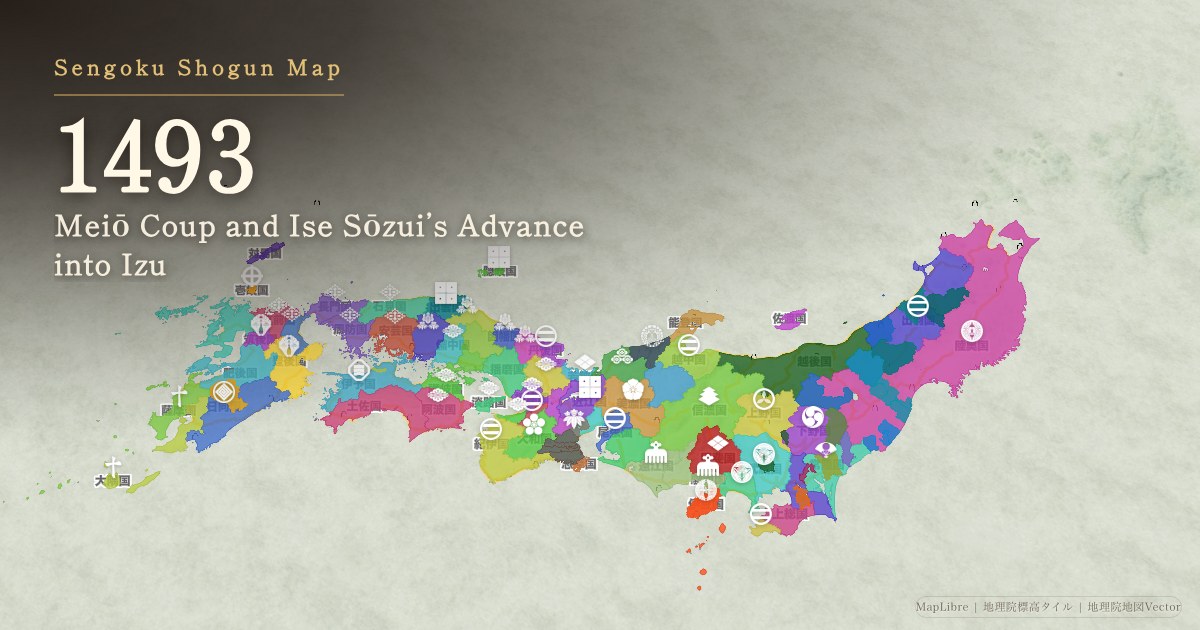
Hosokawa Masamoto staged a coup to depose Shogun Ashikaga Yoshiki, captured Shōkakuji Castle, and forced Hatakeyama Masanaga to commit suicide.
Background
As the succession dispute between Hatakeyama Masanaga and Hatakeyama Yoshitoyoshi (Motokage) continued, Shogun Ashikaga Yoshiki, who supported Masanaga, decided to march on Kawachi Province. Kanrei Hosokawa Masamoto, opposed to this, raised an army in Kyoto during the absence of both the shogun and kanrei, and elevated the shogunal candidate Seikō (Ashikaga Yoshizumi) to power.
Outcome
On the leap 4th month, 22nd day, facing a general assault by Masamoto's forces, Shōkakuji Castle in Kawachi Province—where Masanaga and Yoshiki had established their main camp (present-day Kitsumi Shōkakuji, Hirano-ku, Osaka, within Asahi Shrine)—fell. Hatakeyama Masanaga committed suicide, and Ashikaga Yoshiki was captured. Sources differ on the cause of defeat: Osaka records attribute it to a counterattack by Hatakeyama Yoshitoyoshi's forces, while records from Kamitonda attribute it to Hosokawa Masamoto's general assault.
Course of the battle
1 Leap 4th month, 22nd day, Meiō 2
Fall of Shōkakuji Castle—Hatakeyama Masanaga's Suicide
Facing a general assault by Masamoto's forces, Hatakeyama Masanaga and Ashikaga Yoshiki, defending Shōkakuji Castle, were defeated. Masanaga committed suicide, and Yoshiki was captured.
Points of debate
Sources differ on the direct cause of Masanaga's defeat: Kamitonda records attribute it to Hosokawa Masamoto's general assault, while Osaka records attribute it to a counterattack by Hatakeyama Yoshitoyoshi's forces.
Sources1234·Certainty: High
Historical significance
Shogun Ashikaga Yoshiki was deposed, and Ashikaga Yoshizumi, whom Masamoto elevated to power, became the 11th shogun. Henceforth, shogunal authority was greatly influenced by the will of the Hosokawa Kyōchū house.
Advertisement
Key figures
細川氏
3
Kanrei, leader of the uprising
Raised an army in Kyoto while the shogun and kanrei were absent in Kawachi Province, and elevated the shogunal candidate Ashikaga Yoshizumi (Seikō) to power.
Sources1·Certainty: High
New shogunal candidate elevated by Masamoto
Elevated to shogunal candidate through Hosokawa Masamoto's uprising.
Sources1·Certainty: High
Rival in succession dispute with Hatakeyama Masanaga
Osaka records record Masanaga's defeat as a 'counterattack by Motokage (Yoshitoyoshi).'
Sources3·Certainty: Medium
畠山氏
2
Kanrei, guardian of Kawachi
Set up main camp at Shōkakuji Castle while on campaign in Kawachi with Shogun Ashikaga Yoshiki. The castle fell and he committed suicide.
Sources23·Certainty: High
10th Shogun
Supported Masanaga and was on campaign in Kawachi when the coup occurred in Kyoto; captured after Shōkakuji Castle fell.
Sources1·Certainty: High
Other events of 1493
Notes on the data
The direct cause of Masanaga's defeat differs between sources: Kamitonda records attribute it to a general assault by Hosokawa Masamoto's forces, while Osaka records attribute it to a counterattack by Hatakeyama Yoshitoyoshi. This text presents both accounts without making a definitive judgment. Masamoto's point of mobilization, and subsequent political developments in the Kinai region after the coup (the date of Ashikaga Yoshizumi's shogunal investiture, and the later movements of Hatakeyama Yoshitoyoshi's faction) could not be determined from available sources and are not included on this page.
Sources consulted
- 上富田町「上富田町文化財教室シリーズ 戦国の争乱と山本氏」
- 大阪市「畠山政長(はたけやままさなが)墓所」
- 大阪市平野区「畠山政長の墓」
- 大阪市平野区「正覚廃寺(東之坊)」
The numbers in the text refer to the list above. Certainty indicates how far a statement is supported by the cited sources; it does not refer to the precision of the coordinates or the dating.
Advertisement