INTERACTIVE BATTLE
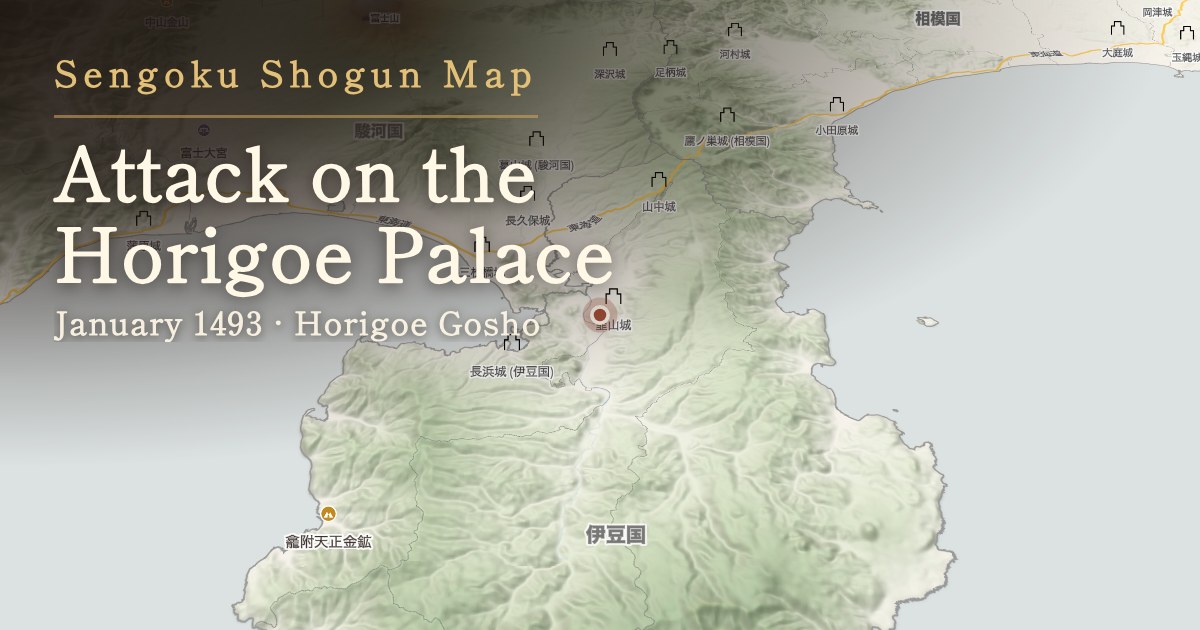
Attack on the Horigoe Palace
January 1493 · Horigoe Gosho
Ise Sōzui (Hōjō Sōun) attacked the Horigoe palace, expelled Ashikaga Chachamaru, and advanced into Izu.
Background
Ise Sōzui (Hōjō Sōun) came from the Ise family, who served the Muromachi shogun. Using his relationship with the Imagawa clan of Suruga as a foundation, Sōzui advanced into Izu. In Izu resided Ashikaga Chachamaru, the Horikoshi Kubo descended from the Kamakura shogunate line, and Sōzui's actions took the form of intervention in this local power.
Outcome
In 1493, Sōzui attacked the Horikoshi residence and defeated Ashikaga Chachamaru, establishing his power base in Izu with Nirayama as his stronghold. Excavation of the residence site has revealed traces of a pond and pieces of burned earthen walls. Chachamaru continued to resist in various locations afterward, and the pacification of Izu was not completed in this year alone.
Course of the battle
1 January 1493
Attack on the Horigoe Palace
Ise Sōzui (Hōjō Sōun) attacked the Horigoe palace, expelled Ashikaga Chachamaru, and advanced into Izu.
Sources12·Certainty: Medium
Historical significance
This battle marked the beginning of Ise Sōzui's advance into Izu, and through the subsequent capture of Odawara and pacification of Sagami, it became the starting point for the Hōjō clan's control of the Kantō region over five generations.
Advertisement
Key figures
後北条氏
1

Commander who led the expansion into Izu
Leveraging his relationship with the Imagawa clan of Suruga, he expanded into Izu, attacked the Horigoe Palace, drove out Ashikaga Chachamaru, and established his base at Nirayama.
Sources34·Certainty: High
堀越公方
1
Horigoe Kubo
He lost the Horigoe Palace when attacked by Ise Sōzui and reportedly continued resistance in various places in Izu and Kantō thereafter. Local records and tradition hold that he was captured at Fukane Castle and killed himself in 1498.
Sources4·Certainty: Medium
Other events of 1493
Sources consulted
- 伊豆の国市「史跡伝堀越御所跡」
- 静岡県「しずおか文化財ナビ 伝堀越御所跡」
- 小田原市「北条氏五代100年の歴史」
- 小田原北条氏ゆかりの市町「堀越御所攻め」
The numbers in the text refer to the list above. Certainty indicates how far a statement is supported by the cited sources; it does not refer to the precision of the coordinates or the dating.
Advertisement