INTERACTIVE BATTLE
Battle of Toishi Castle
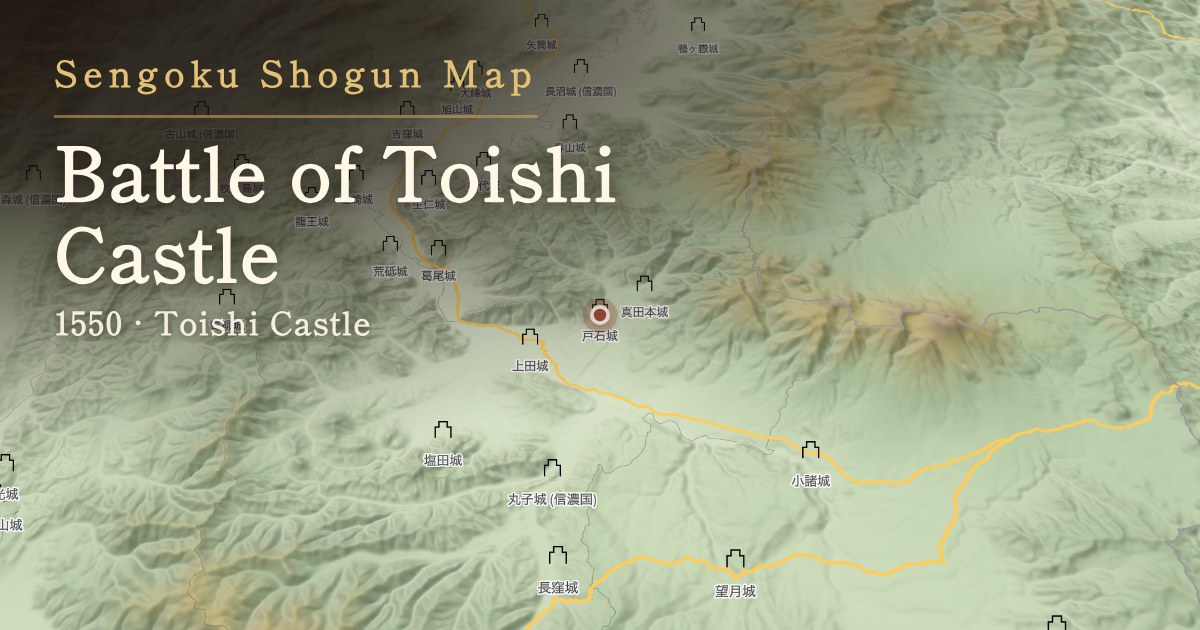
1550 · Toishi Castle
Takeda Harunobu attacked Toishi Castle, held by Murakami Yoshikiyo's side, but failed to capture it and withdrew after suffering heavy losses.
Background
After bringing the Matsumoto Plain largely under control, Takeda Harunobu set out in 1550 (Tenbun 19) to capture Toishi Castle, the most vital stronghold of the Murakami faction. In July, he deployed Sanada Yukitaka, who knew the local terrain well, captured Wada Castle, established his position at Nagakubo, and on August 28, advanced his camp to Yagaeri near Toishi Castle.
Outcome
From September 9, he launched continuous assaults but failed to take the castle in 20 days. On October 1, during the retreat, he faced pursuing attacks from the Murakami forces, suffering a crushing defeat called the "Toishi Collapse" (Toishi-kuzure), with many men, including rearguard commander Yokota Takamatsu, killed in action. The following May 26, 1551 (Tenbun 20), Sanada Yukitaka captured Toishi Castle through negotiation.
Course of the battle
1 July 2 – August 28, 1550
Takeda Harunobu Advances into Chiisagata District to Attack Toseki Castle
Takeda Harunobu, seeking to capture Toseki Castle, the crucial stronghold of Murakami Yoshikiyo, assigned territories including Suwa no Katachi to Sanada Yukitaka. On August 17, he captured Wada Castle; on the 19th, he established his camp at Nagakubo; and on the 28th, he positioned his main force at Yamashiro, near Toseki Castle.
Sources123·Certainty: High
2 September 3 – 30, 1550
Takeda Forces Besiege and Launch General Assault on Toseki Castle
The Takeda forces advanced their main camp to elevated ground near Toseki Castle and launched a general assault beginning on the evening of September 9. Despite twenty days of attacking, they could not capture it. On the 23rd, word arrived that Murakami Yoshikiyo and Takanashi Masayori had negotiated peace, and on the 30th, a military council decided to withdraw.
Sources123·Certainty: High
3 October 1, 1550
Takeda Retreat Pursued by Murakami Forces (Toseki Defeat)
As the Takeda forces began their retreat, Murakami forces immediately pursued them. Many soldiers, including Yokota Takamatsu (Bichunokami), who commanded the rear guard, were killed. The main force barely managed to reach Mochizuki in Saku District.
Points of debate
The casualty figure of "one thousand" is based on the later chronicle "Katsuyamaki" and should not be considered as a confirmed actual number.
Sources123·Certainty: High
4 May 26, 1551
Sanada Yukitaka Captures Toseki Castle Through Stratagem
Sanada Yukitaka, under the Takeda, used stratagem to capture Toseki Castle, which had resisted for forty days the previous year. Through this, Yukitaka reclaimed his base at Sanada.
Points of debate
The specific means of the stratagem are unclear and cannot be confirmed.
Sources123·Certainty: High
Historical significance
In contrast to Harunobu's failed assault, Sanada Yukitaka successfully turned rival Murakami Yoshikiyo through negotiation, recovered his former territory of Sanada, and established his position as a Takeda subordinate. Toishi Castle later became the Sanada clan's seat until Ueda Castle was built, laying the foundation for the subsequent rise of the Sanada family.
Advertisement
Key figures
武田氏
2

Commander-in-chief of the Takeda forces
From July to August 1550, he advanced to Chiisagata and besieged and attacked Toishi Castle, but failed to capture it. On his withdrawal on October 1, he was pursued by Murakami forces and suffered heavy casualties (Toishi collapse).
Sources4·Certainty: High

Takeda guide and strategist
Served as guide and strategist during the 1550 campaign, and through his strategy alone captured Toishi Castle on May 26, 1551.
Sources4·Certainty: High
村上氏
1

Lord of Kuzurao Castle, holding Toishi Castle
Repelled Takeda Harunobu's assault on Toishi Castle and pursued the retreating Takeda forces (Toishi collapse).
Sources45·Certainty: High
Other events of 1550
Notes on the data
The figure of "1,000" casualties during the retreat comes from later compilations such as the Katsuyama Record and is not accepted as a definite number. Similarly, the specific methods of Sanada Yukitaka's negotiation remain a matter of conjecture in the sources themselves, and these details are not included in the text.
Sources consulted
- 上田市「景観ウォッチング~砥石城の城下町、伊勢山を訪ねる~」
- 上田市「真田街道ガイド 上田市」
- 上田市(デジタルミュージアム)「紙本墨書生島足島神社文書 砥石城攻略」
- 上田市「紙本墨書生島足島神社文書 砥石城攻略」
- 坂城町「葛尾城跡と村上義清」
The numbers in the text refer to the list above. Certainty indicates how far a statement is supported by the cited sources; it does not refer to the precision of the coordinates or the dating.
Advertisement