INTERACTIVE BATTLE
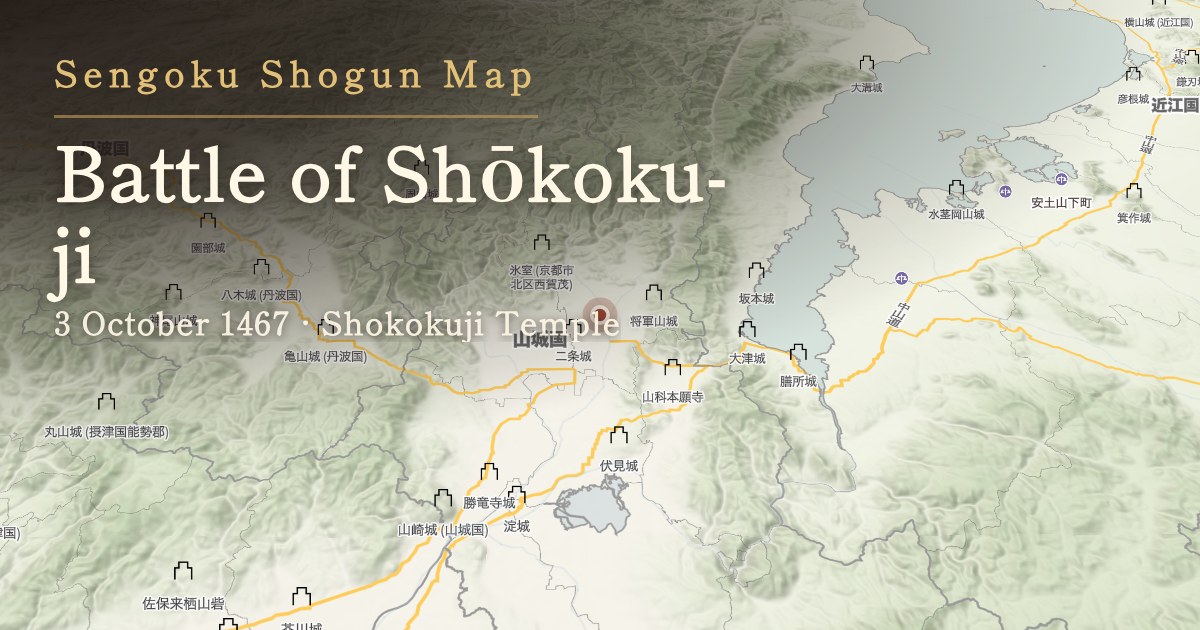
Battle of Shōkoku-ji
3 October 1467 · Shokokuji Temple
Both armies fought fiercely and Shōkoku-ji burned, but neither side won decisively.
Background
Shōkokuji, adjacent to the Flower Palace, was a major temple secured by the Eastern Army and represented a point threatening the Shogun's residence for the Western Army. In the midst of large-scale combat in Kyoto, Yamana Sōzen, commander-in-chief of the Western Army, attempted to recapture it using forces gathered from throughout Kinai and the western provinces.
Outcome
In the tenth month of 1467, Yamana Sōzen led forces from Hatakeyama Yoshinari, Ōuchi Masahiro, and others from the Toki, Rokkaku, and Isshiki clans to attack Shōkokuji. The battle lasted for hours and was fiercely contested. The temple was destroyed by fire, but a decisive outcome was not reached. The precise dates of the battle cannot be confirmed.
Course of the battle
1 October 1467
Yamana Sōzen and the Western Army attack Shōkokuji
To retake Shōkokuji near the Muromachi Palace, Yamana Sōzen of the Western Army mobilized forces from the Hatakeyama, Ōuchi, Toki, Rokkaku, and Isshiki families to attack Shōkokuji, which was held by the Eastern Army.
Points of debate
The specific date of the battle (October 3) cannot be confirmed in Kyoto City records, so only the month (1st month of Ōnin / October 1467) is documented.
Sources123·Certainty: Medium
2 October 1467
After hours of fierce combat, Shōkokuji burns
The Eastern and Western Armies engaged in fierce combat lasting several hours, resulting in the burning of Shōkokuji, though no decisive outcome was reached.
Sources123·Certainty: Medium
Historical significance
The fierce battle for a major temple in close proximity to the Shogun's residence demonstrates that the Ōnin War had escalated into a full-scale conflict involving wide areas of Kyoto.
Advertisement
Key figures
西軍(応仁の乱)
3
Western Army commander-in-chief who led the attack on Shōkokuji
Aimed to recapture Shōkokuji near the Muromachi Palace, mustering forces from Hatakeyama, Ōuchi, Toki, Rokkaku, Isshiki, and other domains to attack the Eastern Army's position at Shōkokuji.
Sources3·Certainty: High
Commander who participated as part of the Western Army
Participated in the attack on Shōkokuji as part of the Western Army. The scale and command structure of his forces remain unclear.
Sources3·Certainty: Medium
Commander who participated as part of the Western Army
Participated in the attack on Shōkokuji as part of the Western Army. The scale and command structure of his forces remain unclear.
Sources3·Certainty: Medium
Other events of 1467
Sources consulted
- 京都市上京区「上京区の史蹟百選 相国寺」
- 京都市上京区「応仁の大乱」
- 京都市「都市史14 応仁・文明の乱」
The numbers in the text refer to the list above. Certainty indicates how far a statement is supported by the cited sources; it does not refer to the precision of the coordinates or the dating.
Advertisement