INTERACTIVE BATTLE
Battle of Goryō
18 January 1467 · Area around Kamigoryo Shrine
Hatakeyama Yoshinari attacked Hatakeyama Masanaga at Kamigoryō Shrine, opening the conflict.
Background
The dispute over the succession to Shogun Ashikaga Yoshimasa became intertwined with the succession dispute within the Hatakeyama clan (between Yoshinari and Masanaga), developing into a conflict between Yamana Sōzen (seeking to remove Masanaga) and Hosokawa Katsumoto (supporting Masanaga). Social instability caused by the previous year's major flood and famine is said to have been a background factor.
Outcome
Hatakeyama Masanaga, barred from attending court and removed as deputy shogun, set fire to his mansion and deployed at the Kamigoryo Shrine, but was defeated by a surprise attack from Hatakeyama Yoshinari and retreated to the Hosokawa residence. The shrine buildings were also burned. However, sources report the dates of Masanaga's deployment and engagement differently—either the night of the first lunar month 17th or early morning of the 18th—and the matter remains undetermined.
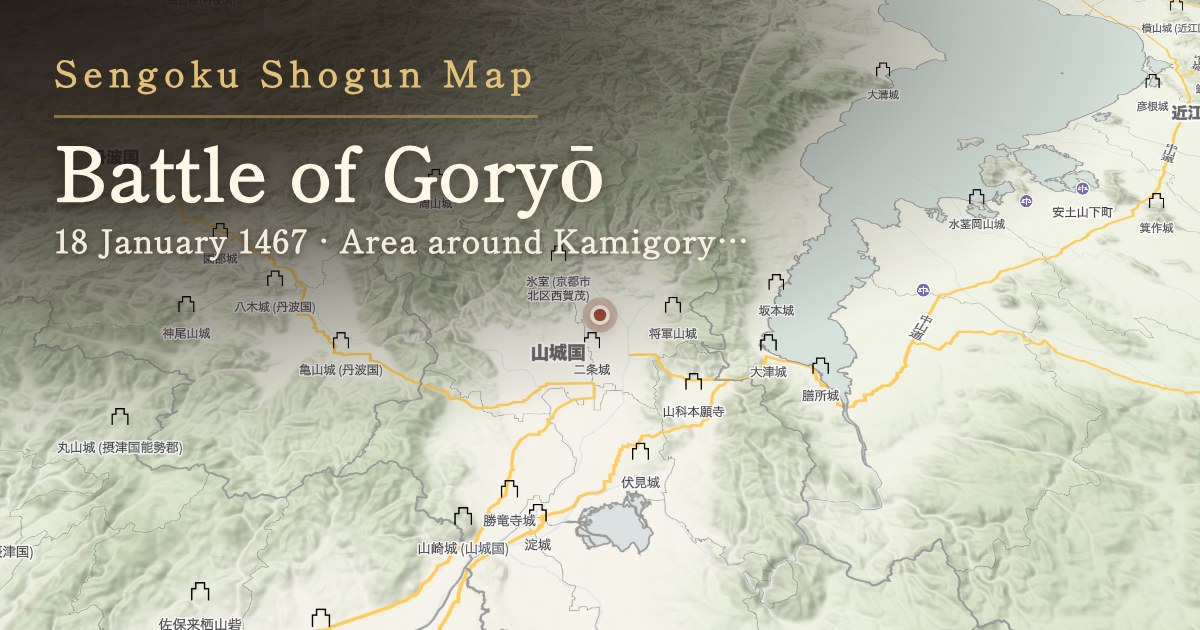
Course of the battle
1 January 18, 1467
Hatakeyama Masanaga takes position at Kami-Goryō Shrine
Hatakeyama Masanaga, stripped of his position as Kanrei and forbidden to attend the Shōgun, burned his own residence and took a position in the woods around Kami-Goryō Shrine.
Points of debate
Sources differ on the dates of troop positioning and combat. Kyoto City, Kamigyo Ward's account of the Ōnin Disturbance records Masanaga's removal on the 7th of the first month and Yoshinari's surprise attack early on the 18th, while Kyoto City's 'Urban History 14: The Ōnin and Bunmei Wars' records Masanaga's positioning on the night of the 17th (Bunshō 2, 1st month) and combat that same night.
Sources123·Certainty: Medium
2 January 18, 1467
Hatakeyama Yoshinari launches surprise attack and engages in battle
Hatakeyama Yoshinari launched a surprise attack on Masanaga's encampment, setting fire to the shrine buildings of Kami-Goryō and engaging in combat.
Sources123·Certainty: Medium
3 January 1467
Masanaga escapes to Hosokawa residence
Hatakeyama Masanaga fled to the residence of Hosokawa Katsumoto. This battle became the catalyst for the Ōnin and Bunmei Wars, with the Eastern Army led by Hosokawa Katsumoto and the Western Army led by Yamana Sōzen.
Sources123·Certainty: Medium
Historical significance
Triggered by this battle, the opposition between the Western Army under Yamana Sōzen and the Eastern Army under Hosokawa Katsumoto escalated, expanding into the eleven-year Ōnin and Bunmei Wars.
Advertisement
Key figures
東軍(応仁の乱)
2
Commander-in-chief deprived of duty and office
Stripped of the Kanrei position after being prohibited from serving the Shogun, he burned his residence and deployed at the Kaminogori Shrine forest, but was defeated by a surprise attack from Yoshinari's forces and fled to the Hosokawa residence.
Sources24·Certainty: High
Kanrei clan supporting Masanaga
Supported Masanaga and received his defeated forces at his residence. After this battle, he became commander-in-chief of the Eastern Army. Whether he directly engaged in this battle cannot be determined from available sources.
Sources24·Certainty: Medium
西軍(応仁の乱)
2
Commander who ambushed Masanaga
Ambushed Masanaga's position at the Kaminogori Shrine, burning temple structures. This battle marked the beginning of the Ōnin-Bunmei War.
Sources24·Certainty: High
Commander reportedly who urged Masanaga's downfall
Reportedly advised the scheme for Masanaga's downfall (based on records from Kamigyo Ward, Kyoto). After this battle, he became commander-in-chief of the Western Army. Whether he directly commanded or engaged in this battle cannot be determined from available sources.
Sources4·Certainty: Medium
Other events of 1467
Sources consulted
- 京都市上京区「応仁の大乱」
- 京都市「都市史14 応仁・文明の乱」
- 京都市「KA030 応仁の乱勃発地」
- 京都市上京区役所「応仁の大乱」
The numbers in the text refer to the list above. Certainty indicates how far a statement is supported by the cited sources; it does not refer to the precision of the coordinates or the dating.
Advertisement