INTERACTIVE BATTLE
Battle of Shigisan Castle
17th day, 8th month to 10th day, 10th month, Tenshō 5 (1577) · Shigisan Castle, Yamato Province (Heguri, Nara)
On the night of October 10, 1577, an army led by Oda Nobutada captured Shigisan Castle in Yamato Province (present-day Heguri, Nara Prefecture). Matsunaga Hisahide, who had shut himself in the castle in defiance of Nobunaga, set fire to the tenshu and died.
織田氏: Oda Nobutada, Sakuma Nobumori, Toyotomi Hideyoshi, Akechi Mitsuhide, Niwa Nagahide, Hosokawa Fujitaka et al. / 松永氏: Matsunaga Hisahide, 松永久通, 森秀光, 海老名勝正
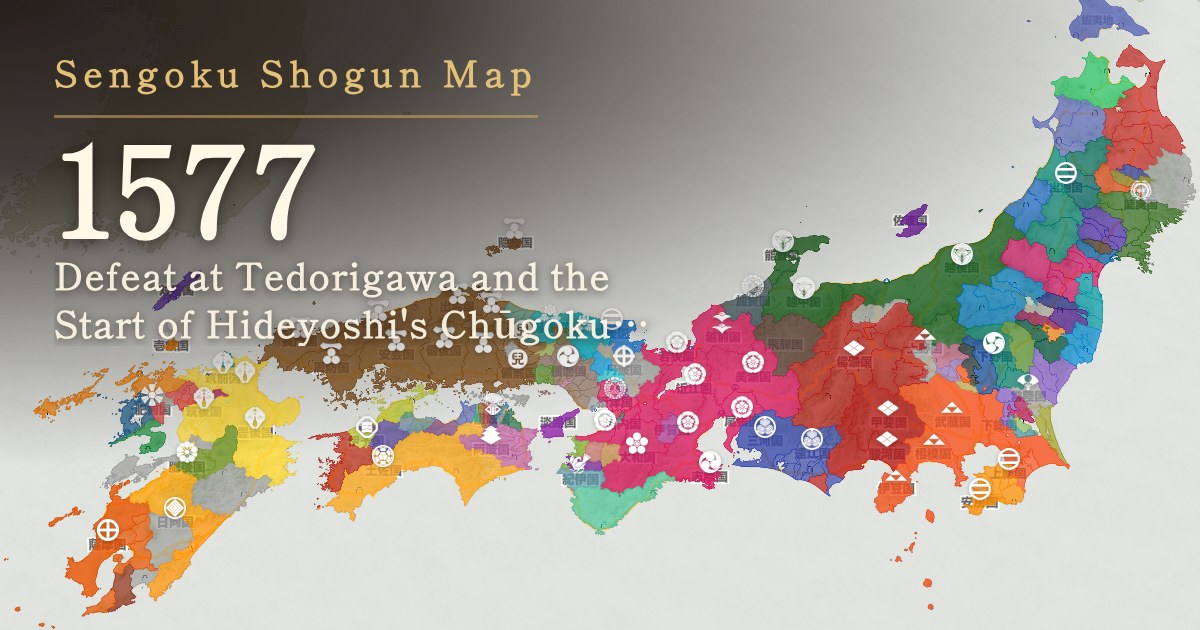
Explore the 1577 map
Change the year to watch territories shift
Background
Matsunaga Hisahide and Hisamichi had been placed as garrison commanders of the Tennōji fort outside Ōsaka after the Battle of Tennōji in May 1576 (Tenshō 4). In August of Tenshō 5 (1577), the two withdrew from their camp and shut themselves in Shigisan Castle, defying Nobunaga. The reason for the defection is not known. There is also a view that they acted in step with Uesugi Kenshin's march on the capital.
Outcome
On the night of October 10, Oda Nobutada's army climbed up from several approaches and took Shigisan Castle. Matsunaga Hisahide set fire to the tenshu and died in the flames. The castle is thought to have been abandoned afterward.
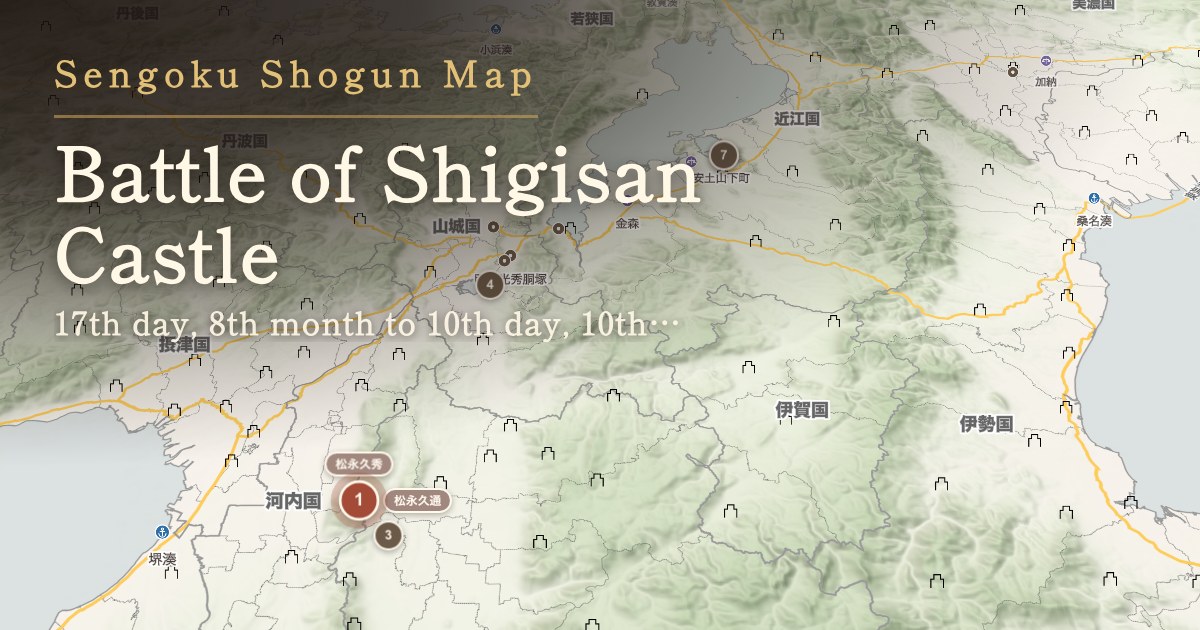
Course of the battle
1 17th day, 8th month, Tenshō 5 (1577)
The defection of Matsunaga Hisahide and Hisamichi
Matsunaga Hisahide and Hisamichi, the permanent garrison at Tennōji, plotted rebellion, abandoned their outpost, and holed up in Shigisan Castle in Yamato. Nobunaga sent Matsui Yūkan to ask what was going on, but Hisahide, bent on treachery, did not appear.
Abandoned his outpost and holed up in Shigisan Castle
Holed up in Shigisan Castle with Hisahide
Sent as Nobunaga's envoy to ask Hisahide what was going on
Sources differ – details
Points of debate
The motive for the defection is not recorded in contemporary sources. There is a view that it responded to Uesugi Kenshin's march on the capital, but this has not been confirmed.
Sources157·Certainty: High
2 27th to 29th day, 9th month, Tenshō 5 (1577)
Oda Nobutada sets out
Oda Nobutada sent out his troops on the 27th, stayed on the 28th at Niwa Nagahide's quarters at Azuchi, and remained there on the 29th.
Stayed at Niwa Nagahide's quarters at Azuchi
Sources
Sources17·Certainty: Medium
3 1st day, 10th month, Tenshō 5 (1577)
The fall of Kataoka Castle
On the 1st day of the 10th month, Hosokawa Fujitaka, Akechi Mitsuhide, Tsutsui Junkei and the Yamashiro contingent attacked Kataoka Castle in Yamato, held by Mori Hidemitsu and Ebina Katsumasa of the Matsunaga side. Fujitaka's son Yoichirō (later Tadaoki, aged fifteen) and his younger brother were first into the castle, and over a hundred and fifty defenders, including the castle lords Mori and Ebina, were killed. The attackers also lost over thirty men from the Nagaoka contingent and over twenty from the Koreto contingent.
Attacked Kataoka Castle
Attacked Kataoka Castle
Attacked Kataoka Castle
First into Kataoka Castle at the age of fifteen
Held Kataoka Castle and was killed
Held Kataoka Castle and was killed
Sources
Sources12347·Certainty: High
4 1st to 2nd day, 10th month, Tenshō 5 (1577)
Nobutada camps at Makishima
Nobutada left Azuchi on the 1st day of the 10th month and stayed at Yamaoka Mimasaka's quarters, then camped at Makishima on the 2nd.
Camped at Makishima
Sources
Sources189·Certainty: Medium
5 3rd day, 10th month, Tenshō 5 (1577)
Pressing in on Shigisan Castle
On the 3rd, Nobutada pressed up to Shigisan Castle, set up camp, and burned the entire town below the castle. On the same day, the Oda forces that had been sent to Kaga in the north returned.
Besieged inside Shigisan Castle
Sources
Sources17·Certainty: Medium
6 Night of the 10th day, 10th month, Tenshō 5 (1577)
The night assault and fall of Shigisan Castle
Under Nobutada, Sakuma Nobumori, Hashiba Hideyoshi, Akechi Mitsuhide and Niwa Nagahide were ordered to attack from the various approaches, and they climbed up during the night. The defenders' bows were broken and their arrows spent, and Hisahide set fire to the tenshu and died in the flames.
Set fire to the keep and burned to death
Assigned an approach in the night assault
Assigned an approach in the night assault
Assigned an approach in the night assault
Assigned an approach in the night assault
Sources differ – details
Points of debate
The story that he died in an explosion together with the Hiragumo tea kettle is a tale handed down later, and it has not been confirmed as fact. The date of the fall (October 10) is consistent across the records.
Sources1567·Certainty: High
7 12th to 17th day, 10th month, Tenshō 5 (1577)
Aftermath: Nobutada's court appointment and return
Nobutada went up to Kyoto on the 12th day of the 10th month, entered Myōkakuji, and was granted the rank of Junior Third Rank and Middle Captain of the Left Palace Guards. He arrived at Azuchi on the 15th to report the suppression to Nobunaga, and returned to Gifu on the 17th.
Arrived at Azuchi and reported the suppression to Nobunaga
Sources differ – details
Points of debate
The one who returned to Gifu on the 17th is thought to have been Nobutada, lord of Gifu Castle.
Sources17·Certainty: Medium
Historical significance
With Hisahide's fall, the Matsunaga clan's power in Yamato came to an end. Oda Nobutada, who served as commander, went up to Kyoto on the 12th day of the 10th month after the battle and was granted the rank of Junior Third Rank and Middle Captain of the Left Palace Guards.
Advertisement
Key figures
織田氏
9

Commander-in-chief of the Oda side
Set out on the 27th day of the 9th month and pressed up to Shigisan Castle on the 3rd day of the 10th month. After the battle he was granted the rank of Junior Third Rank and Middle Captain of the Left Palace Guards.
Sources
Sources1·Certainty: High
Commander in the assault on Shigisan Castle
Assigned one of the approaches in the night assault of the 10th day of the 10th month.
Sources
Sources1·Certainty: High

Commander in the assault on Shigisan Castle
Assigned one of the approaches in the night assault of the 10th day of the 10th month.
Sources
Sources1·Certainty: High

Commander in the assaults on Kataoka and Shigisan Castles
Attacked Kataoka Castle on the 1st day of the 10th month and was also assigned an approach in the night assault of the 10th.
Sources
Sources123·Certainty: High

Commander in the assault on Shigisan Castle
Nobutada stayed at his quarters at Azuchi, and he was assigned an approach in the night assault of the 10th.
Sources
Sources1·Certainty: High

Commander in the assault on Kataoka Castle
Also appears under the name Nagaoka Hyōbu-no-taifu. Together with Tsutsui Junkei and others he attacked Kataoka Castle, and more than thirty of the Nagaoka forces were killed.
Sources
Sources123·Certainty: High

First into Kataoka Castle
Known as Yoichirō, at the age of 15 he and his younger brother were the first to enter Kataoka Castle.
Sources
Sources123·Certainty: High

Commander in the assault on Kataoka Castle
In May of Tenshō 4 (1576), Nobunaga recognized his rule over Yamato. He attacked Kataoka Castle together with Hosokawa Fujitaka and Akechi Mitsuhide.
Sources
Sources16·Certainty: High
Nobunaga's envoy
Sent as Nobunaga's envoy to Hisahide to ask what was going on.
Sources
Sources1·Certainty: High
松永氏
4

Lord of Shigisan Castle
Left his post as the permanent garrison at Tennōji and holed up in Shigisan Castle, then on the night of the 10th day of the 10th month set fire to the keep and burned to death.
Sources
Sources156·Certainty: High
Hisahide's son
Also known as Matsunaga Uemon-no-suke. Together with Hisahide, he withdrew from the Tennōji camp and shut himself in Shigisan Castle.
Sources
Sources1·Certainty: High
Castle commander at Kataoka
He held Kataoka Castle together with Ebina Katsumasa, and was killed on October 1.
Sources
Sources123·Certainty: High
Castle commander at Kataoka
He held Kataoka Castle together with Mori Hidemitsu, and was killed on October 1.
Sources
Sources123·Certainty: High
Other events of 1577
Notes on the data
For Hisahide's end, the text goes only as far as the Shinchō Kōki's 'set fire to the keep and burned to death.' The story that he blew himself up together with the Hiragumo tea kettle is a tradition that even Nara Prefecture hedges as 'it is said,' with a strong flavor of war chronicles and later anecdotes, so it is not adopted. The execution of the hostages Hisahide had given is left out of the phases: the Shinchō Kōki gives no date and the matter is a grave one, so it will not be included until checked against an annotated edition. The tale that the fall of the castle fell on the same day as the burning of the Great Buddha Hall of Nara is also not used. The date of the defection (the 17th day of the 8th month) rests on the Shinchō Kōki alone.
Sources consulted
- 太田牛一『信長公記』巻十(国立国会図書館所蔵)
- 文化庁「文化遺産オンライン」織田信長自筆書状(十月二日
- 長岡与一郎宛)
- 上牧町片岡城跡活用検討委員会「町内に在する片岡城跡の活用に向けての答申」
- 平群町「県指定 信貴山城跡」
- 奈良県「信貴山城」(奈良県歴史文化資源データベース「いかす・なら」)
- 城郭マスタ(shiro.geojson)
- 宇治市「宇治市議会だより 第96号」
- 宇治市「宇治市の維持向上すべき歴史的風致」
The numbers in the text refer to the list above. Certainty indicates how far a statement is supported by the cited sources; it does not refer to the precision of the coordinates or the dating.
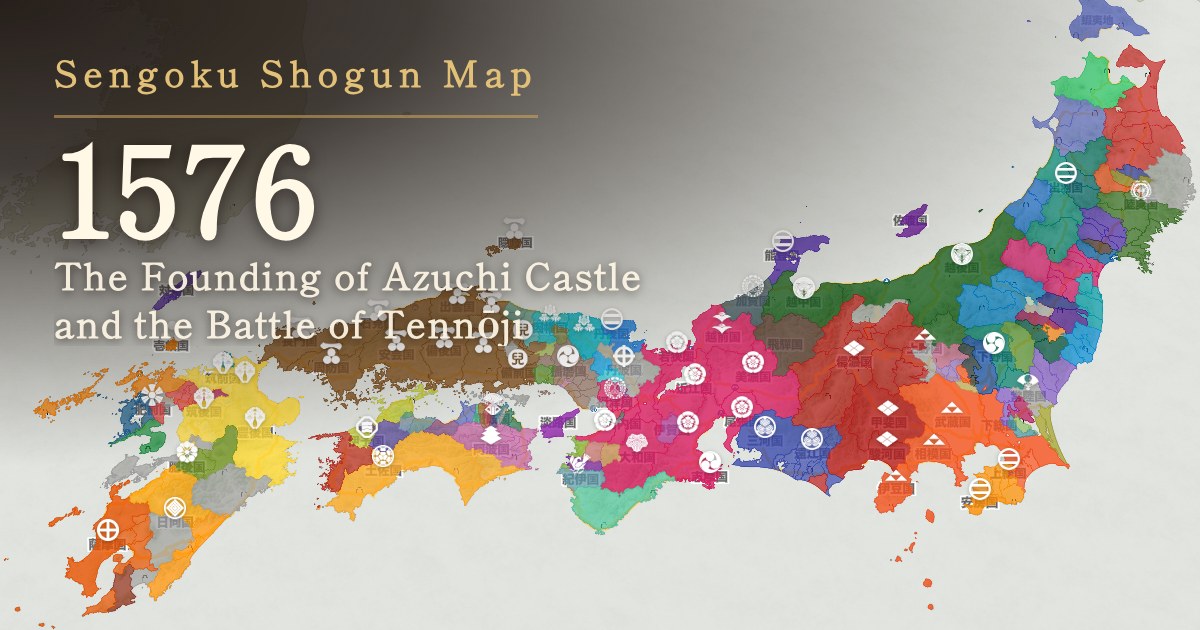
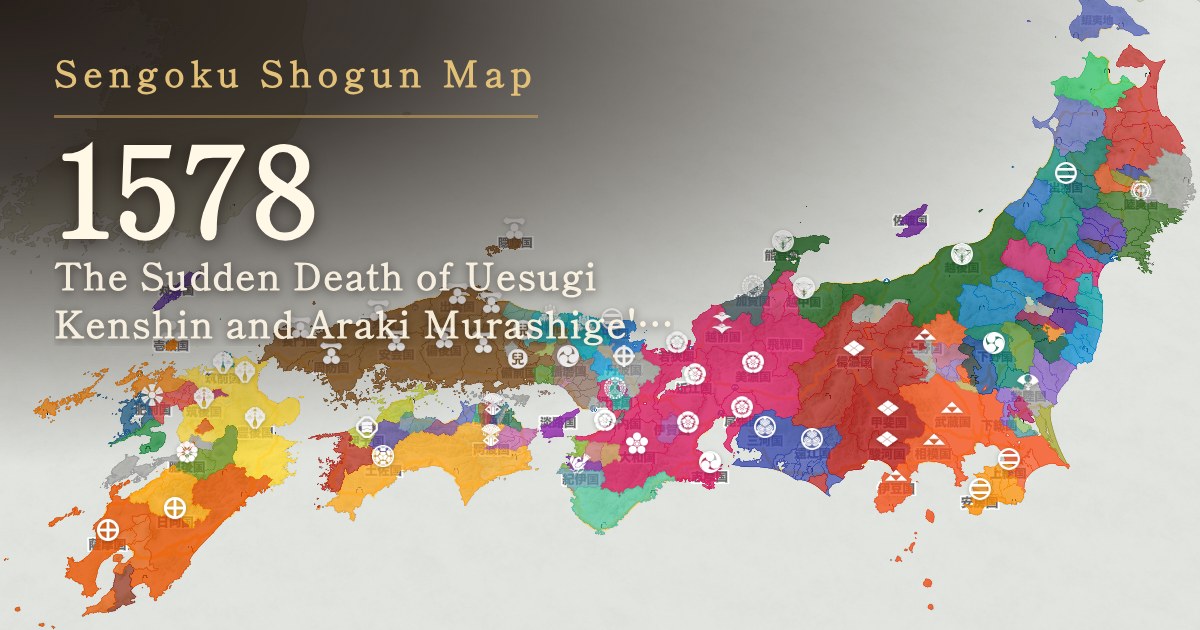
Territories before and after the battle
The year before, the year of the battle, and the year after, side by side. Tap a map to open that year.
Advertisement