INTERACTIVE BATTLE
First Battle of Kizugawa Inlet
7th month, Tenshō 4 (1576) · Kizugawaguchi (Kizugawa Inlet), Settsu Province (Osaka Bay)
In July 1576, at the Kizugawa Inlet in Settsu Province (near the mouth of the Kizu River in present-day Osaka City) on Osaka Bay, a Mōri and Murakami fleet defeated the Oda naval forces and carried provisions into the besieged Ishiyama Honganji.
織田氏: 真鍋七五三兵衛, 沼野伝内, 沼野伊賀, Sakuma Nobumori / 毛利氏: Mōri Terumoto, 児玉太夫, 粟屋太夫, 浦兵部 / 村上氏: 村上元吉, 村上吉充
Explore the 1576 map
Change the year to watch territories shift
Background
In the 4th month of Tenshō 4 (1576), Ashikaga Yoshiaki ordered the Mōri to support Honganji, and in the 6th month Shimotsuma Rairen of Honganji urgently asked the Mōri for relief. The Oda side had been building siege forts around Osaka since the 4th month and had also built a fortified position on the Sumiyoshi shore, where Manabe Shichigobyōe and Numano Dennai were posted to guard the sea.
Outcome
The Mōri and Murakami forces defeated the Oda naval forces and brought provisions into Ishiyama Honganji. The Mōri side is said to have had 700 to 800 ships and the Oda side over 300. The Mōri side threw in what were called 'hōroku' fire arrows and burned the Oda boats to pieces. Many commanders were killed, including Manabe Shichigobyōe, Numano Iga and Numano Dennai. Nobunaga tried to go out in person but called it off on news that the matter was already settled, and placed a guard unit in the castle at Sumiyoshi shore.
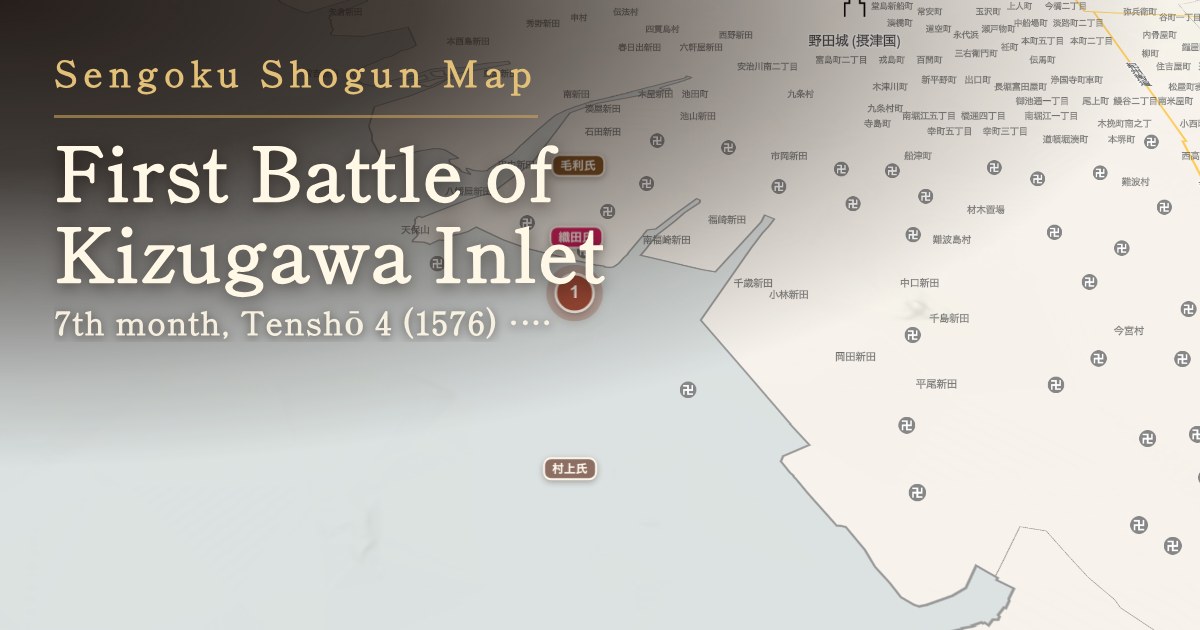
Course of the battle
1 7th month, Tenshō 4 (1576)
Arrival of the Mōri fleet
The Noshima and Kurushima forces of Aki, with Kodama Dayū, Awaya Dayū, Ura Hyōbu and others joining, mustered 700 to 800 large ships, sailed onto the sea off Osaka and tried to bring provisions in.
Sources differ – details
Points of debate
The standard view identifies 'Kodama Dayū', 'Awaya Dayū' and 'Ura Hyōbu' with Kodama Narihide, Awaya Mototane and Ura (Nomi) Munekatsu, but the true names have not been settled.
Sources125·Certainty: Medium
2 7th month, Tenshō 4 (1576)
The Oda interception and the fighting on land
Manabe Shichigobyōe, Numano Dennai, Numano Iga, Miyazaki Kamatayū and others held off the enemy at Kizugawa Inlet with over three hundred ships. Meanwhile the insurgents of Osaka came rushing out of forts such as Kizu and sent foot soldiers against the fort at Sumiyoshi, and Sakuma Nobumori sent troops from Tennōji to strike from the flank, so that the fighting swayed back and forth for several hours.
Held off the enemy at Kizugawa Inlet with over three hundred ships
Held off the enemy at Kizugawa Inlet
Held off the enemy at Kizugawa Inlet
Sent troops from Tennōji to strike from the flank
Sources differ – details
Points of debate
The locations of the forts at Kizu and Sumiyoshi are unclear.
Sources15·Certainty: Medium
3 7th month, Tenshō 4 (1576)
Decision at sea: hōroku fire arrows and the delivery of provisions
At sea, the Mōri side used what were called 'hōroku' fire arrows, throwing them to trap the Oda boats and burn them. Outnumbered, many notable men, including Manabe Shichigobyōe, Numano Iga and Numano Dennai, were killed, and the western side won and brought provisions into Osaka. It is also said that the Murakami forces of Motoyoshi of Noshima and Yoshimitsu of Innoshima smashed the Oda warships with gunpowder bombs.
Killed at sea
Killed at sea
Killed at sea
Is said to have crushed the Oda ships with hōroku fire arrows
Is said to have crushed the Oda ships with hōroku fire arrows
Sources differ – details
Points of debate
The dates differ: the Oda record gives the 15th day of the 7th month, and the Mōri record gives the 13th to 14th. The Oda losses and ship counts are rough figures from the Oda record.
Sources1235·Certainty: Medium
4 From the 7th month, Tenshō 4 (1576)
Afterward: the fort on the Sumiyoshi shore and the order to build large ships
Nobunaga tried to go out in person but called it off on news that the battle had already been decided. Yasuda Kyūroku and Ijichi Buntayū entered the castle on the Sumiyoshi shore as its guard. After the defeat, Nobunaga is said to have ordered Kuki Yoshitaka and others to build large ships.
Sources differ – details
Points of debate
Kuki Yoshitaka is not listed among the commanders who took part in this battle. The location of the castle on the Sumiyoshi shore is not clear.
Sources145·Certainty: Medium
Historical significance
The Oda blockade at sea was thrown back for the time being. After the defeat, Nobunaga is said to have ordered Kuki Yoshitaka and others to build large ships, which led to the Second Battle of Kizugawa Inlet in 1578.
Advertisement
Key figures
織田氏
4
Commander of the Oda guard fleet
Posted to guard the sea off the Sumiyoshi shore, he met the Kizugawa Inlet force with more than 300 ships. He is said to have been killed in this battle.
Sources
Sources1·Certainty: High
Commander of the Oda guard fleet
Entered the sea guard off the Sumiyoshi shore together with Manabe Shichigobyōe, and met the Kizugawa Inlet force. He was killed.
Sources
Sources1·Certainty: High
Commander of the Oda guard fleet
Among the more than 300 ships, he met the Kizugawa Inlet force and was killed.
Sources
Sources1·Certainty: High
Commander of the interception on land
Sent troops out from Tennōji to strike from the flank and fought the insurgents for several hours.
Sources
Sources1·Certainty: High
毛利氏
4

Head of the Mōri side
Head of the Mōri side, who received the request for relief from Honganji following Ashikaga Yoshiaki's request.
Sources
Sources2·Certainty: Medium
Mōri-side commander
Said to be one of those who mustered 700 to 800 ships and sailed out to sea off Osaka. His true name has not been settled.
Sources
Sources1·Certainty: Medium
Mōri-side commander
Said to be one of those who mustered 700 to 800 ships and sailed out to sea off Osaka. His true name has not been settled.
Sources
Sources1·Certainty: Medium
Mōri-side commander
Said to be one of those who mustered 700 to 800 ships and sailed out to sea off Osaka. His true name has not been settled.
Sources
Sources1·Certainty: Medium
村上氏
2
Commander of the Noshima Murakami
Said to be a commander of the Murakami forces who smashed Oda ships with gunpowder bombs (hōroku fire arrows).
Sources
Sources3·Certainty: Medium
Commander of the Innoshima Murakami
Said to be a commander of the Murakami forces who smashed Oda ships with gunpowder bombs (hōroku fire arrows).
Sources
Sources3·Certainty: Medium
Other events of 1576
Notes on the data
The date is the 15th day of the 7th month in the Oda-side Shinchō Kōki, but the 13th to 14th in Mōri-side records (the Batsuetsuroku as cited in the Hiroshima prefectural chronology), so no day is asserted. Mōri-side commanders are given only as written in the Shinchō Kōki (Kodama Dayū, Awaya Dayū, Ura Hyōbu); the identifications with real names (Kodama Narihide, Nomi Munekatsu, Awaya Motokane and others) cannot be confirmed from official sources and are not adopted. The ship counts are the rough figures of the Shinchō Kōki. Kuki Yoshitaka is not named in this passage of the Shinchō Kōki and is therefore not counted among the participants. The present-day sites of the fort on the Sumiyoshi shore and the Mōri launching points cannot be confirmed and are not shown on the map. Because the coastline has changed through landfill, the map marker is a representative point near the river mouth.
Sources consulted
- 太田牛一『信長公記』巻九(国立国会図書館所蔵)
- 広島県立文書館『広島県史年表(中世2)』
- 愛媛県生涯学習センター『えひめの記憶』「伊予水軍の活躍」
- 鳥羽市「戦国武将九鬼嘉隆と九鬼水軍」
- 広島県立文書館『広島県史年表(中世2)』(天正4年7月13日〜14日、摂津国木津川口)
The numbers in the text refer to the list above. Certainty indicates how far a statement is supported by the cited sources; it does not refer to the precision of the coordinates or the dating.
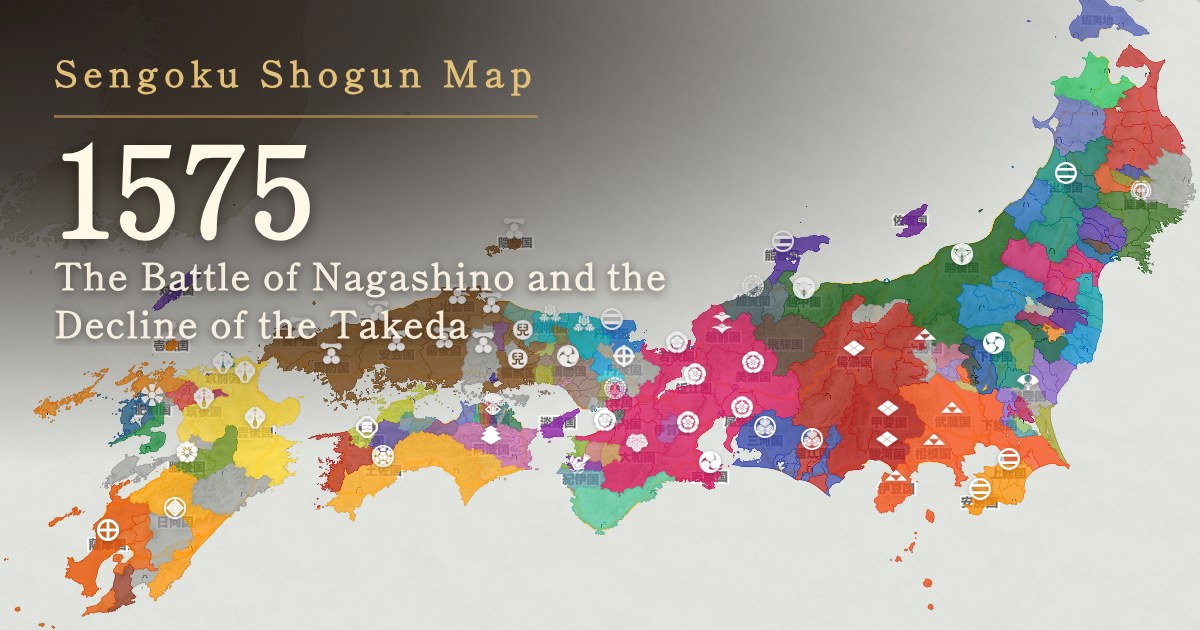
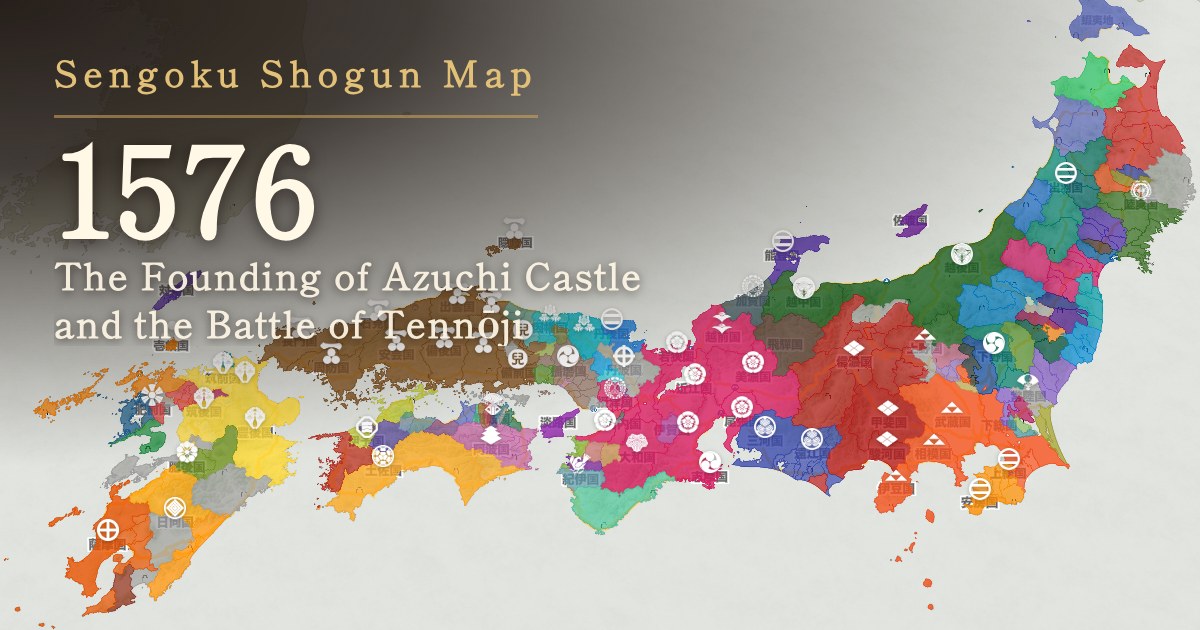
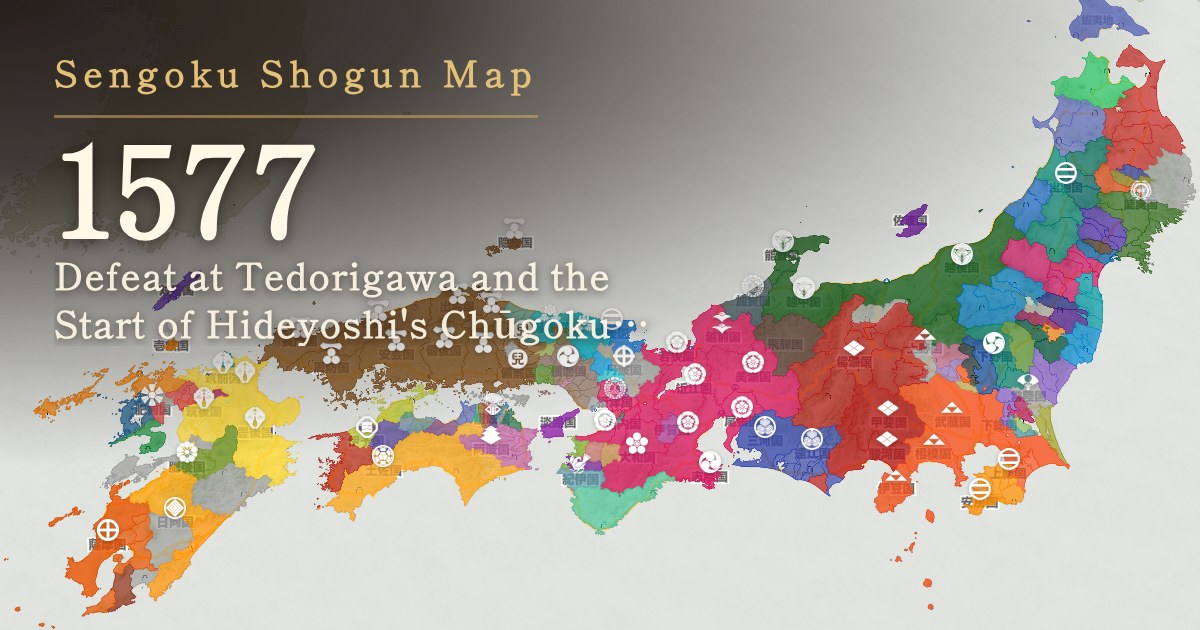
Territories before and after the battle
The year before, the year of the battle, and the year after, side by side. Tap a map to open that year.
Advertisement